
Top 10 Data Science Courses in 2026: Syllabus, Skills & Career Outcomes
Confused by hundreds of data science courses? We compared the top 10 for 2026 by syllabus, skills and career outcomes. See who each course suits, who it does not, and what a real learning week looks like.
Ten data science courses, from free IIT lectures to live classroom programmes, compared by what they teach and where they can take your career.
It is placement season, and your LinkedIn feed keeps showing one word: data. Seniors say data science is the smart move. Relatives say, "Do some course first, beta." You search online and find hundreds of data science courses, all promising a job. So which one actually teaches what Indian employers test in interviews?
This guide answers that question. We compared ten options for fresh graduates, from free IIT lectures to live classroom programmes in Mumbai. For each course, you will see the syllabus, the skills you build, who it suits and where it can realistically lead. You will also see what a typical learning week looks like, through a short Python demo.
We are Cinute Digital, a Mumbai-based tech-training institute. Our own programme is on this list, so we have kept the comparison fair. Every course comes with honest trade-offs, and several are completely free.
By the end, you will know which course fits your background, your time and your goals.
The top 10 data science courses in 2026 for freshers are CDPL's Data Science and AI Master Program, IBM Data Science, Andrew Ng's Machine Learning Specialization, Google Advanced Data Analytics, IIT Madras BS in Data Science, HarvardX Data Science, NPTEL Python for Data Science, Kaggle Learn, Deep Learning Specialization and fast.ai.
What Is a Data Science Course, and What Should It Teach?
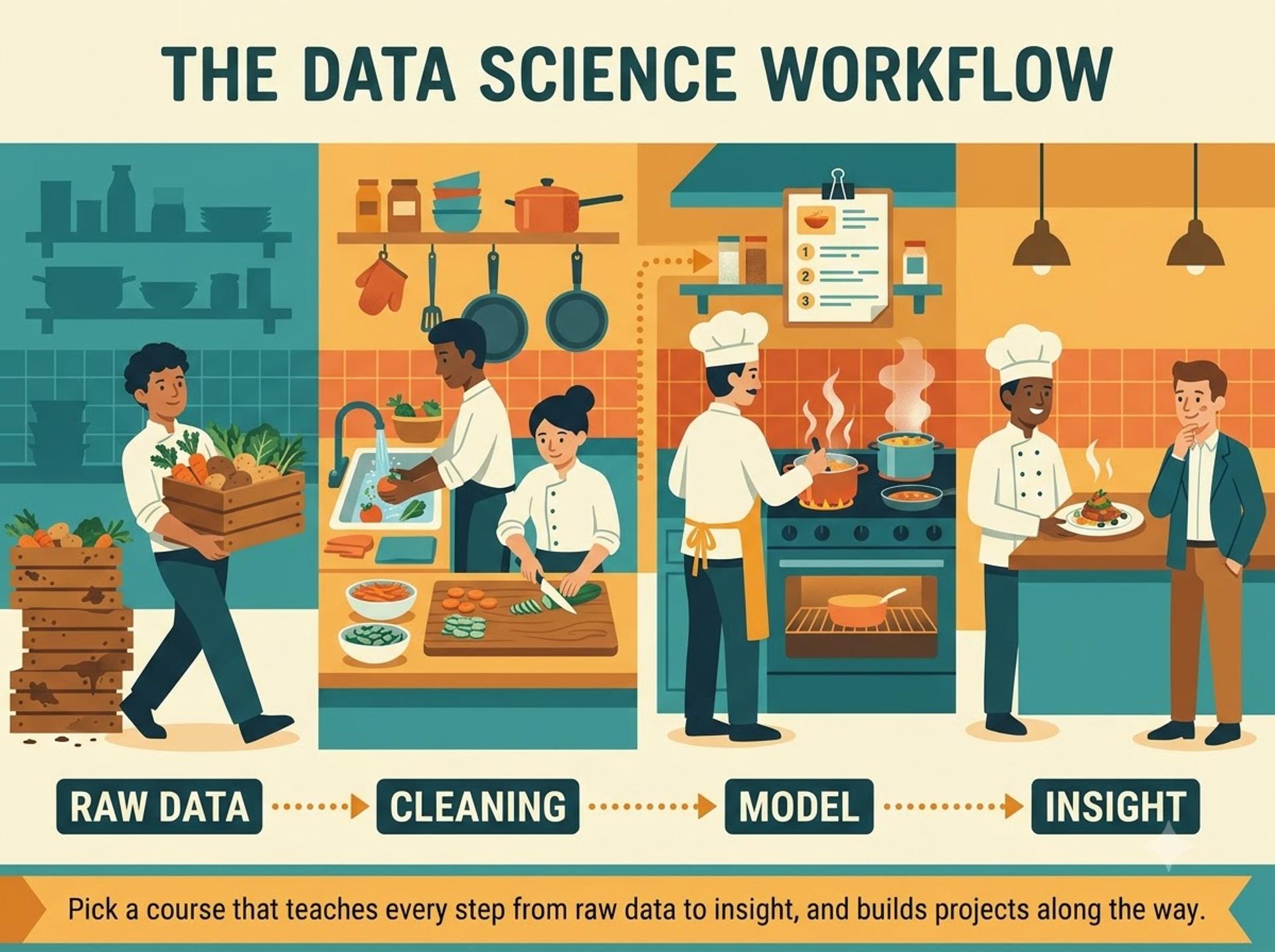
A data science course teaches you to turn raw data into decisions. Think of a busy restaurant kitchen in Dadar. Raw vegetables arrive every morning. Someone washes and chops them, a cook follows a recipe, and a dish reaches the customer.
Data science works the same way. Raw data arrives from apps, sales and sensors. You clean it, analyse it, build a model, and present the insight to someone who acts on it. A good course trains you for every station in that kitchen, not just the final dish.
A strong data science syllabus in 2026 usually covers six layers:
- Programming: Python, and sometimes R, for working with data.
- Databases: SQL to pull data from company systems.
- Statistics and probability: sampling, hypothesis tests and regression.
- Data wrangling and visualisation: pandas, Matplotlib, and BI tools like Power BI or Tableau.
- Machine learning: classification, regression and clustering with scikit-learn.
- Projects and deployment: a portfolio that proves you can solve real problems.
Most data science courses now add a seventh layer: generative AI basics, such as prompt engineering and working with large language models. Employers increasingly expect at least a working awareness of these tools.
Where should you begin if you have never written code? Start with a Python programming course before anything else. Python is the base language of almost every course on this list. A strong start here makes every later module, from pandas to machine learning, much easier.
One more point matters. A course is not the same as a certificate. A certificate shows you finished something. Projects show that you can actually do the work. When you compare courses, check how many real projects you will build, not just how many videos you will watch.
Why Data Science Skills Matter in India's 2026 Job Market
AI is changing how Indian companies hire. A Nasscom–Indeed report found that by January 2026, about 14% of job postings in India mentioned AI. A year earlier, the figure was 8.9%. The same report found that 86% of employers had already seen AI change job roles.
Hiring data also points to rising demand. Naukri's figures, as reported for September 2026, showed AI and ML hiring up about 20%, against about 2% growth in overall hiring. The WEF Future of Jobs Report 2025 projects about 54% net growth for data analysts and scientists in India between 2025 and 2030.
Here is the honest part. Demand is strong but uneven. Employers now screen harder for real skills, and freshers with only a certificate struggle. Strong projects and solid SQL and statistics separate shortlisted candidates from the rest. Good data science courses close that gap with real, graded projects.
These are the common entry roles after a good course:
Salary ranges are approximate, based on public 2026 salary guides. Verify on Naukri, AmbitionBox or Glassdoor before relying on them. Top product firms and global capability centres (GCCs) may pay more. IT services firms usually pay at the lower end.
The data scientist salary in India grows quickly with experience and specialisation. Public guides put mid-level data scientists (3–6 years) at roughly ₹10–28 LPA, though this range is approximate. GenAI and MLOps skills tend to push offers higher.
If you want a shorter, ML-focused route into these roles, our machine learning hero program covers Python, statistics and core algorithms in about 95 hours. That is a sensible size for a fresher who wants depth without a long programme.
Top 10 Data Science Courses in 2026: Compared
We judged each course on five things that matter to a fresh graduate:
- Syllabus depth: Does it cover Python, SQL, statistics, ML and projects?
- Hands-on work: Will you build real projects, or mostly watch videos?
- Credential value: Will recruiters recognise the name?
- Support: Can you get live doubt-solving, mentoring or interview help?
- Career outcomes: Does it prepare you for a specific role?
We did not rank by fees, because prices change often. Check current costs on each provider's page.
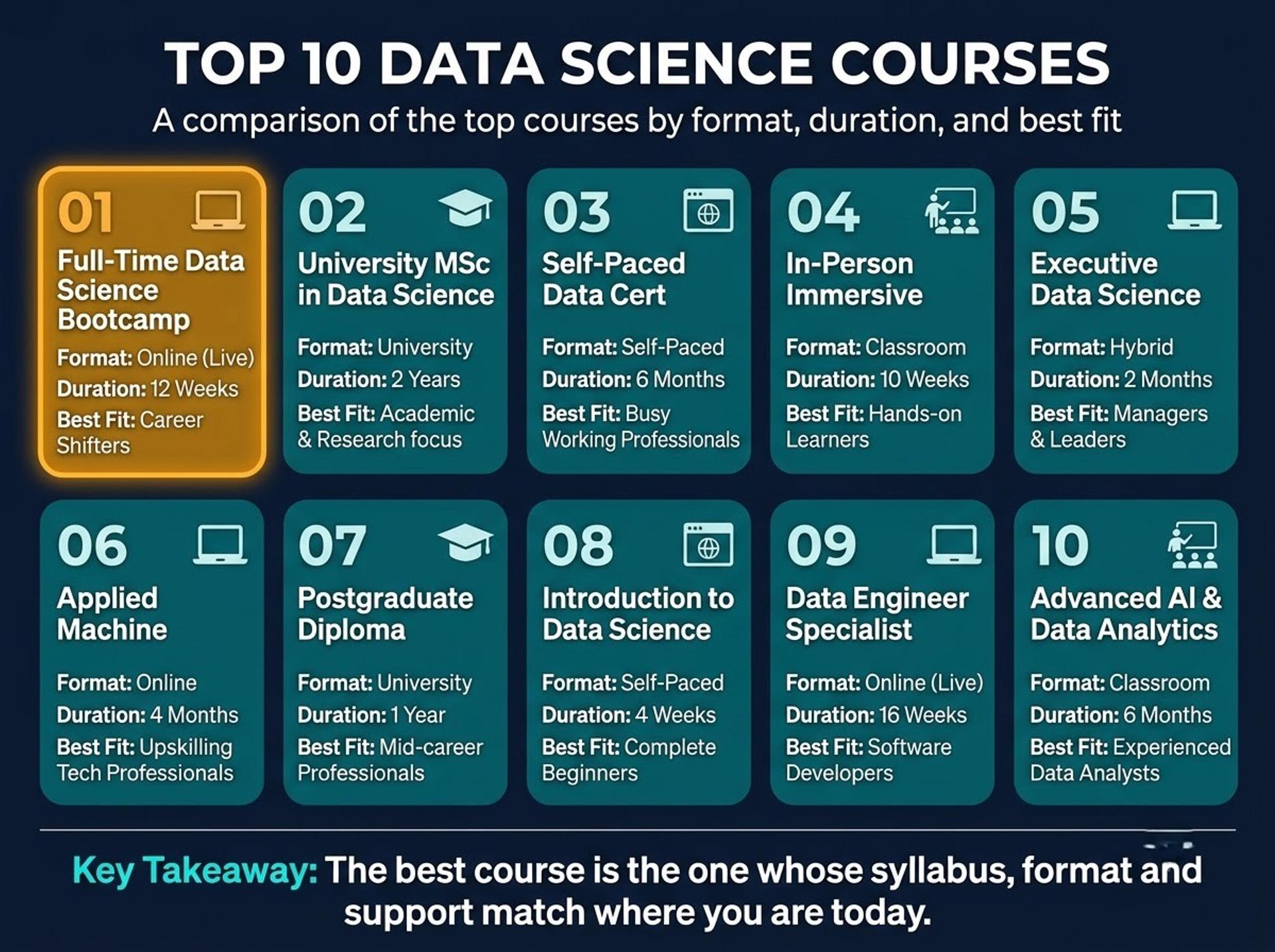
Top 10 at a glance
Durations are approximate and taken from provider pages in November 2026. Verify before enrolling.
1. Comprehensive Data Science and AI – Master Program (CDPL)
Our Data Science and AI Master Program is listed at about 255 hours on its course page. You can join live online or in a classroom. The syllabus runs from MySQL, Excel, Power BI and Tableau to Python, statistics, machine learning and R. It continues into deep learning, NLP, generative AI and prompt engineering, and ends with real-time projects and a capstone portfolio.
- Career outcome: Project portfolio, mock interviews, resume support and placement assistance.
- Suits: Freshers who want live mentoring and one structured path from basics to AI.
- Not for: Learners who only want a short, self-paced introduction.
2. IBM Data Science Professional Certificate (Coursera)
This beginner-level series needs no prior experience. It covers data science tools and methodology, Python, SQL, data analysis, visualisation and machine learning, with hands-on labs and a final capstone. You earn a Coursera certificate and an IBM digital badge, which makes it a popular online data science certification.
- Suits: Absolute beginners who want a well-known global brand and a flexible schedule.
- Not for: Learners who need live doubt-solving or local placement help.
3. Machine Learning Specialization (DeepLearning.AI & Stanford Online)
Andrew Ng teaches this beginner-friendly, three-course programme. It covers supervised learning, neural networks, decision trees, unsupervised learning, recommender systems and reinforcement learning basics. The maths is kept light, but the intuition is deep.
- Suits: Anyone who wants to truly understand how ML algorithms work.
- Not for: Learners who need SQL, BI tools or data cleaning practice, which it does not focus on.
4. Google Advanced Data Analytics Professional Certificate (Coursera)
Coursera labels this an advanced-level programme and recommends prior analytics experience. It covers Python, exploratory data analysis, statistics and hypothesis testing, regression models and machine learning. It also teaches Tableau and how to explain insights to stakeholders.
- Suits: Graduates who already know basic analytics, or who finished a beginner course.
- Not for: Complete beginners, who may find the pace steep.
5. IIT Madras BS in Data Science and Applications (Online)
This online programme is open to anyone who has passed Class 12, through a qualifier process. It has multiple exit points: a foundation certificate, diplomas, a BSc or the full BS degree. You can see every level on the IIT Madras programme structure page.
- Suits: Learners who want an IIT credential and can commit several years.
- Not for: Anyone who needs to be job-ready within six months.
6. HarvardX Data Science Professional Certificate (edX)
This nine-course series uses R, not Python. It moves from R basics through visualisation, probability, inference, wrangling, regression and machine learning. It ends with a capstone in which you build a movie recommendation system.
- Suits: Statistics lovers, and those eyeing research, pharma or biotech analytics.
- Not for: Freshers who want a Python-first stack for most industry roles.
7. NPTEL Python for Data Science (IIT Madras)
This free four-week course covers Python basics, NumPy, pandas, visualisation, and case studies on regression and classification. Learning is free. A certificate requires clearing a proctored exam, and the certificate carries the NPTEL and IIT Madras logos. Look for the next run on the NPTEL online courses portal.
- Suits: Students who want to test their interest at no cost.
- Not for: Anyone expecting job-ready depth from four weeks.
8. Kaggle Learn Micro-Courses
Kaggle offers short, free courses that run in your browser, so there is nothing to install. Topics include Python, pandas, data cleaning, SQL, visualisation and machine learning. Each course you finish earns a certificate of completion. Browse the Kaggle Learn course library to pick a gap to fill.
- Suits: Hands-on learners who want to fix one skill gap quickly.
- Not for: Learners who need a structured path, mentoring or a strong standalone credential.
9. Deep Learning Specialization (DeepLearning.AI)
This five-course series builds on machine learning basics. It covers neural networks, ways to improve them, convolutional networks for images, and sequence models for text. Treat it as a second step, not a starting point.
- Suits: Learners who finished #3 and want to move towards AI roles.
- Not for: Beginners without Python and ML fundamentals.
10. Practical Deep Learning for Coders (fast.ai)
This free course is built for people with some coding experience. It uses a code-first, top-down style with PyTorch and the fastai library. You train working models from the first lesson and learn the theory as you go. It does not offer a certificate.
- Suits: Coders who learn best by building real models.
- Not for: Anyone who mainly needs a certificate for the resume.
What a Typical Course Week Looks Like (Short Demo)
Around the middle of most courses here, you train your first machine learning model. Here is a compact version using scikit-learn and the classic Iris flower dataset.
Here is what each part does:
- Imports: load the dataset, the splitting tool, the model and the scoring function.
load_iris: gives 150 flowers, each with four measurements (X) and a species label (y).train_test_split: keeps 20% of the rows aside for testing.random_state=42makes the split repeatable.DecisionTreeClassifier(max_depth=3): creates a simple tree limited to three levels of questions.fit: trains the model on the training rows.predictandaccuracy_score: test the model on unseen rows and print the result.
A perfect score looks exciting, but the Iris dataset is small and clean. Real company data is messy, so expect lower scores and far more cleaning work. That gap is exactly why the courses with real projects prepare you better.
Practical Tips and Common Mistakes When Choosing a Course
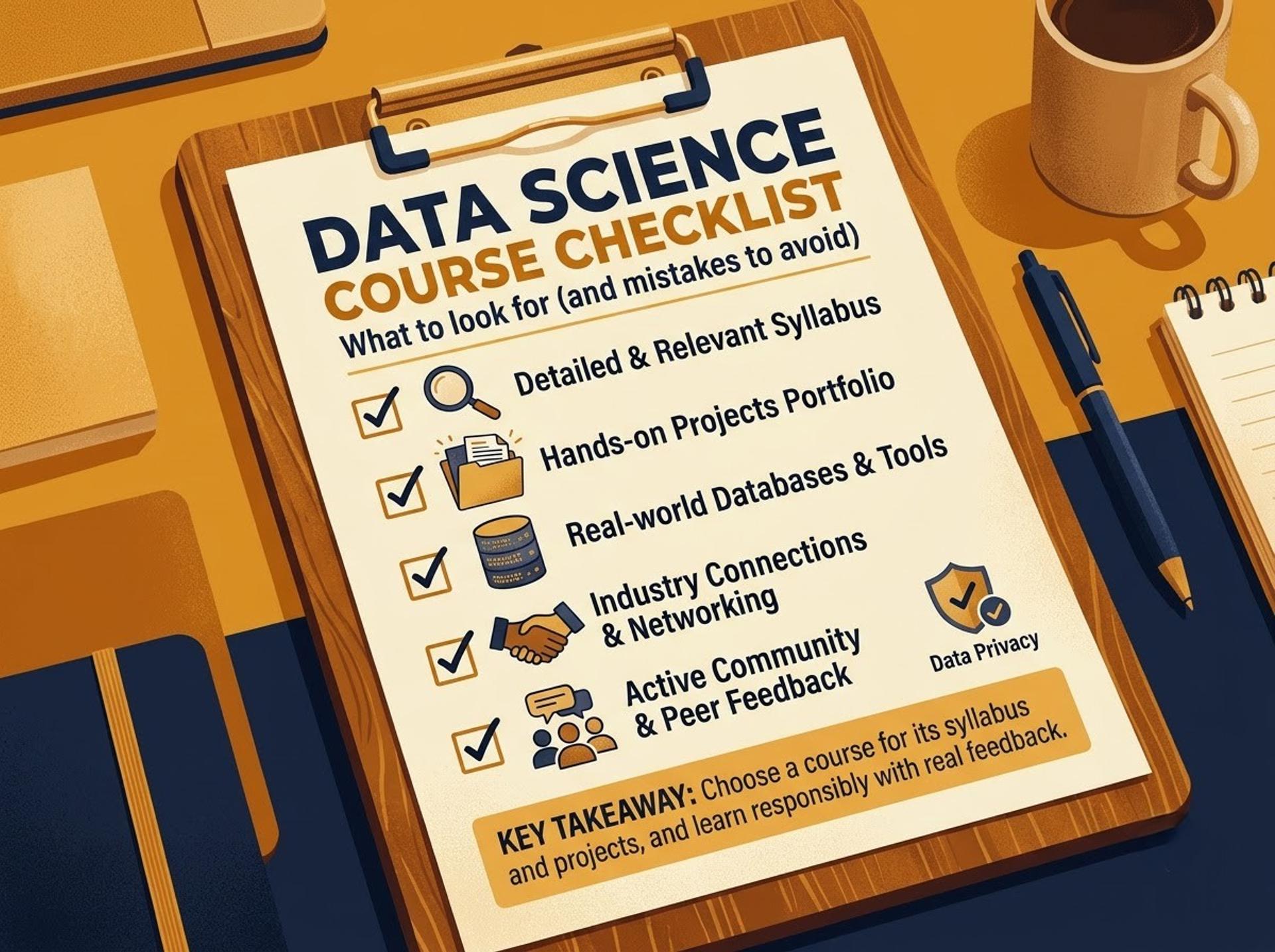
Comparing data science courses is only half the job. Most freshers do not fail because they picked a bad course. They fail because of how they choose and use it. Avoid these five mistakes, and you will get far more value from whichever course you pick.
- Choosing by brand alone. A famous logo does not guarantee the right syllabus. Match the modules to the role you want.
- Collecting certificates instead of projects. Recruiters shortlist portfolios. If you learn best by building, a project-based data science masterclass gives you several capstones to discuss in interviews.
- Skipping SQL and statistics. Many interview rounds start with SQL queries and basic probability. Do not rush past them to reach "AI".
- Believing job-guarantee claims. When you shortlist a data science course with placement assistance, ask what support actually includes. Look for mock interviews, resume reviews and referrals, not promises of guaranteed salaries.
- Learning alone. Join a study group, enter Kaggle competitions or find a mentor. Feedback speeds up learning more than extra videos do.
A note on responsible practice: Data science often touches personal data. India's Digital Personal Data Protection Act, 2023 sets rules on how organisations handle it. Use public or properly licensed datasets for practice, and never scrape personal information without permission. Check your models for bias, especially in hiring, lending or healthcare projects.
Career Path and Learning Roadmap After a Data Science Course
Most freshers start as data analysts or junior data scientists. With experience, they move into data scientist, ML engineer or AI specialist roles. Freshers with Python, SQL, statistics and two or three strong projects get noticed fastest.
Here is a realistic roadmap. It is approximate and assumes 10–15 hours of study a week.
Once your machine learning basics are strong, deep learning and generative AI is the logical next skill. Employers increasingly ask for NLP and LLM experience alongside classic ML, so this step widens your options.
Do not wait until the course ends to apply. Start applying for internships and analyst roles from around month five, when your first projects are ready. Interviews teach you what to practise next.
So what is the best data science course for freshers? It is the one that takes you from zero to a working portfolio on a timeline you can sustain. Shortlist two data science courses from the table above, and try a free module of each before committing.
Conclusion
Choosing between data science courses feels hard because so many look alike. Three points make the decision simpler.
First, check the syllabus before the brand. Python, SQL, statistics, machine learning and projects are the core. Second, match the format to your life. Self-paced courses need discipline, while live programmes give structure and mentoring. Third, build proof. Projects, not certificates, get you shortlisted.
Free options like NPTEL and Kaggle are great for testing your interest. Global certificates from IBM, Google and DeepLearning.AI add credibility. Structured programmes with mentoring help when you want a guided path to your first role.
If you want help choosing, you can book a free demo class with our trainers and ask every question this guide raised. Bring your degree details and weekly study hours, so the advice fits you.
Your first data job is closer than it looks. Start with one step this week.
Frequently Asked Questions
1. What is the best data science course for beginners in India?
No single course is best for everyone. If you are a complete beginner, IBM’s Data Science Professional Certificate and Kaggle Learn are good self-paced starts, and NPTEL’s Python for Data Science is a free four-week trial. For live mentoring, projects and placement assistance, a structured programme such as CDPL’s Data Science and AI Master Program suits freshers who want a guided path. Choose based on syllabus, projects and the support you need.
2. How to choose a data science course with placement assistance?
Start with the syllabus. It should cover Python, SQL, statistics, machine learning and real projects. Then ask exactly what placement assistance includes: mock interviews, resume reviews, LinkedIn help and referrals are good signs. Be careful with guaranteed-job or guaranteed-salary claims. Ask to speak with past learners, and check whether placement figures come with dates and a clear method.
3. Is a data science course worth it in 2026?
For most freshers, yes, as long as the course builds real skills and projects. AI-related hiring in India is rising, and employers increasingly value practical data skills. A certificate alone rarely gets you hired, though. The course is worth it if you finish it, build two or three strong projects, and practise SQL and statistics for interviews.
4. How long does it take to complete a data science course?
It depends on the course. Short courses like NPTEL’s Python for Data Science take about four weeks. Self-paced certificates from IBM or Google take roughly four to six months at around ten hours a week. Structured master programmes run to a few hundred hours. Most consistent learners need about six to nine months to become interview-ready, though this is an approximate figure.
5. How much does a data scientist earn in India as a fresher?
Public 2026 salary guides suggest fresher data scientists in India usually earn roughly ₹5–10 LPA. IT services firms tend to sit at the lower end, while top product firms and GCCs may pay more to strong graduates. Fresher data analysts typically start around ₹3.5–6 LPA. These are approximate figures, so verify current numbers on Naukri, AmbitionBox or Glassdoor.
Tags

Cezzane Khan is a dedicated and innovative Data Science Trainer committed to empowering individuals and organizations.