
Model Deployment with Flask: Land an ₹8 LPA ML Job
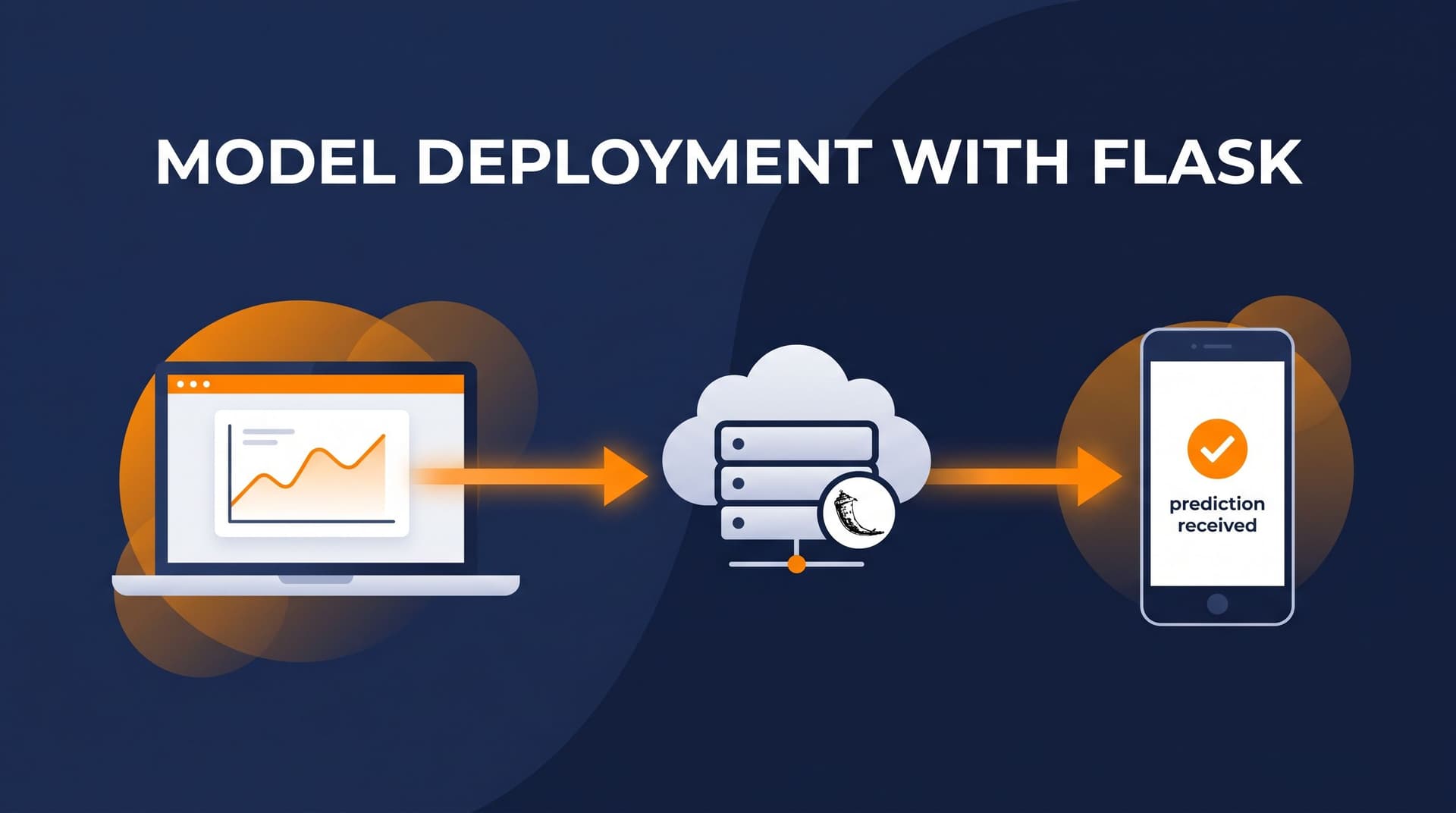
Most ML learners stop at a Jupyter notebook. Recruiters want to see your model live. This guide teaches model deployment with Flask step by step from a saved model file to a working prediction API and shows how this single skill pushes your profile toward higher-paying ML roles.
Turn your trained model into a live API recruiters can actually test. A practical, code-first guide to model deployment with Flask written for India's 2026 ML job market.
Introduction
You spent weeks training a model. Accuracy looks great in your notebook. Then a recruiter asks one question: "Can I test it?" And suddenly your project lives nowhere but your laptop. This is the gap that quietly costs Indian ML aspirants their first job. Model deployment with Flask closes that gap. It takes your trained model and turns it into a live API anyone can call from a browser, an app, or a phone.
In this guide you will build a working prediction API in under 30 lines of Python. You will learn how to save a model, wrap it in Flask, send it real data, and get predictions back. You will also see exactly which roles this skill unlocks and the realistic salary range in India for 2026. No fluff just the one skill that moves you from "I did a project" to "I shipped something." Let us start with what deployment actually means.
Model deployment with Flask is the process of taking a trained machine learning model and exposing it as a web service using the Flask framework. You load the saved model, wrap it in an API endpoint, and return predictions over HTTP so any app, website, or user can send data and receive results in real time.
Foundation: What Is Model Deployment with Flask?
Think of your trained model like a brilliant chef who only cooks inside a locked kitchen. The food is excellent but nobody can order it. Deployment is opening a counter where customers place orders and receive dishes. Flask is that counter.
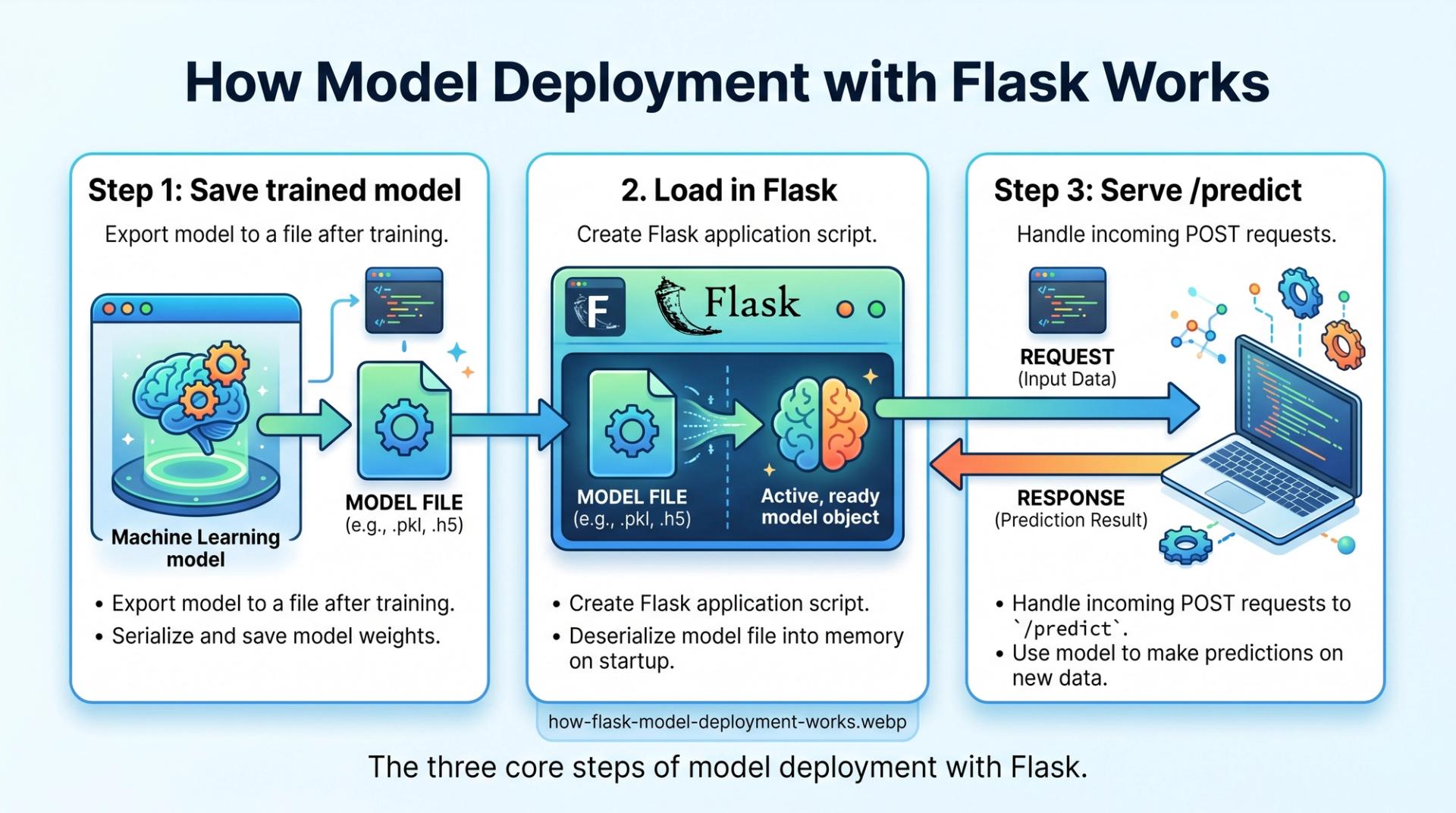
Flask is a lightweight Python web framework. "Lightweight" means it does not force a heavy structure on you perfect for wrapping a single model quickly. When you do model deployment with Flask, three things happen:
- Your model is saved to a file (so you do not retrain every time).
- Flask loads that file once when the server starts.
- Flask exposes a URL endpoint (like
/predict). When someone sends data to that URL, your model returns a prediction.
The data usually travels as JSON over HTTP the same language web apps and mobile apps already speak. That is why deployment matters: it makes your model usable by software, not just by you in a notebook. If you are still getting comfortable with Python syntax, a structured Python Programming course makes the rest of this guide far easier to follow.
Key Takeaway: Flask is the counter that lets the world order predictions from your model.
Why It Matters: The India 2026 Job Reality
Here is the uncomfortable truth. Thousands of candidates can train a model. Far fewer can deploy one. That scarcity is exactly where your salary leverage sits.
In India's 2026 hiring market, "ML Engineer" and "MLOps Engineer" roles increasingly expect you to show a model running as an API not just a notebook screenshot. Deployment signals you understand the full lifecycle, which is what production teams pay for. That end-to-end view is exactly what a comprehensive Data Science and AI master program is designed to build, from raw data to a model in production.
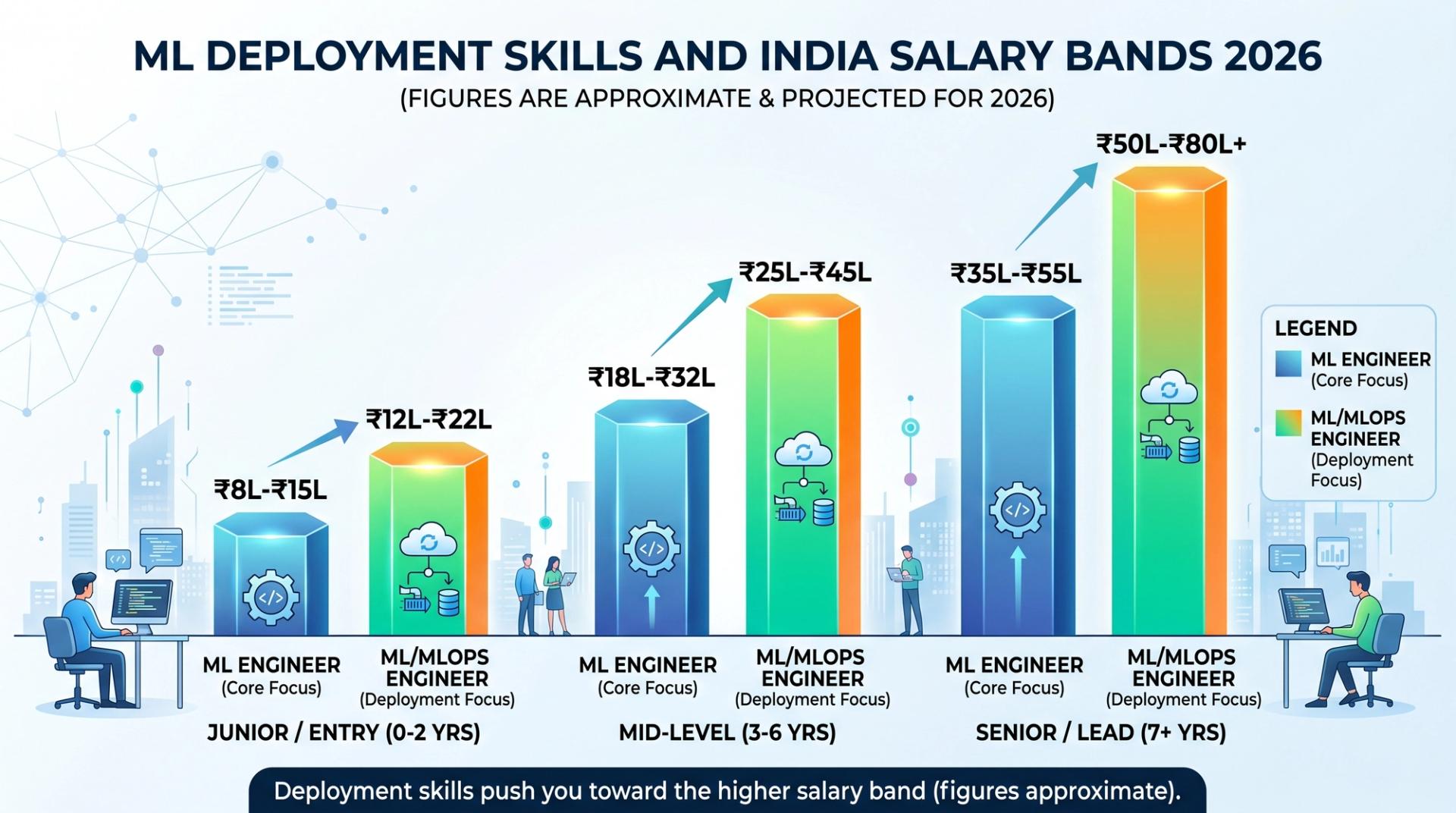
Realistic salary ranges (approximate verify with a salary/industry tool, as figures vary by city, company, and experience):
- Fresh ML / Junior roles: roughly ₹4–6 LPA (approximate).
- ML Engineers with deployment + API skills: roughly ₹6–10 LPA (approximate).
- Mid-level MLOps / production ML: can go higher in metros (approximate).
The ₹8 LPA in this article's title sits inside that mid-band achievable, not guaranteed. It depends on your portfolio, interview performance, and the depth of skills you stack on top of deployment. The point is simple: deployment is one of the highest-leverage skills you can add right now, because it is exactly what most candidates skip.
Key Takeaway: Training a model gets you noticed; deploying one gets you hired.
Deep Dive: Deploy Your Model Step by Step
Let us build a real prediction API. We will use the classic Iris dataset and a scikit-learn model. Follow along every line is explained.
Step 1 : Train and save your model. Create train_model.py:
Line by line: we import joblib (saves models to disk), load the Iris data into features X and labels y, create a Random Forest, train it with .fit(), then save it with joblib.dump(). Run it once.
Expected output:
Step 2 : Build the Flask API. Create app.py:
Line by line: we create the Flask app and load the model once at startup (efficient not on every request). The / route is a health check. The /predict route accepts a POST request, reads JSON, reshapes the features into one row, predicts, and returns the result as JSON.
Step 3 Run the server.
Step 4 Test it. In a new terminal:
Expected output:
That 0 is your model's predicted Iris class served live over HTTP. You just deployed a machine learning model.
Step 5 Make it production-grade. Flask's built-in server is for development only. For production use Gunicorn and a requirements.txt:
Then run:
Flask vs FastAPI quick comparison:
Start with Flask to understand the fundamentals the concepts transfer directly.
Key Takeaway: A working ML API is barely 25 lines the value is in understanding every line.
Practical Tips, Common Mistakes & Responsible Deployment
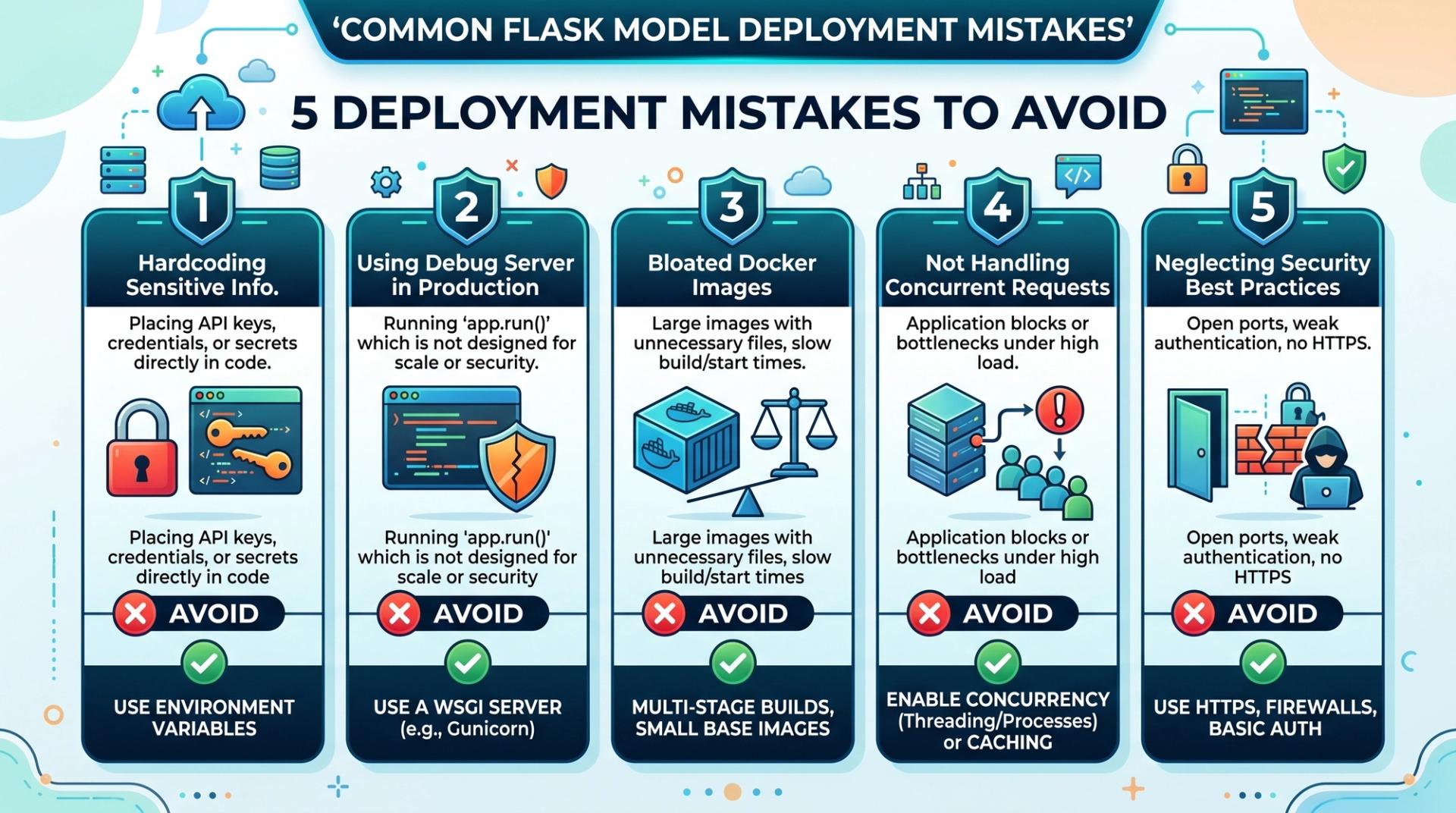
Five mistakes beginners make:
- Loading the model inside the route. Load it once at startup, not on every request it kills performance.
- No input validation. Always check the incoming JSON shape before predicting, or one bad request crashes your API.
- Using
debug=Truein production. It exposes internals. Turn it off when you deploy. - Forgetting
requirements.txt. Your API will not run elsewhere if dependencies are not pinned. - Ignoring version mismatch. Train and serve with the same scikit-learn version, or loading the model may fail.
Responsible / ethical deployment (do not skip this): A deployed model affects real people. Add a basic privacy mindset early do not log sensitive user inputs without consent, secure your endpoint (API keys or auth before public exposure), and document what data your model was trained on. If your model makes decisions about people (loans, hiring, health), bias testing and transparency are not optional they are part of responsible AI practice, a theme covered well in a Prompt Engineering with Gen AI course with its dedicated responsible-AI and governance module. Recruiters increasingly ask about this.
Key Takeaway: A safe, validated, version-locked API is what separates a demo from a deployment.
Career Path & Learning Roadmap
Deployment is a doorway, not a destination. Here is what it opens and what to learn next.
Roles this skill supports: ML Engineer, MLOps Engineer (junior), Data Scientist (product-facing), AI/Backend Engineer. In each, "can you ship a model?" is a recurring interview theme. If you lean more toward dashboards and reporting than production APIs, an adjacent route like advanced data analytics with Python libraries opens a parallel set of business-intelligence roles.
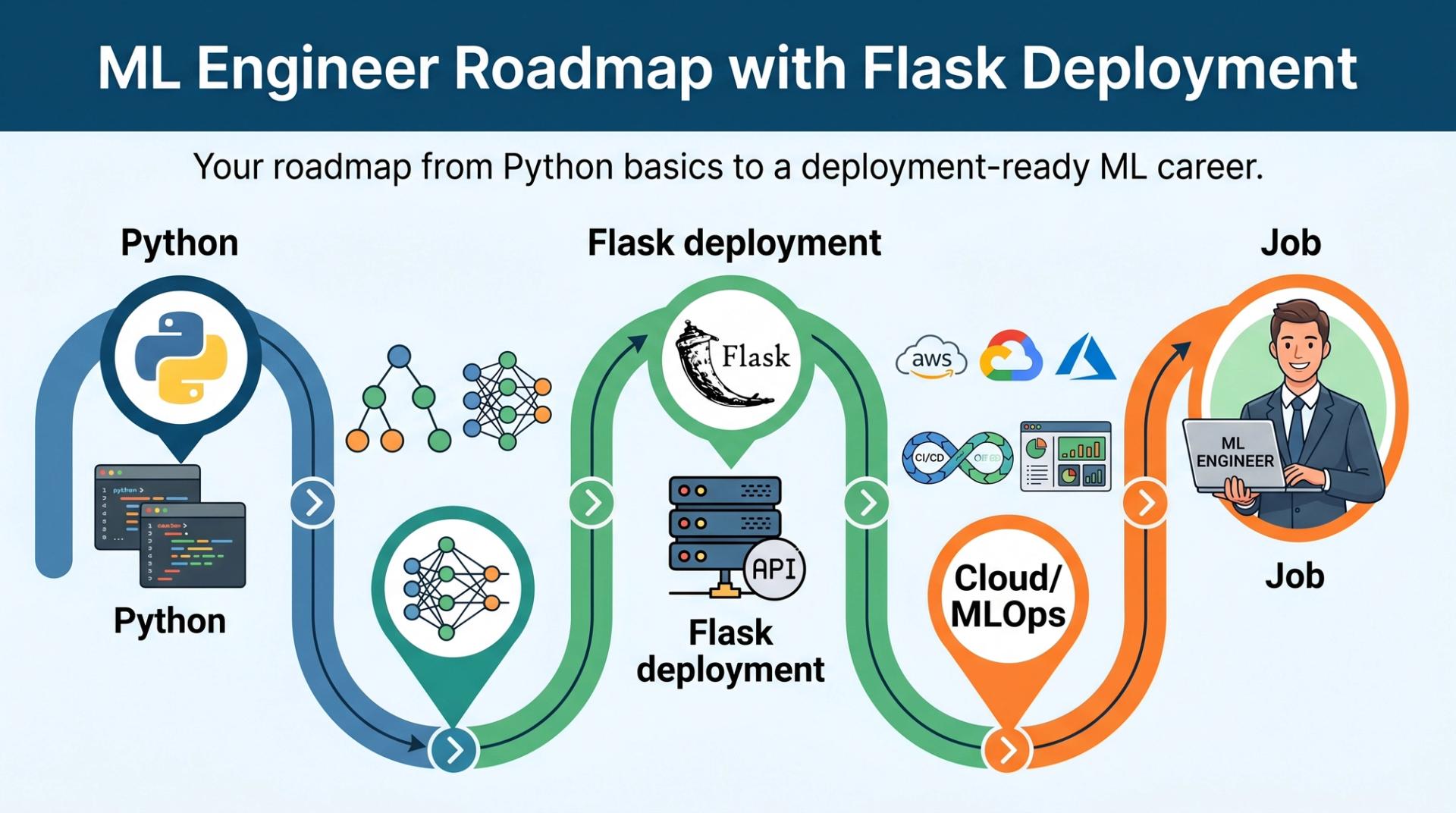
What to learn next, in order:
- solid Python foundations :
- machine learning and data science with Python so you understand what you are deploying;
- deployment depth Docker, cloud (AWS/Render), and CI/CD :
- monitoring and retraining (true MLOps). To push beyond classic models, you can later layer on deep learning, NLP and generative AI.
Realistic timeline to job-readiness: With consistent effort, roughly 4–8 months from Python basics to a deployable portfolio (approximate depends on your starting point and weekly hours).
The fastest path is structured, mentor-led learning with real projects you can show recruiters exactly how CDPL designs its training. A deeper advanced Data Science and Machine Learning masterclass is built to give you a portfolio recruiters respect.
FAQ Section
Q1. What is model deployment with Flask?
Model deployment with Flask means taking a trained machine learning model and exposing it as a web service using the Flask framework. You save the model to a file, load it inside a Flask app, and create an endpoint like /predict. Any app or user can then send input data over HTTP and receive predictions in real time, turning your notebook project into a usable, live service.
Q2. How do I deploy a machine learning model using Flask?
First, train your model and save it with joblib or pickle. Next, create a Flask app that loads the saved model once at startup. Add a /predict route that reads incoming JSON, runs model.predict(), and returns the result as JSON. Test locally with curl, then serve it in production using Gunicorn with a pinned requirements.txt file for reliable, repeatable deployment.
Q3. Is learning Flask deployment worth it for ML jobs in India?
Yes. Most ML candidates can train a model but cannot deploy one, so deployment is a strong differentiator in India's 2026 job market. Roles like ML Engineer and MLOps Engineer expect you to show a model running as an API. Adding deployment to your portfolio signals you understand the full lifecycle, which directly improves your hiring chances and salary leverage (figures vary approximate).
Q4. How long does it take to become job-ready in ML deployment?
With consistent effort, roughly four to eight months is realistic from Python basics to machine learning algorithms, then deployment with Flask, Docker, and cloud (approximate, depends on your starting point and weekly study hours). A structured, mentor-led program with real projects shortens this by keeping your learning focused and giving you a portfolio recruiters can actually test.
Q5. How much can I earn with ML deployment skills in India?
Salaries vary widely by city, company, and experience, so treat all figures as approximate (verify in a salary tool). Junior ML roles often sit around ₹4–6 LPA, while ML Engineers with deployment and API skills commonly fall in the ₹6–10 LPA band. Deployment is not a guarantee of any number, but it is one of the highest-leverage skills for moving into the higher band.
Conclusion
Three things to remember. First, model deployment with Flask is what turns a notebook project into something the world can use. Second, it is a genuine career lever in India's 2026 market because most candidates skip it. Third, the code is simple the understanding is what gets you paid.
If you want to build this skill properly, with mentors, real projects, and a portfolio recruiters respect, explore CDPL's machine learning programs or book a free demo to see if it fits your goals. You do not need to be a genius to ship a model. You need the right steps, in the right order, with someone in your corner. You just took the first step keep goin
Tags

Cezzane Khan is a dedicated and innovative Data Science Trainer committed to empowering individuals and organizations.