
Ultimate Guide: How to Clean Data and Get Hired Fast
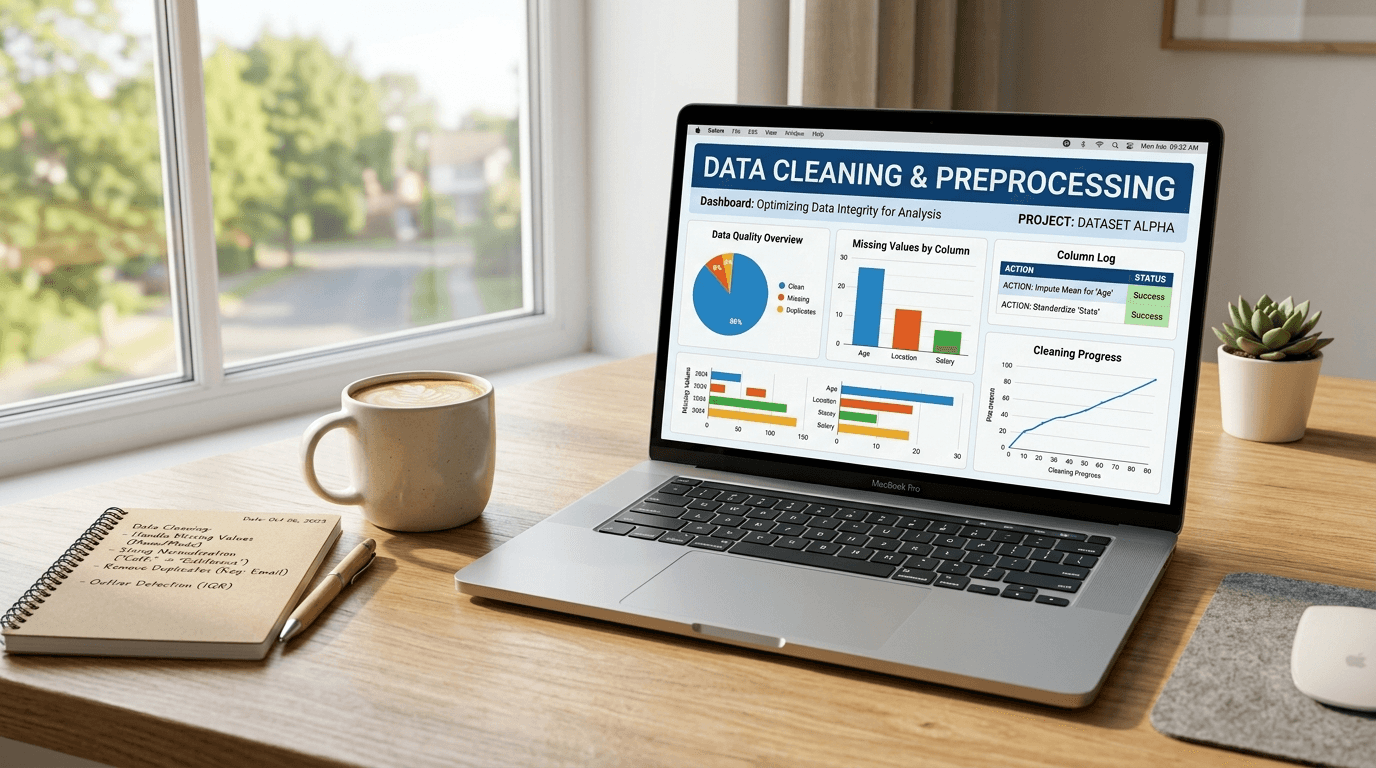
Applying for jobs but getting no response? The secret lies in mastering messy data. Here is the ultimate beginner's guide to data cleaning and landing your first tech role in 2026.
An in-depth, beginner-friendly tutorial exploring why data pre-processing is the most sought-after skill in 2026, complete with a step-by-step roadmap, salary insights, toolkit recommendations, and career advice for aspiring data professionals looking to boost their employability.
You’ve spent months learning Python. You know how to build beautiful dashboards. You’ve memorized complex algorithms. Yet, when you apply for data analyst or data science roles, you hear nothing but crickets.
Why? Because the market is flooded with beginners who only know how to work with perfect, pre-packaged datasets.
Here is the harsh truth about the tech industry in 2026: real-world data is a disaster. It is messy, incomplete, and full of errors. Companies are not just looking for people who can build AI models; they are desperate for problem-solvers who can turn their chaotic, garbage data into reliable gold. If you want to stand out from thousands of other applicants and secure your future, you need to master data preparation.
In this ultimate guide, we will break down exactly how to clean data for beginners in 2026. You will learn the industry secrets, avoid the rookie mistakes, and discover a roadmap that takes you from a struggling student to an in-demand professional.
Ready to stop getting rejected and start getting hired? Let’s dive in.
Why Data Cleaning is the #1 Skill You Need in 2026
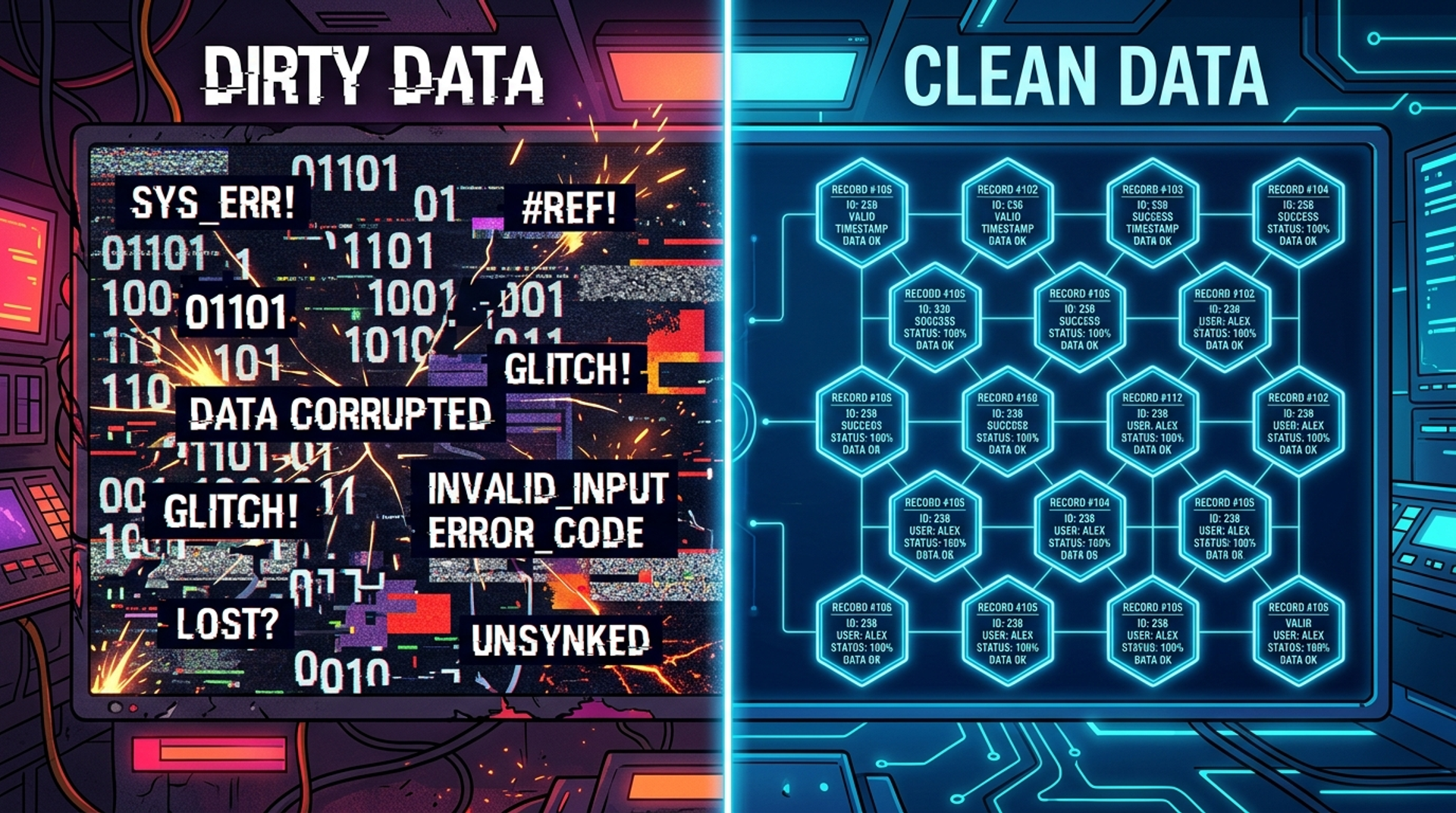
We live in the era of Artificial Intelligence. Everyone is talking about machine learning, predictive analytics, and automated decision-making. But there is an old saying in computer science that remains the absolute law of the land: "Garbage In, Garbage Out" (GIGO).
If you feed messy, incorrect data into the smartest AI model in the world, it will give you terrible results.
For beginners, learning to clean data feels like doing the digital dishes. It isn't glamorous. However, data professionals spend roughly 60% to 80% of their time collecting and preparing data. This means that when a hiring manager looks at your resume, they are quietly asking themselves: "Can this person handle the ugly reality of our company's databases?"
When you master data cleaning, you instantly bypass the entry-level competition. You transition from someone who just "knows code" to a professional who solves real business problems.
Ready to stop struggling alone? Start your career with our complete Data Analytics Complete Course and master the skills employers are actively searching for.
Career Opportunities & Salary Potential: The True Value of Clean Data
Let’s talk about your future. You might be wondering if specializing in data pre-processing is actually worth your time. The short answer is: absolutely.

The fear of job competition is real, especially for recent graduates. But the opportunity here is massive. Because most students skip the "boring" stuff to focus on flashy AI tools, there is a massive shortage of talent capable of handling foundational data engineering and analytics tasks.
Here is a glimpse of the career paths that open up when you know how to handle real-world datasets:
- Data Analyst: The entry point for many. You will extract, clean, and visualize data to help stakeholders make decisions. (Average global starting salaries range from $60,000 to $85,000+, with highly competitive starting packages in emerging tech hubs like India).
- Data Engineer: The architects. They build the pipelines that automatically clean and move data. This is one of the fastest-growing and highest-paying tech roles globally.
- Machine Learning Engineer: You cannot train models without pristine data. Understanding preprocessing makes you a superior ML engineer.
The Stability Factor: Tools change. Languages evolve. But the need for human intuition to spot data errors? That is future-proof. Mastering this gives you incredible career stability.
Want to build a portfolio that proves your worth? Join our beginner-friendly training program and work on real-world, messy datasets that get you noticed.
5 Common Mistakes Students Make with Messy Data
When you are first starting out, it is easy to accidentally destroy your dataset while trying to fix it. Here are the top mistakes to avoid:
1. Blindly Deleting Missing Values (Nulls)
When students see a blank cell or an "NaN" (Not a Number), their first instinct is often to delete the entire row. Stop doing this. If you drop every row with missing information, you might lose 40% of your dataset and introduce heavy bias. Instead, you must learn to impute (fill in) missing values using means, medians, or predictive modeling.
2. Ignoring Outliers
Imagine a database of student ages containing the numbers 19, 20, 21, and 999. That "999" is an outlier—likely a typo. If you don't remove or adjust it, your average age calculation will be completely ruined.
3. Skipping Data Backups
Never perform operations on your original, raw file. Always create a copy before you begin your preprocessing steps. If you make a mistake and overwrite the raw data, you cannot reverse it.
4. Inconsistent Formatting
To a computer, "New York", "new york", and " NY " are three completely different locations. Beginners often forget to standardize text data, leading to wildly inaccurate visualizations and reports.
5. Relying Solely on Automated Tools
While tools are great, relying on them 100% without manually inspecting your data is dangerous. Always eyeball a sample of your rows to understand the context of the information.
Need hands-on practice? Learn this skill step-by-step in our Advanced Data Manipulation Masterclass and avoid these costly rookie errors.
Step-by-Step Roadmap to Start Cleaning Messy Data
You don’t need a PhD in mathematics to do this. You just need a logical mindset and a systematic approach. Here is your beginner-friendly roadmap to tackling any messy file.

Step 1: Understand the Business Problem First
Before you write a single line of code, ask yourself: What is the goal of this project? If you don't know what you are trying to solve, you won't know which columns are important and which ones can be ignored.
Step 2: Remove Duplicates and Irrelevant Data
Start by deduplicating your records. If a customer accidentally clicked "Submit" twice on a web form, you don't want to count their purchase twice. Next, drop columns that have absolutely no relevance to your specific analysis (e.g., dropping a "User ID" column if you are only analyzing global temperature trends).
Step 3: Fix Structural Errors
This involves standardizing your data.
- Ensure all text is in the same case (lowercase or uppercase).
- Remove leading and trailing white spaces.
- Ensure dates are formatted uniformly (e.g., converting all dates to YYYY-MM-DD).
Step 4: Handle Missing Data Strategically
Now you tackle the blanks. You have a few options:
- Drop them: Only if the missing data is extremely minimal (less than 5%) and random.
- Impute them: Fill numerical blanks with the median or mean of that column. Fill categorical blanks with the "mode" (the most frequent value) or label them simply as "Unknown".
Step 5: Validate Your Logic
Once you finish, do a sanity check. Run basic descriptive statistics. Does the maximum age make sense? Are there any negative numbers in a column for "Revenue"? Validation proves you are a professional, not just an amateur.
Best Tools and Platforms for Beginners
You don't have to learn everything at once. Start simple, and scale up as you grow.

- Microsoft Excel / Google Sheets: Do not underestimate spreadsheets. For datasets under 1 million rows, functions like
TRIM(),VLOOKUP(), and Conditional Formatting are incredibly powerful for quick fixes. - Python (Pandas Library): This is the industry standard for 2026. Python's Pandas library allows you to write scripts that can clean millions of rows of data in seconds. Functions like
.dropna(),.fillna(), and.drop_duplicates()will become your best friends. - SQL (Structured Query Language): If the data lives in a database, you need SQL. Learning to use
CASEstatements andCAST()functions will allow you to clean data right as you extract it. - OpenRefine: A powerful, free tool specifically designed for dealing with messy data, clustering similar text variations, and transforming formats without needing heavy coding knowledge.
Take the guesswork out of your education. Enroll in our Python for Data Science Bootcamp where we teach you exactly how to use Pandas and SQL for real-world scenarios.
Your Free Roadmap: Get Hired in 90 Days
If you want to fast-track your success, you need a plan. Here is a simple, 90-day blueprint to get you interview-ready:
- Days 1–30: Master the Basics. Learn Excel formulas, understand data types, and start practicing basic SQL queries.
- Days 31–60: Python & Pandas. Move your focus to coding. Learn how to import CSVs into Python, handle missing values, and standardize text.
- Days 61–90: Portfolio Building. Go to platforms like Kaggle, download a notoriously messy dataset, clean it thoroughly, document your steps, and publish it on GitHub.
When a recruiter sees a portfolio project specifically highlighting how you cleaned the data (rather than just the final graph), you instantly move to the top of the pile.
Frequently Asked Questions (FAQs)
Do I need advanced math to learn data cleaning?
Not at all! You need logic and attention to detail. Basic arithmetic is usually enough for standardizing and formatting data. The math only becomes complex if you dive deep into advanced machine learning algorithms.
How long does it take to learn these skills?
If you dedicate 1-2 hours a day, you can master the fundamentals of Excel and SQL for data pre-processing in about 3 to 4 weeks. Adding Python to your toolkit will take another month of focused practice.
Will AI replace data analysts?
AI is incredibly smart, but it lacks business context. AI can automate the repetitive tasks, but a human must define the rules, understand the nuances of the business problem, and validate that the data makes sense. Learning these skills ensures you control the AI, rather than being replaced by it.
Conclusion: Your Career Starts With Clean Data
Applying for jobs without mastering foundational data handling is like trying to build a house without laying the concrete first. It leads to frustration, burnout, and rejection.
By understanding the importance of pre-processing, recognizing common mistakes, and following a step-by-step roadmap, you are taking control of your future. You are building a skill set that companies desperately need and are willing to pay top dollar for in 2026.
Don't wait for the perfect moment. The demand is high right now, and the barrier to entry for beginners has never been more accessible if you focus on the right steps.
Ready to transform your career? Take action today. Join our comprehensive Data Professional Certification Program and get step-by-step guidance, real-world projects, and the exact resume frameworks you need to land your first job. Let’s build your future together!
Tags

Cezzane Khan is a dedicated and innovative Data Science Trainer committed to empowering individuals and organizations.