
End-to-End Testing Strategies in Software Testing: A Practical QA Guide
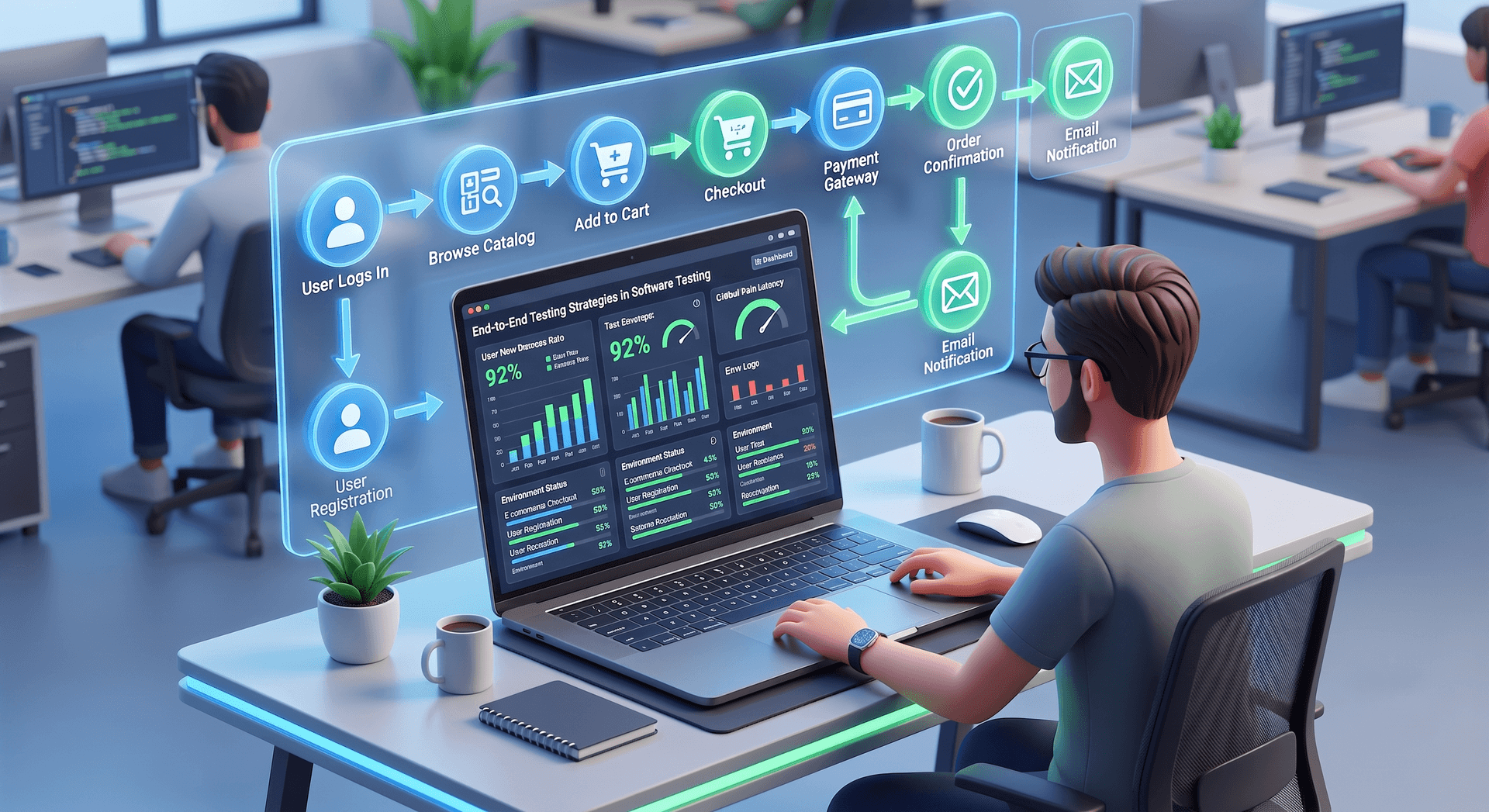
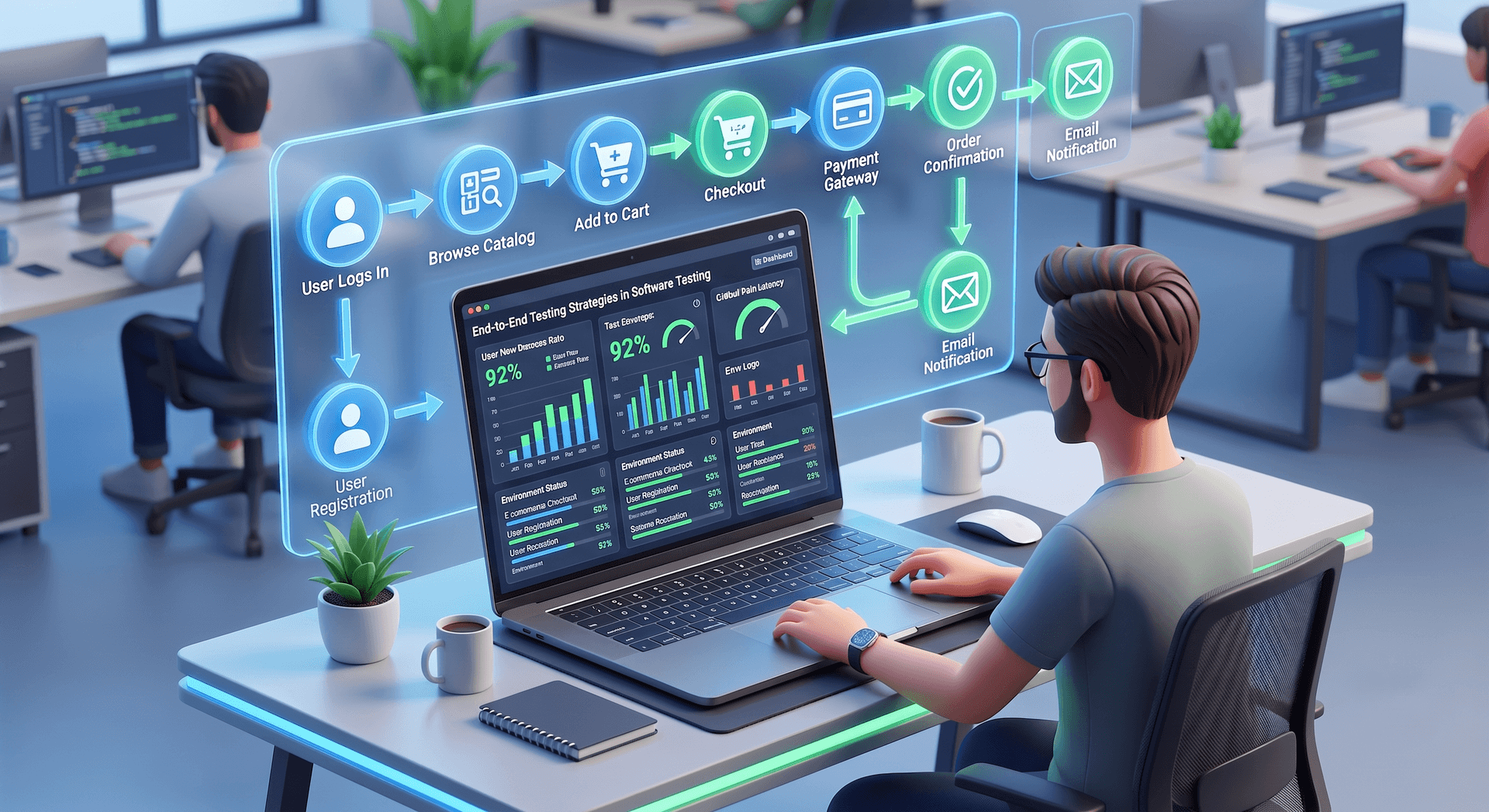
End-to-end testing validates the complete user journey across systems not just isolated features. This guide breaks down practical E2E testing strategies, tools, best practices, and common challenges in simple language, so QA beginners and professionals alike can build reliable, business-focused test suites.
A practical, beginner-friendly guide to end-to-end testing strategies in software testing covering key techniques, tools, and best practices to build reliable QA test suites.
Software rarely fails because one button is broken. It usually fails because the journey between systems breaks a payment goes through but the confirmation email never arrives, or an order is placed but inventory never updates. This is exactly the gap that end-to-end (E2E) testing is built to close.
If you are a QA beginner, a manual tester moving into automation, or a developer who wants to understand quality assurance better, this guide breaks down end-to-end testing strategies in software testing in plain, practical language no jargon overload, just what you need to actually apply it.
What Is End-to-End Testing in Software Testing?
End-to-end testing is a software testing strategy that validates an entire application flow from start to finish exactly the way a real user would experience it. Instead of checking one function or one module in isolation, E2E testing follows the complete path: user login, data entry, database updates, third-party integrations (like payment gateways or APIs), and final output.
Think of an e-commerce checkout: a user browses products, adds items to a cart, applies a coupon, pays online, and receives an order confirmation. End-to-end testing checks that this entire chain works correctly, including every handoff between the frontend, backend, database, and external services.
This is different from unit testing (which checks a single piece of code) or integration testing (which checks how two components talk to each other). E2E testing sits at the top of the testing pyramid because it validates the system as a whole, replicating real-world business scenarios.
Why End-to-End Testing Matters for Software Quality
Many QA teams focus heavily on functional testing and skip comprehensive end-to-end coverage and that's usually where production bugs slip through. Here's why E2E testing deserves a dedicated strategy:
- It catches integration failures early. Modules can pass individually but still fail when connected.
- It mirrors real user behavior. E2E scenarios are built around actual user journeys, not isolated code paths.
- It protects business-critical workflows like checkout, onboarding, loan approval, or claims processing the flows that directly affect revenue.
- It reduces post-release defects, which lowers the cost of fixing bugs after deployment (fixing a bug in production costs far more than catching it during testing).
- It builds confidence for release sign-off, since stakeholders want proof that the whole system works, not just parts of it.
If you're new to QA fundamentals and want a refresher on how testers document what E2E testing uncovers, this guide on defect reporting and tracking in software testing explains the bug lifecycle testers follow once a flaw is found.
End-to-End Testing vs Other Testing Types
Testers often confuse E2E testing with related testing types. Here's a simple comparison:
If you're building strong fundamentals in manual QA before moving to automated E2E workflows, CDPL's manual software testing course is a solid starting point it covers SDLC, STLC, and test case design that every E2E strategy is built on.
Core End-to-End Testing Strategies in Software Testing
Here are the practical strategies experienced QA teams use to design reliable, maintainable end-to-end testing suites.
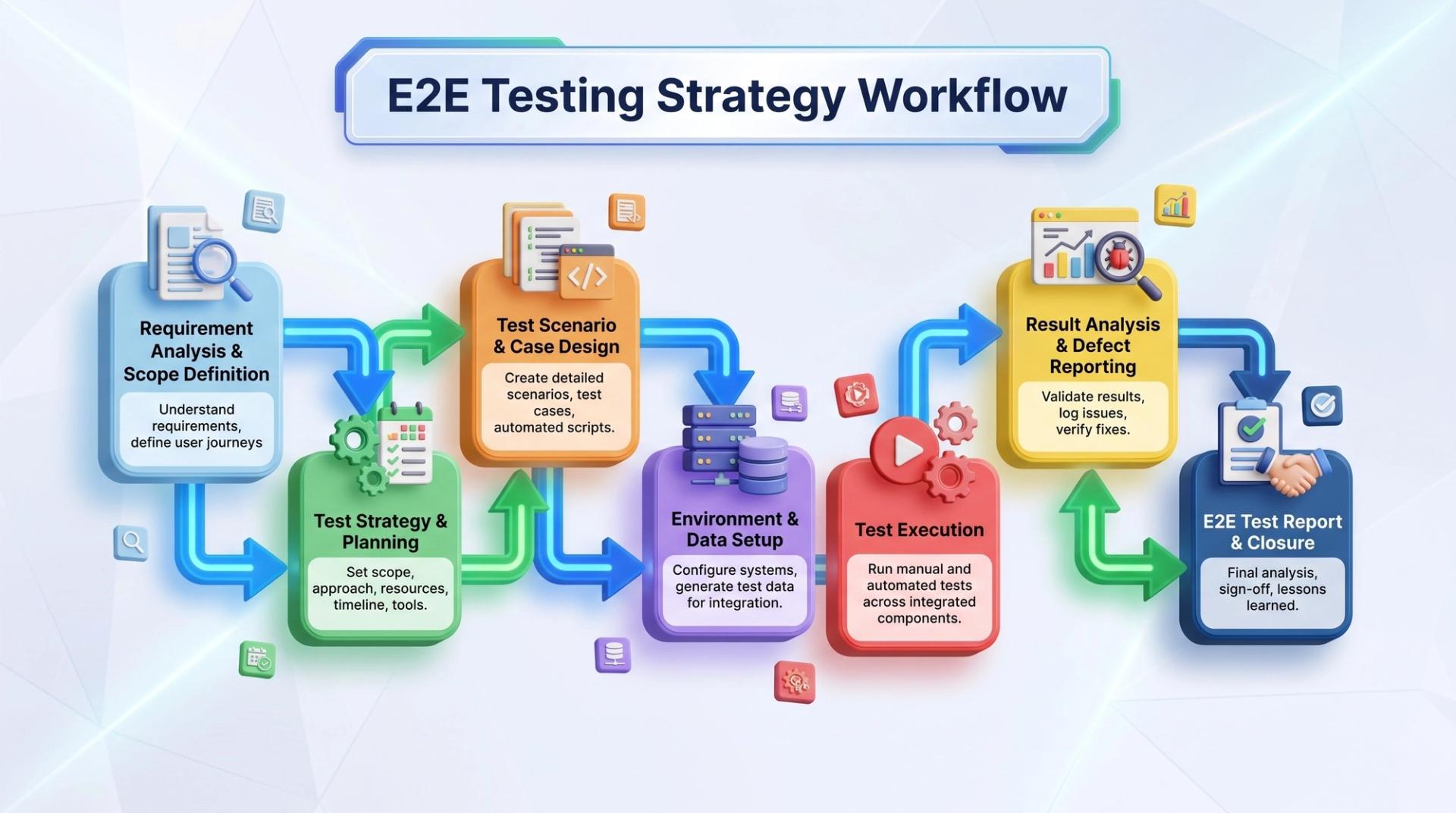
1. Map User Journeys Before Writing Test Cases
Before automating anything, list out the critical business flows: registration, login, search, checkout, payment, refund, notification delivery, and so on. Prioritize flows by business impact and usage frequency. A strategy built on real user journeys (not just technical modules) ensures your E2E suite tests what actually matters to the business.
2. Use a Risk-Based Testing Approach
You cannot automate every possible path nor should you. Risk-based E2E testing focuses effort on high-risk, high-impact areas: payment processing, data security, third-party integrations, and workflows with legal or compliance implications. Lower-risk areas can rely on lighter testing coverage. This keeps your test suite fast, focused, and cost-effective. CDPL's Advanced Software Testing course dedicates an entire module to risk-based testing and test strategy design for exactly this reason.
3. Build a Layered Test Environment Strategy
E2E tests touch multiple systems UI, APIs, databases, message queues, and sometimes third-party services. A strong strategy defines:
- A stable, production-like test environment
- Test data management (using masked or synthetic data instead of real customer data)
- Environment provisioning so tests can run repeatedly without manual reset
Without this, E2E tests become flaky and unreliable one of the biggest complaints QA teams have about end-to-end automation.
4. Combine UI Automation with API-Level Validation
Pure UI-based E2E testing is slow and brittle. A smarter strategy layers UI automation (for real user-flow validation) with API testing (for faster, more stable checks of backend logic). For example, you might automate the checkout UI flow once, but validate order status, payment confirmation, and inventory updates directly through APIs. If you want to strengthen this skill, CDPL's API testing course using Postman and REST APIs teaches exactly how to validate backend responses that power your E2E scenarios.
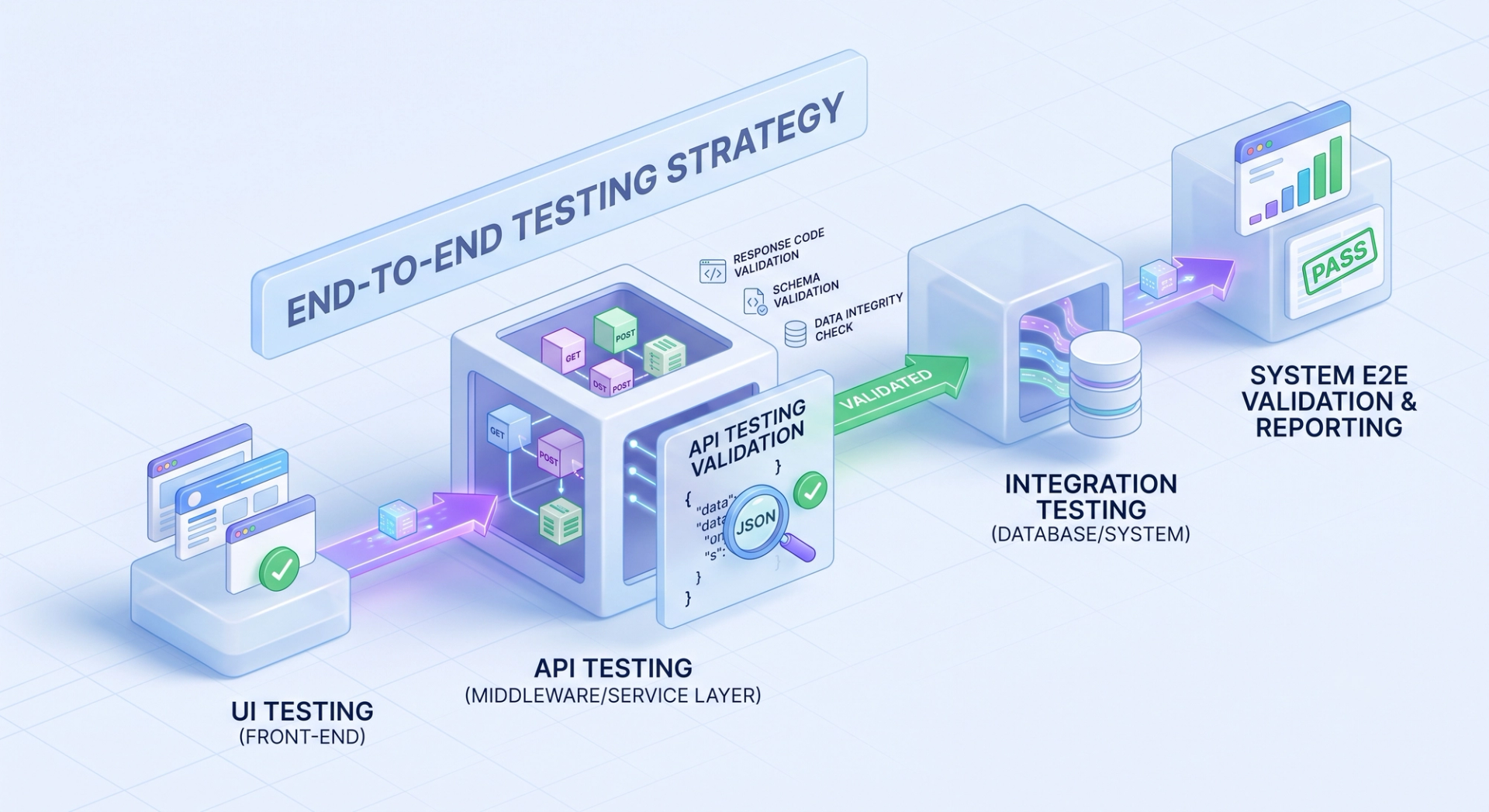
5. Apply the Test Automation Pyramid
Not every E2E test needs to run through the full UI. The testing pyramid recommends more unit tests, a moderate number of integration tests, and fewer (but high-value) end-to-end tests at the top. This keeps your test suite fast to run and easier to maintain, while still validating the complete flow where it matters most. CDPL's Advanced Automation Testing course covers building maintainable automation frameworks aligned to this pyramid using Selenium and CI/CD pipelines.
6. Validate Data Flow with ETL and Database Testing
Many end-to-end workflows involve data moving between systems a user action in one application might trigger a data pipeline, warehouse update, or reporting dashboard refresh elsewhere. A complete E2E strategy includes validating this backend data movement, not just the visible UI outcome. For teams working with data pipelines, CDPL's ETL testing course is directly relevant, covering data warehouse testing, SQL validation, and pipeline testing lifecycles.
7. Integrate E2E Tests into CI/CD Pipelines
End-to-end tests deliver the most value when they run automatically on every build, every pull request, or every nightly deployment rather than manually before a release. Integrating E2E suites into CI/CD pipelines (using tools like Jenkins) catches regressions early and keeps quality checks continuous rather than reactive.
8. Design for Cross-Browser and Cross-Device Coverage
A user journey that works perfectly on Chrome desktop might break on Safari mobile. Strong E2E strategies include running critical flows across multiple browsers, devices, and screen sizes to catch compatibility issues before real users do.
If you want a single structured path that combines manual test strategy, automation frameworks, API testing, and CI/CD into one program, CDPL's Advanced Manual and Automation Testing Master Program is built specifically to take testers from fundamentals to end-to-end automation readiness.
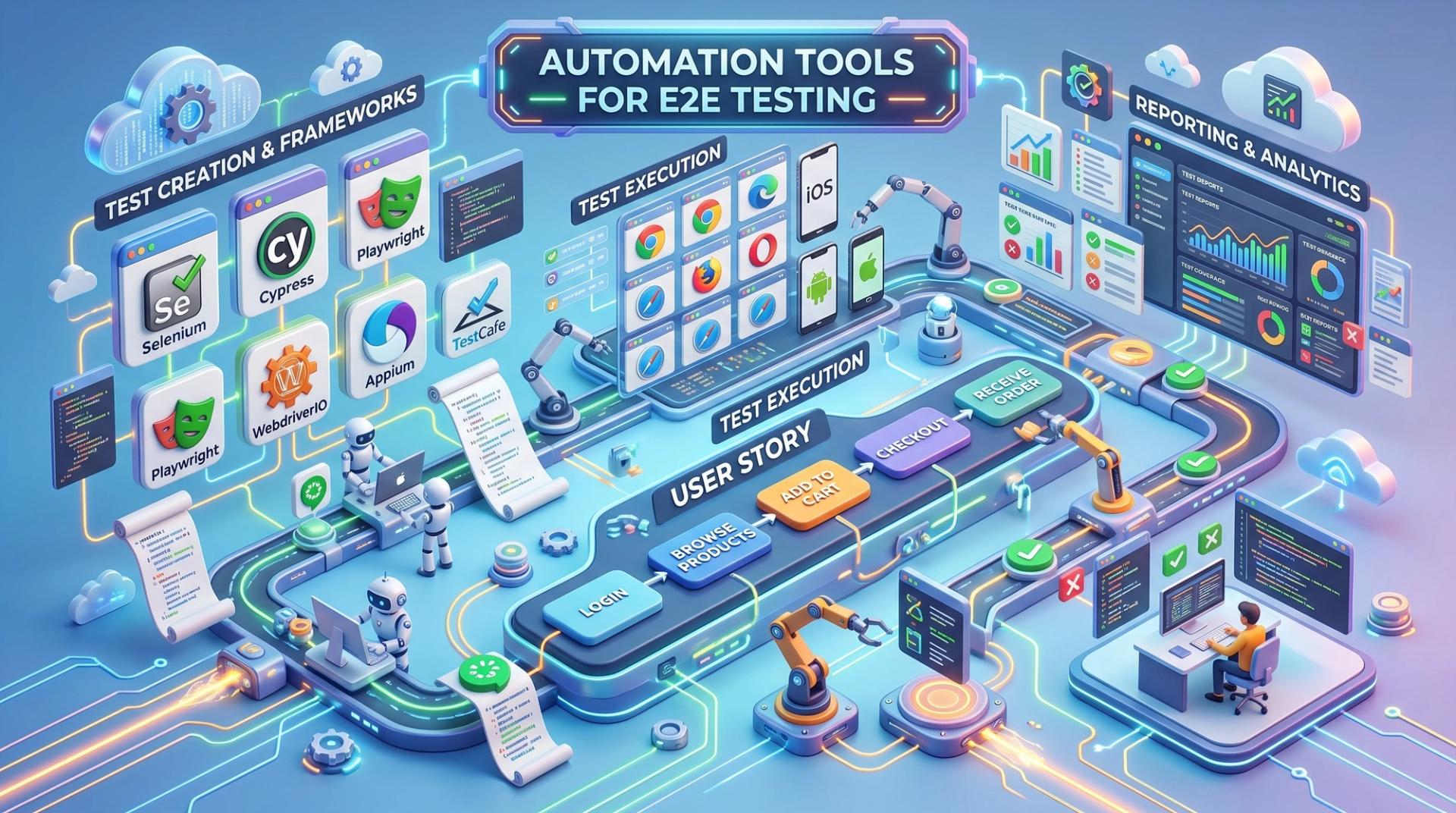
Popular Tools Used for End-to-End Testing
Choosing the right tool depends on your tech stack, team skill level, and application type:
- Selenium WebDriver - the industry standard for browser-based UI automation, supports multiple languages.
- Cypress - fast, developer-friendly, great for modern JavaScript applications.
- Playwright - supports multi-browser, multi-tab testing with strong reliability for complex flows.
- Postman / REST Assured - for API-level validation within E2E scenarios.
- JMeter - useful when E2E scenarios need performance validation under load.
- Jenkins - for integrating E2E suites into CI/CD pipelines.
- TestRail / Jira - for managing test cases, execution reports, and defect tracking across the E2E suite.
Learning these tools hands-on, rather than just reading about them, is what actually prepares testers for real QA roles which is why project-based learning matters so much in this field.
Best Practices Checklist for a Reliable E2E Testing Strategy
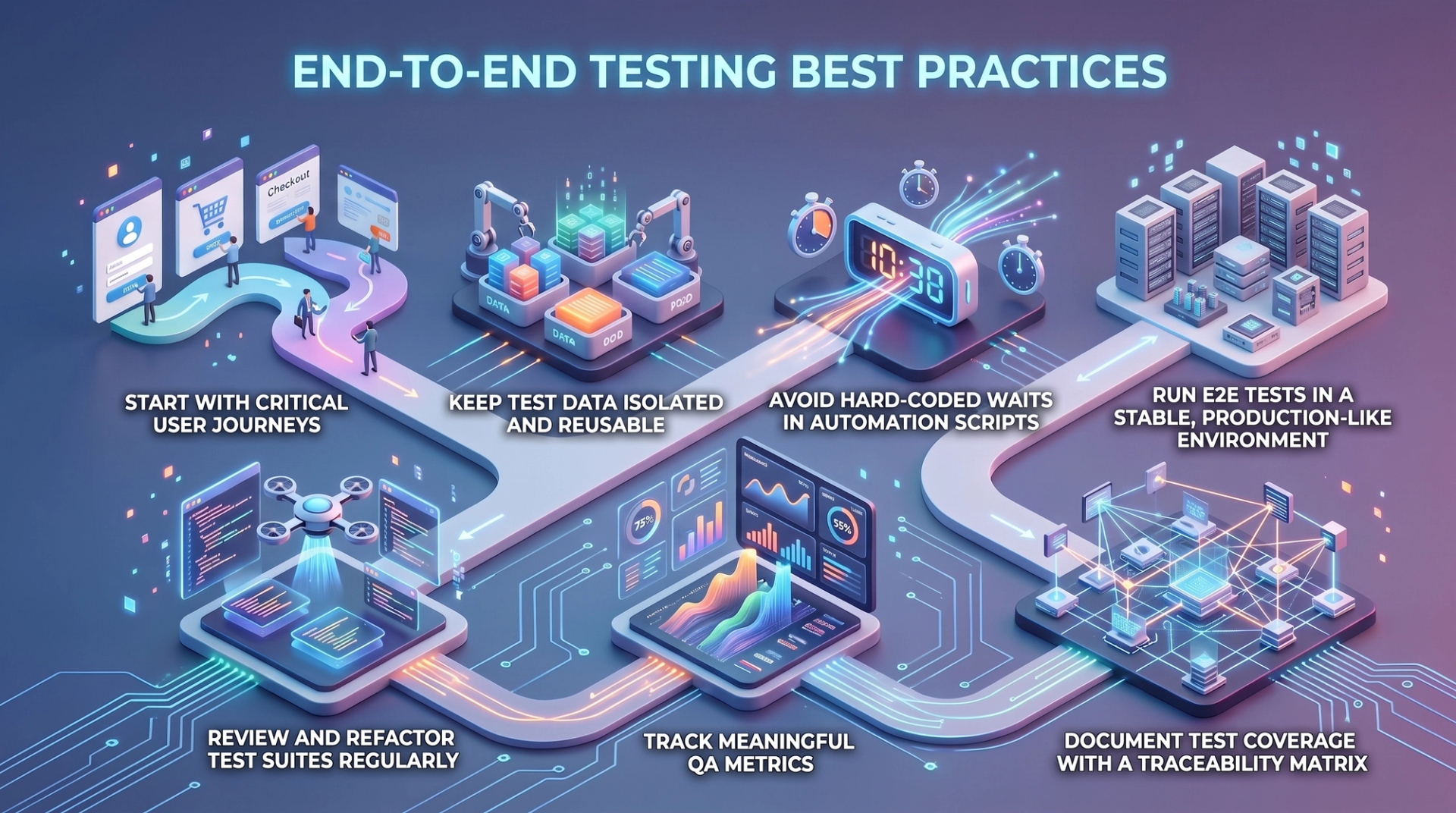
- Start with critical user journeys, not every possible click path.
- Keep test data isolated and reusable so tests don't interfere with each other.
- Avoid hard-coded waits in automation scripts - use dynamic waits instead to reduce flakiness.
- Log and report defects clearly, including steps to reproduce, severity, and priority, so developers can act fast.
- Run E2E tests in a stable, production-like environment, never against constantly changing dev builds.
- Review and refactor test suites regularly - outdated E2E tests create false confidence.
- Track meaningful QA metrics like pass rate, defect density, and mean time to resolution to show stakeholders real quality trends.
- Document test coverage with a traceability matrix, linking test cases back to business requirements.
Common Challenges in End-to-End Testing (and How to Handle Them)
- Flaky tests: Caused by unstable environments or poor synchronization; solve with better waits and stable test data.
- Slow execution: Too many UI-heavy tests slow down pipelines; balance with API-level checks and parallel execution.
- Maintenance overhead: UI changes break tests frequently; use the Page Object Model and reusable components to reduce rework.
- Test data conflicts: Multiple test runs sharing the same data cause false failures; use isolated or synthetic datasets.
- Limited environment access: Coordinate closely with DevOps teams to get consistent, production-like test environments.
Building a Career Around End-to-End Testing Skills
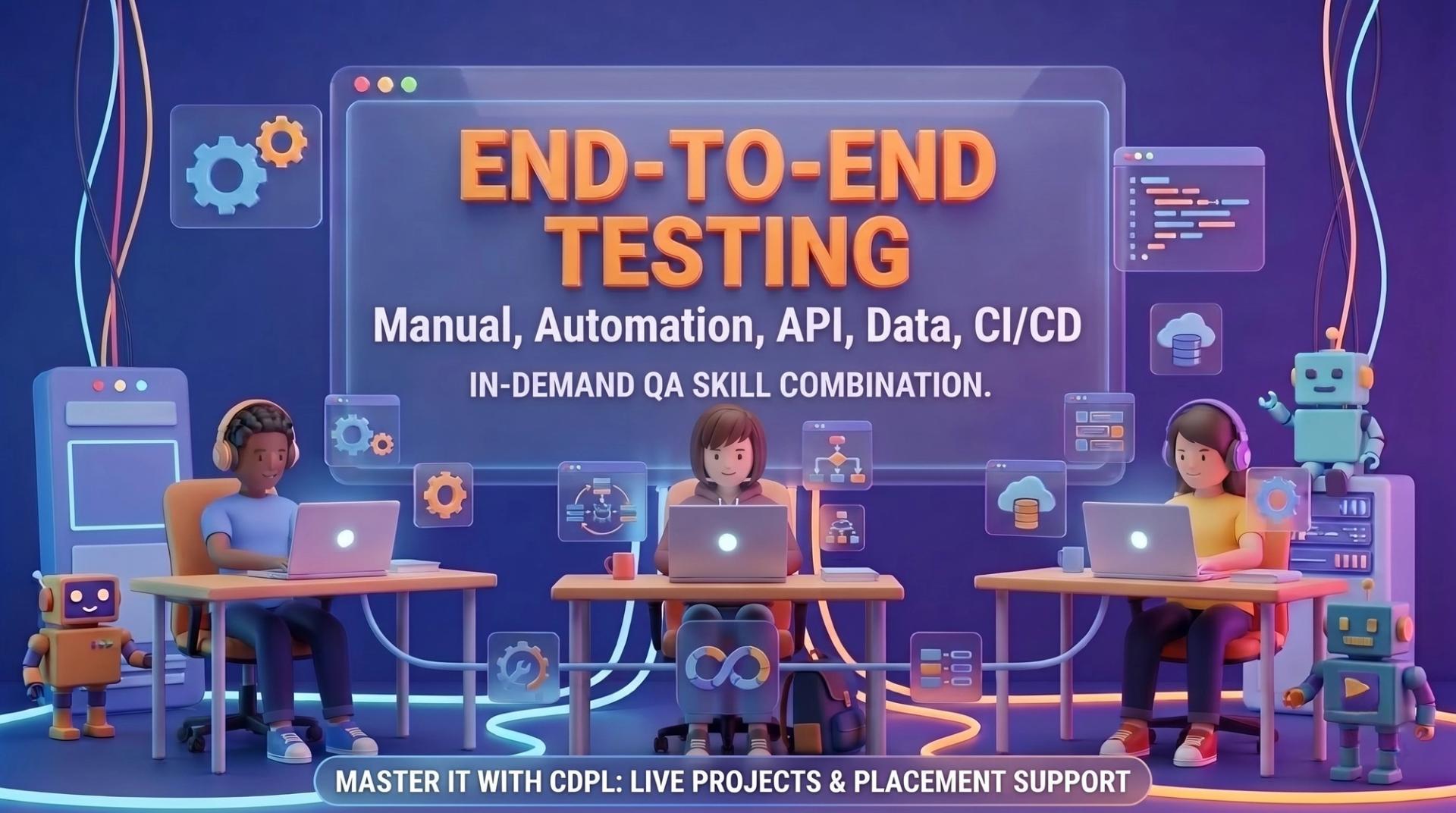
End-to-end testing sits at the intersection of manual test design, automation engineering, API validation, and even data testing which makes it one of the most in-demand skill combinations in QA hiring today. Recruiters actively look for testers who can design a complete test strategy, not just execute individual test cases.
If you're serious about building this skill set with structured, mentor-led training and real project experience, explore CDPL's full Software Testing course programs in Mumbai and Thane, which cover manual testing, automation, API testing, ETL testing, and CI/CD everything an end-to-end testing strategy actually requires. With live projects, ISTQB-aligned training, and dedicated placement support, learners move from fundamentals to job-ready QA and SDET roles with practical, hands-on confidence.
Frequently Asked Questions
Q1. What is the main goal of end-to-end testing?
The main goal is to validate that an entire application workflow from the user's first action to the final system output works correctly across all connected systems.
Q2. Is end-to-end testing the same as system testing?
No. System testing validates the whole application against requirements, while end-to-end testing specifically simulates real user journeys across integrated systems, including third-party dependencies.
Q3. Which tools are best for end-to-end testing beginners?
Selenium and Cypress are commonly recommended starting points, along with Postman for API-level validation within E2E scenarios.
Q4. How much of my test suite should be end-to-end tests?
Following the test automation pyramid, E2E tests should be the smallest but most business-critical layer, supported by a larger base of unit and integration tests.
Conclusion
End-to-end testing strategies in software testing aren't about running more tests they're about running the right tests, in the right order, covering the flows that matter most to real users and the business. By mapping user journeys, applying risk-based prioritization, layering UI with API validation, and integrating tests into CI/CD, QA teams can catch critical failures before they ever reach production.
Whether you're a beginner learning testing fundamentals or a professional building automation expertise, mastering end-to-end testing is one of the most valuable skills you can add to your QA toolkit and one of the most rewarding to apply in real projects.
Tags

A Manual Tester in TESTRIQ QA LLP and also as Corporate Trainer with CDPL. With a focused career in training and development.