
How to Answer Manual Testing Interview Questions (2026)?
Preparing for a QA interview in 2026? This guide breaks down how to answer manual testing interview questions using real examples instead of memorised definitions. From STLC basics to a live test-case walkthrough, you'll learn to think and answer like a working tester.
A fresher's practical guide to answering manual testing interview questions with confidence real examples, common mistakes, and a 2026 career roadmap from Cinute Digital's QA trainers.
How to Answer Manual Testing Interview Questions (2026)?
Picture this: you've just finished your B.Tech or BCA, applied to fifty job postings on Naukri and LinkedIn, and finally landed an interview call for a QA Analyst role at a Pune-based IT services company. The panel opens with "Walk me through the software testing life cycle," and your mind goes blank. If you're searching for manual testing interview questions the night before your big day, you're not alone this scene plays out in interview rooms across Bengaluru, Pune, Mumbai and Hyderabad every single day, because most freshers memorise definitions instead of learning to think like a tester.
This guide fixes exactly that gap. You'll learn how to structure answers the way experienced QA engineers actually think, work through a short test-case demo, and see the mistakes that quietly cost freshers their offers. The trainers at Cinute Digital have coached hundreds of QA aspirants through this exact transition, from classroom theory to interview-ready confidence.
By the end, you won't just recall answers you'll know how to build one on the spot, even for a question you've never rehearsed.
To answer manual testing interview questions well, explain concepts in your own words, back each answer with a real example or mini scenario, and connect it to the testing life cycle. Structure responses as definition, purpose, and example this shows interviewers you understand testing as a practical skill, not just memorised theory.
What Is Manual Testing, Really?
Manual testing is the process of executing a software application without automation tools, to find defects before real users do. You, the tester, act as the very first customer clicking every button, entering unexpected inputs, and checking whether the product behaves the way it's supposed to.
Think of it like quality checking at a Mumbai dabbawala operation. Before a tiffin leaves the kitchen, someone checks the box is sealed, the food matches the order, and the address code is correctly marked all by hand, using judgement, not a machine. Manual testing works the same way: a human tester applies judgement to decide if a login page, a payment flow, or a mobile app screen "feels right" and functions correctly something a script alone often misses on the first pass.
Interviewers ask foundational questions here "What is manual testing?", "What is the difference between manual and automation testing?", "What is SDLC and STLC?" not because they doubt you've read a textbook, but to check if you can explain a technical idea simply, using terminology close to the ISTQB glossary of testing terms that most Indian training programmes and interview panels reference. In a real QA job, you'll explain bugs to developers, product managers and clients who don't share your vocabulary. Your ability to simplify is being tested as much as your technical knowledge.
The Software Testing Life Cycle (STLC) is the backbone of almost every foundational question: requirement analysis, test planning, test case design, environment setup, test execution, and test cycle closure. Learn to name these six phases in order, then be ready to explain what happens in each one with a one-line example. Most freshers who study a structured manual testing course find this the easiest section to master, because it rewards preparation more than raw experience.
Key takeaway: If you can explain STLC using a real-world analogy instead of textbook language, you've already answered better than most candidates in the room.
Why Manual Testing Interview Questions Focus on 2026 Hiring Trends
India's IT services sector continues to be one of the largest recruiters of fresh QA talent, and NASSCOM's 2026 strategic review points to continued growth in the country's tech sector even as hiring patterns shift (approximate verify current figures on the report page). What's changed is the shape of the role: pure manual-only openings are shrinking, but "manual-plus" roles testers who understand automation basics, API testing, and databases are in strong demand across product companies, fintech, and IT services firms in Mumbai, Pune, Bengaluru and Hyderabad.
For freshers, typical entry points include QA Analyst, Junior Test Engineer and Manual Tester roles. Approximate (verify with a current salary survey) fresher packages in metros range from roughly ₹2.5 to ₹4.5 lakh per annum, rising to ₹5–8 lakh per annum with one to two years of solid experience and a working knowledge of tools like JIRA, Postman and basic SQL. Recent coverage of the 2026 IT hiring outlook suggests services firms plan to keep adding headcount this year, even as the skill bar for entry-level testers rises. These are indicative ranges only always cross-check current numbers on a salary-benchmarking site before you negotiate.
Interviewers in 2026 increasingly ask manual testers to describe their exposure to automation concepts, even for "manual-only" openings, because most QA teams now work in hybrid pods where testers write some scripts and review automated results. This is why candidates who pair their foundation with an automation testing training programme often report an edge in interviews not because they're expected to code fluently on day one, but because they can speak confidently about tools like Selenium when asked.
Key takeaway: Employers aren't just hiring "manual testers" anymore they're hiring problem-solvers who understand testing broadly, so mention your awareness of automation even in a manual round.
How to Structure an Answer A Live Walkthrough
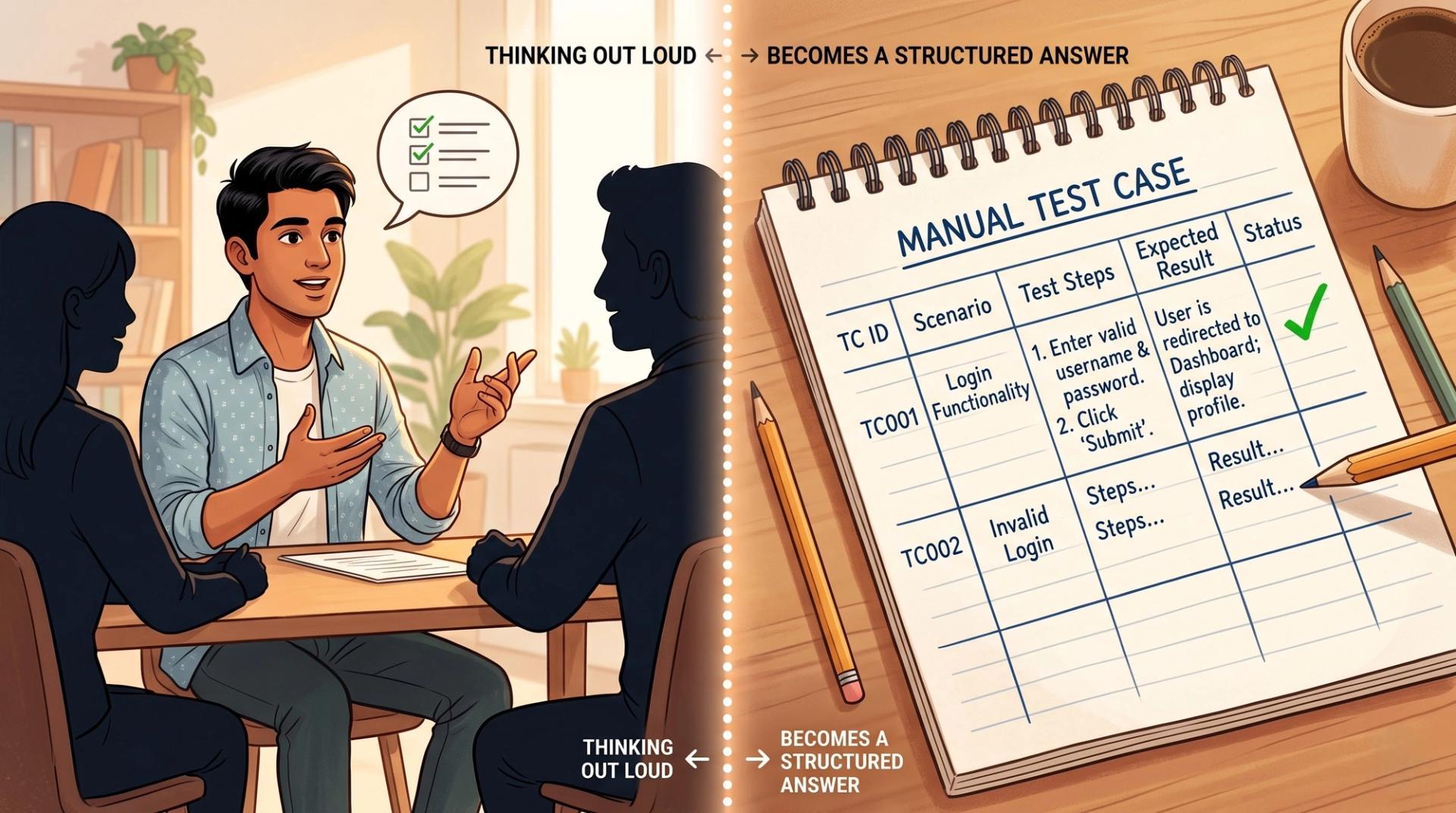
Let's simulate a real interview moment. The interviewer says: "Write a test case to verify the login functionality of a website." Here's how a well-prepared candidate walks through it, step by step.
Step 1 : Clarify scope out loud. Say: "Should I cover only valid login, or also negative scenarios like wrong password and blank fields?" This single sentence signals you think about edge cases before writing anything a trait every QA lead values.
Step 2 : State your test case structure. A good manual test case includes: Test Case ID, Test Scenario, Pre-conditions, Test Steps, Test Data, Expected Result, and Actual Result.
Step 3 : Write it out. A sample entry might look like this:
Step 4 : Mention the negative cases. Add one line: "I'd also write cases for an incorrect password, an empty field, and SQL-injection-style input in the username field, to check the app fails safely rather than crashing."
That last line does double duty , it shows testing maturity and quietly touches on security awareness, which interviewers love hearing from a fresher.
Many interviews also test whether you know your vocabulary precisely. A quick comparison that trips up freshers:
Modern QA rounds , even manual-focused ones , often ask a bonus question: "Have you tested an API?" You don't need to be an automation expert to answer well; describe checking a response status code, verifying the JSON payload, and confirming response time using a tool. Learning the basics through a structured API testing with Postman module gives you enough vocabulary to answer this confidently without overselling your automation skills.
Key takeaway: Interviewers reward structure and out-loud thinking more than a "perfect" answer narrate your process, don't just state your conclusion.
Common Mistakes Freshers Make (and How to Avoid Them)
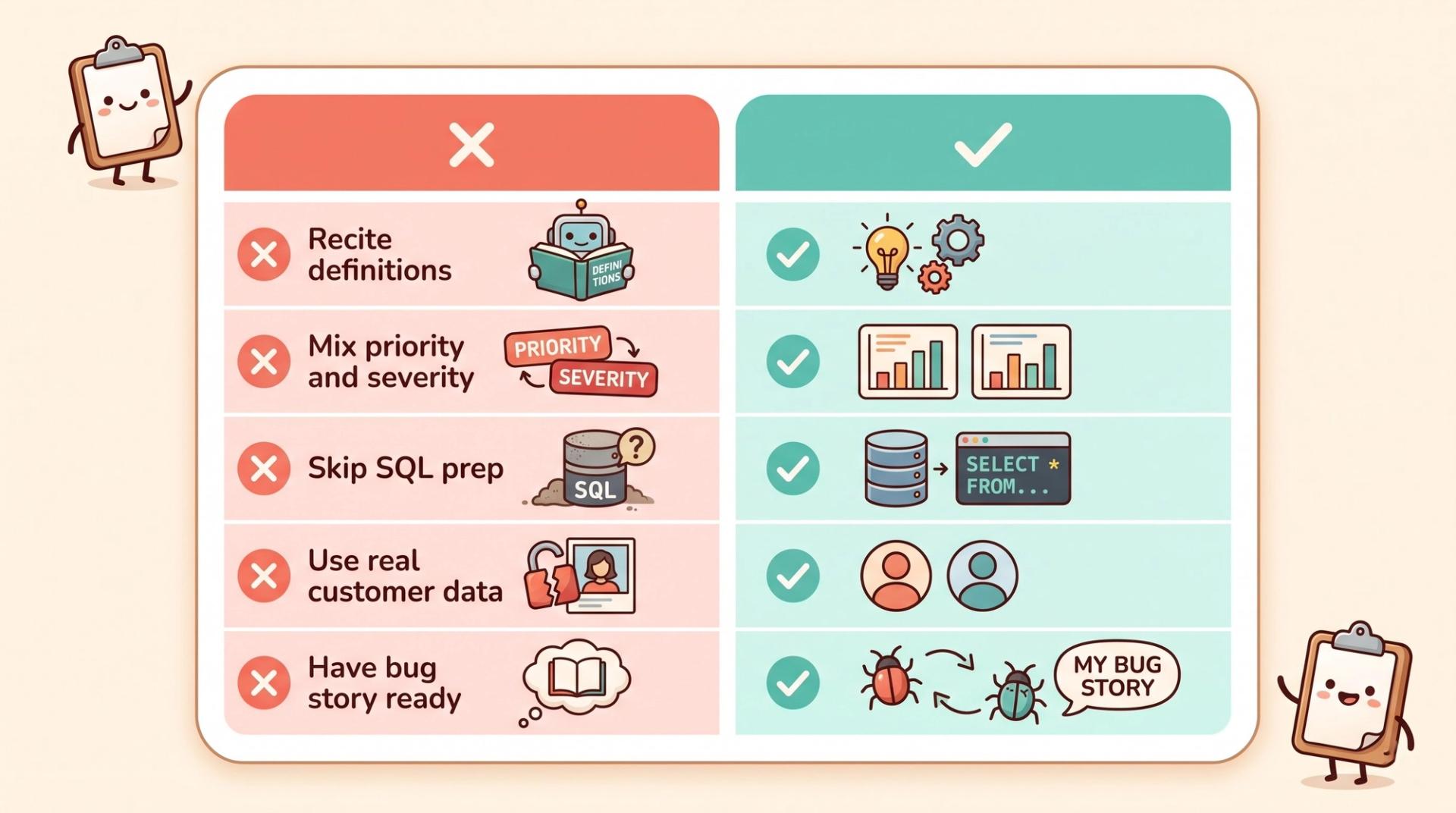
Mistake 1 : Reciting definitions instead of reasoning. Saying "regression testing is testing after a code change" is correct but thin. Add why it matters: "so we make sure a bug fix in the payment module didn't break the login flow."
Mistake 2 : Treating priority and severity as the same idea. Severity is about impact on the product (a crash is high severity); priority is about urgency of fixing it (a spelling mistake on the homepage might still be high priority before a client demo). Keep these separate in every answer.
Mistake 3 : Not preparing for the SQL round. Many manual testing interviews include basic database questions writing a simple SELECT query, or explaining how you'd verify data after a batch update. Brushing up on SQL and database testing basics before the interview removes an entirely avoidable stumble, since interviewers expect testers to verify data at the backend, not just the UI.
Mistake 4 : Treating test data casually. Never use real customer data names, phone numbers, card details in test environments or interview examples. Responsible testers always use masked, synthetic or clearly fictional data, both on real projects and in interview answers, because data-privacy expectations apply to test environments too, not only to production systems.
Mistake 5 : Not preparing a "tell me about a bug you found" story. Keep one real (or class-project) bug ready, told as: what you did, what broke, how you reported it, and what you learned.
Key takeaway: Precision in vocabulary and one well-rehearsed bug story will carry you further than memorizing forty definitions.
Your Career Path After Manual Testing
Cracking your first manual testing interview opens doors to roles like QA Analyst, Test Engineer, and eventually Senior Tester or Test Lead as you gain experience. Many testers also move sideways into automation engineering, API testing specialization, or QA-to-business-analyst transitions within two to four years.
A realistic timeline: 6–8 weeks of focused preparation (STLC, test case writing, defect life cycle, basic SQL) can get a genuine fresher interview-ready for entry-level roles (approximate depends on your starting point). The next 12–18 months on the job is where real depth builds learning your company's tools, writing your first automation scripts, and understanding release cycles under pressure.
The natural next skill after manual testing is programming, because most automation frameworks Selenium, Appium, and API tools are built on a language you can read and modify. A Java programming course is a common bridge for manual testers moving toward automation, since Selenium's most widely used bindings are Java-based, and many Indian product companies still hire automation testers against a Java-first job description.
If you're serious about this transition, structured, mentor-led training compresses the guesswork. Programmes that combine manual testing fundamentals with a path into automation and API testing alongside mock interviews and resume support tend to shorten the gap between "I finished a course" and "I got an offer."
Key takeaway: Manual testing is a strong entry point, not a ceiling — plan your next 12 months around one adjacent skill, not five.
Conclusion: Walk In Prepared, Not Just Rehearsed
Three things will move the needle most in your next interview: explain concepts with real examples instead of textbook lines, keep your vocabulary precise (severity versus priority, test case versus test scenario), and always have one genuine bug story ready to tell. Manual testing interview questions aren't designed to trip you up they're designed to check whether you can think like a tester under normal conversational pressure, and that's a skill you can deliberately build.
If you want structured practice mock interviews, guided test-case exercises, and honest feedback on where you're weak it helps to work with people who interview QA candidates for a living. You're welcome to book a free demo class with our training team and see if the format fits how you learn.
Whatever you decide, walk into your next interview remembering this: every senior QA engineer once sat exactly where you're sitting now, unsure of the STLC phases and nervous about the SQL round. Preparation, not talent, is what closes that gap.
FAQ SECTION
Q1. What is manual testing in software testing?
Manual testing is the practice of executing an application's features by hand, without automation scripts, to check whether it behaves as expected. A tester follows planned test cases, tries valid and invalid inputs, and logs any deviation as a defect. It's usually the first testing approach freshers learn, because it builds the judgement and domain understanding that automation testing later builds on you can't automate a check you don't understand manually first.
Q2. How do you answer manual testing interview questions?
Structure every answer as definition, purpose, and a real example don't just recite a textbook line. If asked about a process like the defect life cycle, name the stages, then walk through one bug you've actually logged or role-played. Interviewers are checking whether you understand testing as a practical skill, not just memorised vocabulary, so narrating your thought process out loud usually scores better than a technically "perfect" one-line answer.
Q3. Is manual testing still worth learning in 2026?
Yes, with a caveat: pure manual-only roles are shrinking, while "manual-plus" roles that combine manual testing with basic automation, API testing and SQL are growing (approximate verify with current job postings). Manual testing is still the right entry point for freshers, because it teaches the fundamentals test design, defect reporting, domain thinking that every automation engineer eventually relies on. Treat it as your foundation year, not your entire career plan.
Q4. How long does it take to prepare for a manual testing interview?
Most freshers with a testing-course background can get interview-ready in roughly 4–8 weeks of focused practice (approximate, depends on your starting point). Prioritise the STLC and defect life cycle, test case writing, priority versus severity, basic SQL queries, and one well-rehearsed real bug story. Mock interviews compress this timeline significantly, because they expose gaps in how you explain concepts, not just what you know.
Q5. How much does a manual tester earn in India?
Fresher manual tester salaries in Indian metros are approximately ₹2.5–4.5 lakh per annum, rising to roughly ₹5–8 lakh with one to two years of experience and added skills like automation exposure or SQL (approximate — always verify current figures with a salary-benchmarking tool, since ranges vary by city, company size and skill set). Testers who add automation or API testing skills typically see faster salary growth than those who stay manual-only.
Tags

A Manual Tester in TESTRIQ QA LLP and also as Corporate Trainer with CDPL. With a focused career in training and development.