
Data Science Course Fees for Beginners (Start from Zero)
Confused by data science course fees? This beginner guide explains what you pay for, typical fee bands in India and Mumbai, hidden costs and how to compare courses fairly. Learn to judge any fee quote before you enroll
A fresher-friendly guide to data science course fees in India: what you pay for, typical fee bands, hidden costs and how to compare courses fairly.
Take Riya, a typical BCom graduate from Mumbai. Her LinkedIn feed is full of data analyst posts, and every course ad promises a bright future. Then she collects five brochures and finds five very different prices, from a few thousand rupees to several lakh. Which one suits a beginner?
If Riya’s confusion sounds familiar, you are in the right place. Data science course fees for beginners in India vary so widely that the price alone tells you very little. A cheap course can cost more if it leaves gaps. An expensive one is wasted if you cannot use it.
We wrote this guide at Cinute Digital, a Mumbai-based tech-training institute, for exactly this choice. You will learn what a fee really covers, what typical fee bands look like, how to compare courses fairly and which mistakes to avoid. By the end, you can judge any fee quote yourself.
So, can you read a price tag the way a data scientist reads a dataset?
Data science course fees in India vary widely: short certification courses at private institutes often cost roughly ₹30,000 to ₹90,000 (approximate), while degrees and PG diplomas cost several lakh. For a fresher starting from zero, compare syllabus, hours, projects and support, not just the price tag.
What Are You Actually Paying For in a Data Science Course?
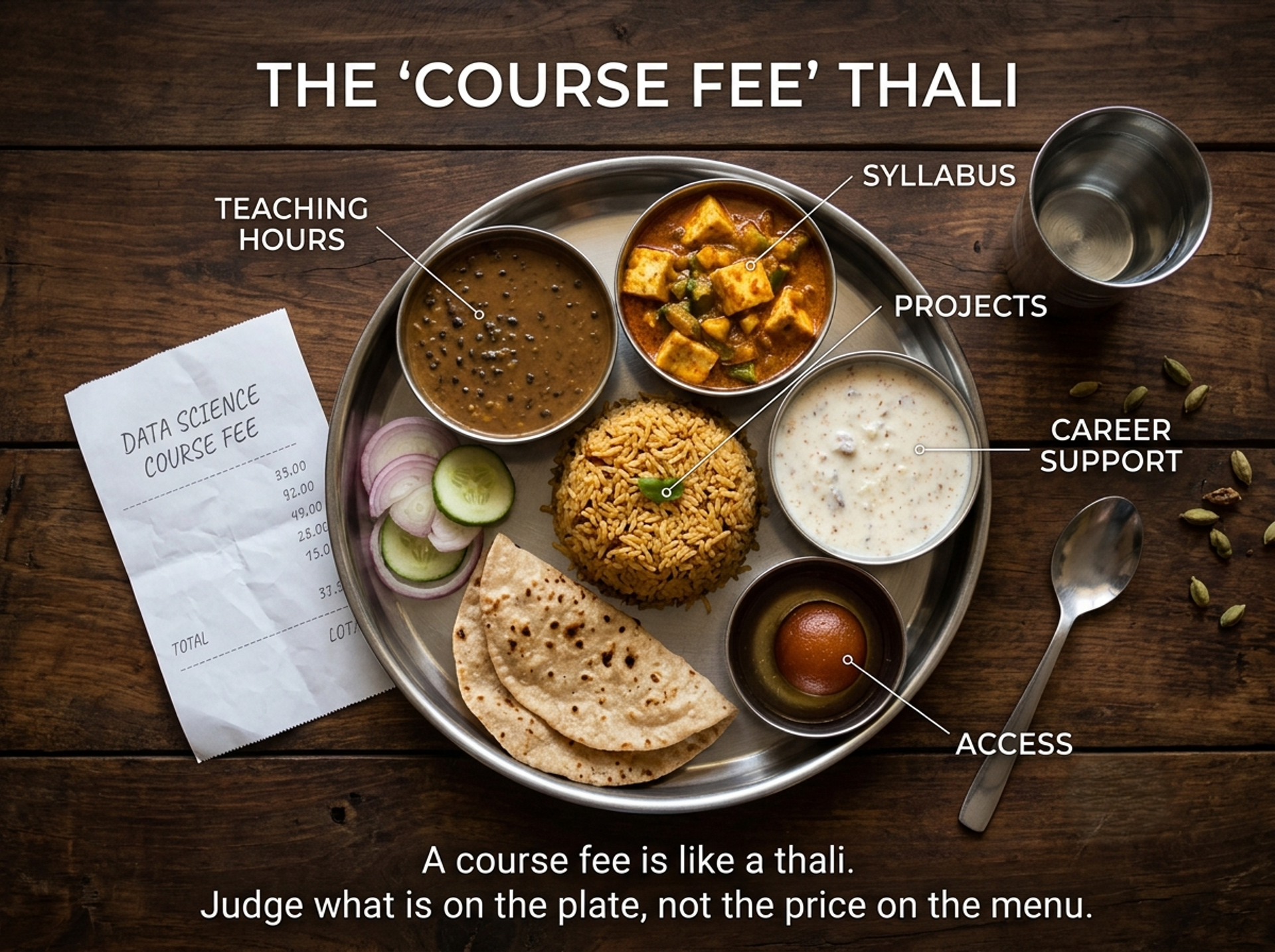
Start with one idea: a course fee is like a thali price. Two thalis can cost the same, yet one has dal, sabzi, roti and sweet while the other is mostly rice. You judge the meal by what is on the plate, not by the number on the menu.
A data science course works the same way. Data science means using Python, statistics and machine learning to find patterns in data and help people make better decisions. So a fair fee should cover the full learning plate:
- Teaching hours: live online or classroom sessions with a trainer who answers your doubts.
- Core syllabus: Python, statistics, SQL basics, data visualisation and machine learning.
- Hands-on projects: real datasets, not just slides.
- Career support: resume help, mock interviews and placement assistance.
- Learning access: recordings, notes and tool or lab access.
Why do fees differ so much? Four things drive most of the gap: trainer experience, batch size, live versus recorded delivery and the amount of career support. A small batch with an experienced trainer costs more to run than a large recorded one, and the fee reflects that difference.
Notice what the list does not contain: a job guarantee. No honest institute can promise one. Your fee pays for training and support, and your practice turns that training into skill.
Where should a beginner start? A good data science course for freshers begins with Python programming for data science, because every later topic, from data cleaning to machine learning, builds on it. If a syllabus jumps to algorithms in week one, ask how complete beginners will keep up.
Finally, the fee is only part of your cost. Your laptop, internet and the months you spend studying instead of earning also count. We put numbers on this in the comparison section below.
Data Science Course Fees in India and Mumbai: The 2026 Picture
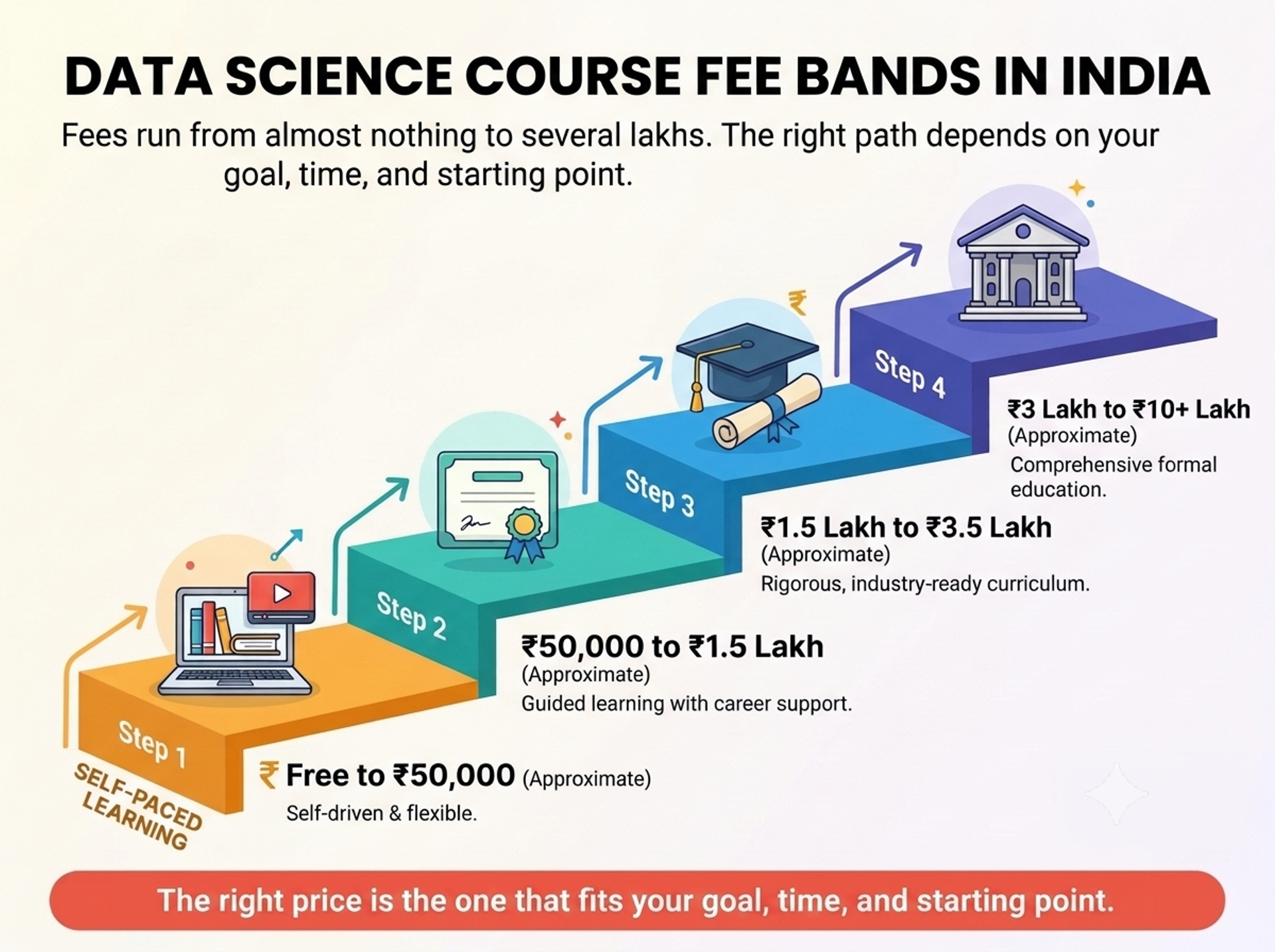
Data science course cost in India falls into broad bands. In mid-2026, third-party fee listings for Mumbai institutes showed most certification-style courses between ₹30,000 and ₹90,000, with a few premium programmes near ₹2 lakh. Treat every figure as approximate and verify it on the institute’s own page.
Here is how the bands usually look (approximate, verify before deciding):
- Self-paced online courses: free to a few thousand rupees. Support is limited, so discipline matters.
- Institute certification courses (about 3–9 months): roughly ₹30,000 to ₹90,000 in listings, with some higher.
- Business-school PG diplomas (about 1 year): around ₹3.5 lakh in one listing.
- Degrees (BSc or MSc Data Science): from roughly ₹20,000 at some affiliated colleges to several lakh at private universities.
Data science course fees in Mumbai follow this same pattern. Compare at least three institutes on the same criteria before you decide.
Why do people pay these fees at all? Based on general industry observation, demand for analytics and AI skills stayed strong in Indian hiring through 2025–2026. Mumbai’s banks, e-commerce firms, healthcare companies and IT services all hire for data roles. Freshers usually start as junior data analyst, business analyst, MIS executive or associate data scientist. One aggregator lists ₹5 to ₹25 lakh a year for data scientists in Mumbai (approximate, verify with a current industry source). That range is so wide that it proves one point: your skills and portfolio matter more than the course’s brand.
To see what role-focused training looks like, read the syllabus of a machine learning with Python program. Look for Python, statistics, model building and projects, and confirm the exact topics and duration on the course page.
How to Compare Fees: Cost per Hour, Hidden Costs and a Quick Demo
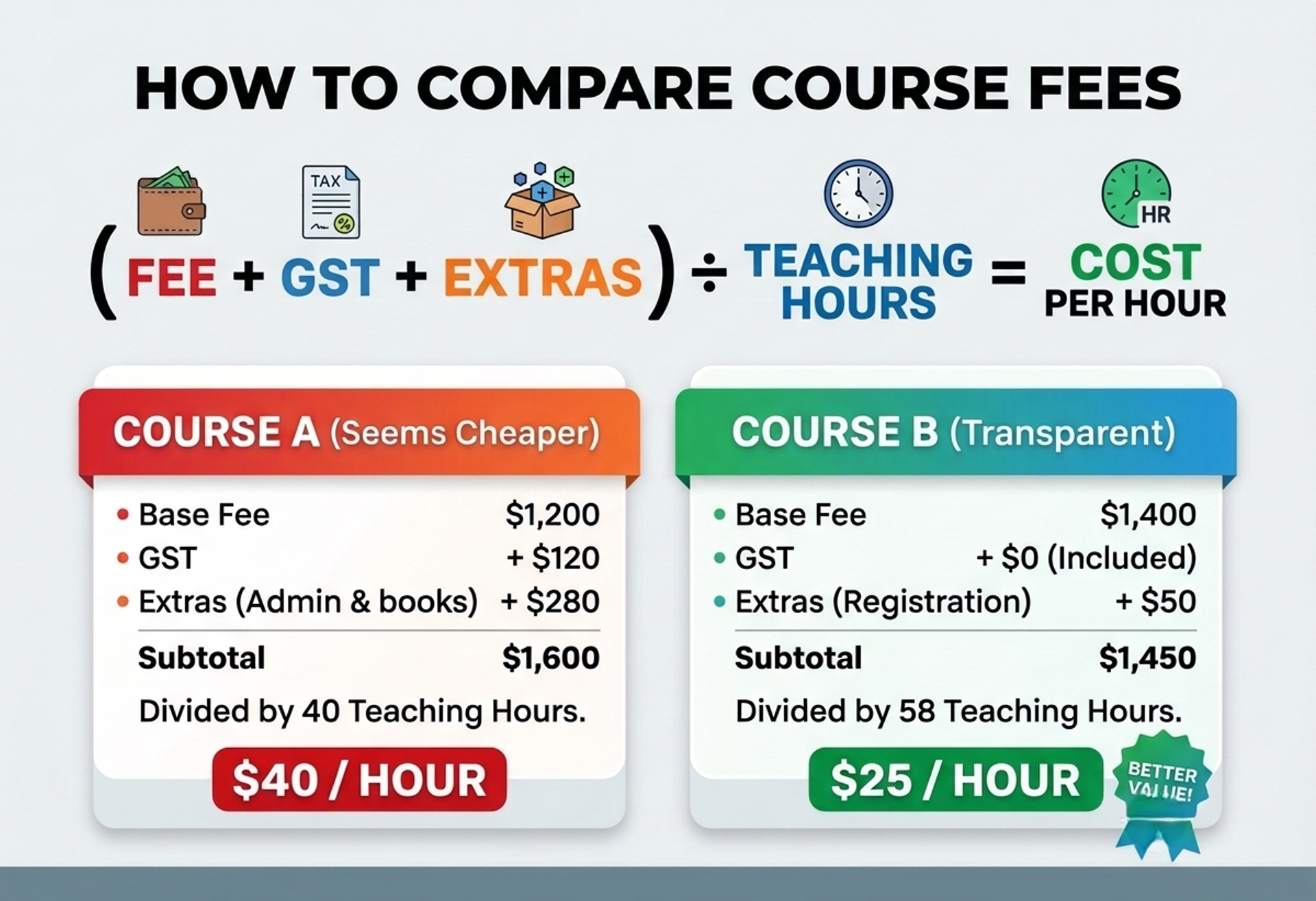
Comparing data science course fees fairly takes three steps.
- Ask what the fee includes. Confirm GST, exam or certificate charges, study material and whether a missed batch can be repeated.
- Divide the total cost by teaching hours. A lower fee often means fewer hours.
- Check syllabus, projects and support. Count the projects, ask who teaches and ask how big the batch is.
A table puts the options side by side:
Now turn step 2 into code. This small Python function adds GST and extra costs, then divides by teaching hours. The numbers are examples, not real quotes.
Line by line:
- Line 1 defines the function. The default gst_percent=18 is a common rate for private training. Set it to 0 if the fee already includes GST, and confirm the rate with the institute.
- Line 2 adds GST to the fee, then adds extras such as exam or material charges.
- Line 3 returns the total cost and the cost per hour, rounded to whole rupees.
- The last line runs an example: a ₹60,000 fee, 150 hours and ₹3,000 of extras.
Expected output:
So this course costs about ₹492 per teaching hour after GST and extras. Now try true_cost(45000, 60). You get (53100, 885). The ₹45,000 course looks cheaper, yet it costs far more per hour of teaching. Cost per hour is a lens, not a verdict, because trainer quality and projects still matter.
Check the data science course duration and syllabus too. Data lives in databases, so MySQL and SQL fundamentals should come before any model, since SQL is how you pull data into Python. If a course skips it, ask how you will fetch your own data.
Once the Python above feels comfortable, the official pandas documentation is a free next step for learning data handling.
5 Beginner Mistakes When Paying for a Data Science Course
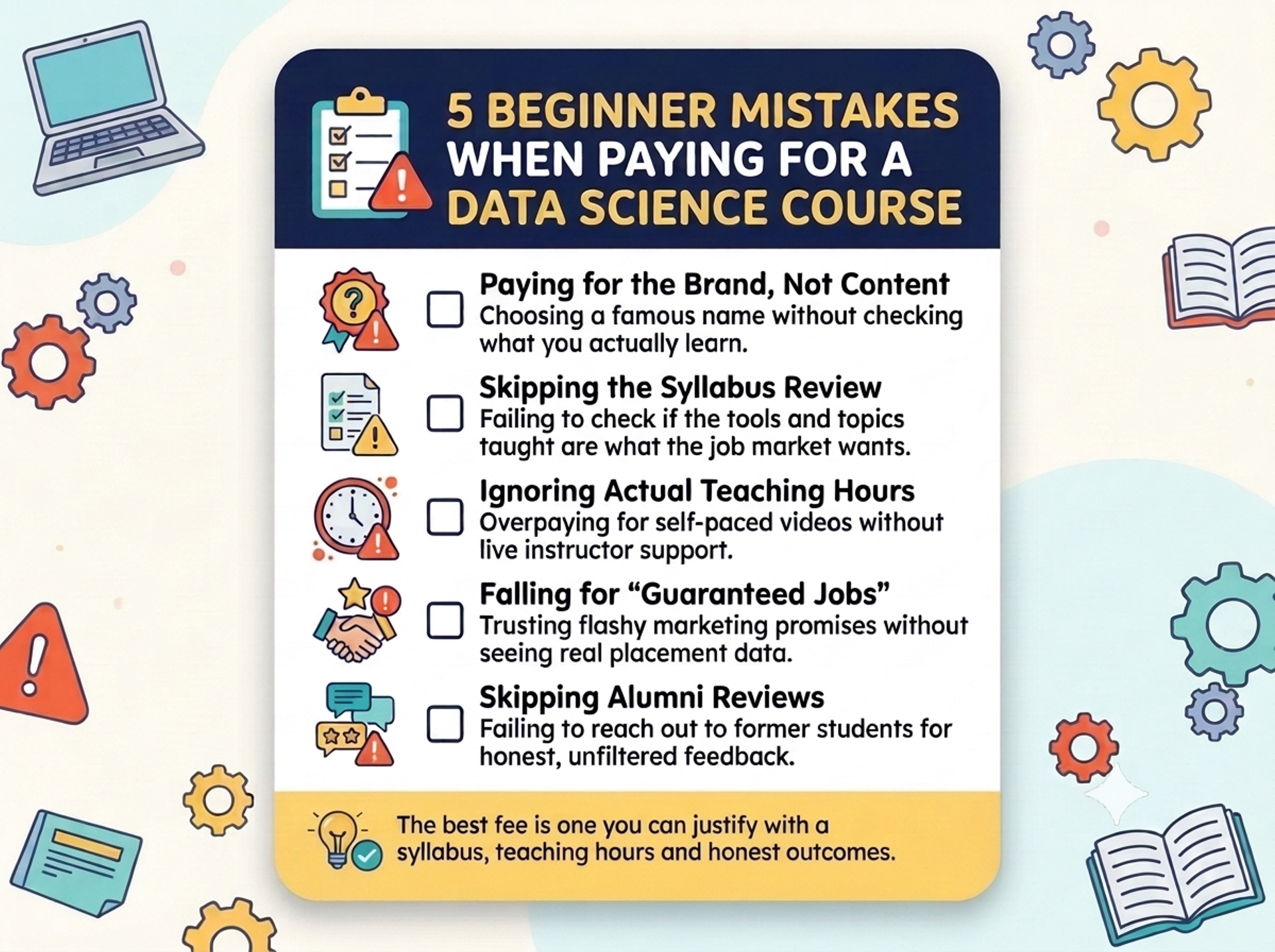
Most fee regrets come from the same five mistakes. Avoid them and you are ahead of most beginners.
- Choosing the lowest fee only. A ₹30,000 course with 40 hours costs more per hour than a ₹60,000 course with 150 hours. Compare cost per hour, not the headline fee.
- Believing guaranteed-job claims. No institute controls the hiring market. Look for honest wording such as “placement assistance”, and ask exactly what it includes: resume reviews, mock interviews, interview preparation?
- Skipping the syllabus check. Ask for the week-by-week topics and the project list before you pay. Check that Python, statistics, SQL and machine learning appear in a sensible order.
- Learning models but not communication. Analysis that nobody understands has little value. Power BI for data visualisation turns your findings into dashboards a manager can read in a minute, so add a visualisation tool to your plan.
- Paying without clear terms. Ask about instalments, refunds and batch changes, and get the answers in writing.
A quick test: if a brochure sounds more confident than its syllabus, slow down and ask more questions.
A note on responsible practice. Build portfolio projects on public or properly licensed datasets. Do not scrape personal data, and never upload a former employer’s confidential files. Ethical habits protect you and make you easier to hire.
Career Path and Learning Roadmap for Freshers
A data science course can lead to junior data analyst, business analyst, reporting or MIS analyst, associate data scientist and machine learning intern roles. Many people begin in analyst roles and move towards modelling as their skills grow.
Here is a realistic roadmap for a fresher starting from zero:
- Months 1–2: Python basics, Excel and SQL.
- Months 3–4: statistics, data cleaning and visualisation.
- Months 5–6: machine learning, with the scikit-learn user guide as a free companion, plus two or three projects.
- Months 7–9: portfolio polish, a GitHub profile, mock interviews and applications.
With steady daily practice, six to twelve months to job-readiness is a realistic target (approximate, depends on your hours and background). Is a data science course worth it? For freshers who practise consistently, usually yes. It suits you less if you want a shortcut to a high salary. If you prefer, you can begin with Excel or Power BI analytics first and move into data science later.
If you want one structured route covering Python, statistics, machine learning and AI, explore the Data Science and AI Master Program. Confirm the current syllabus, duration and fee on the course page.
Conclusion: Pay for Skills, Not for a Brand Name
Data science course fees for beginners are not one number. They are a bundle, and you can learn to read it. Remember three points:
- A fee is a thali price, so judge teaching hours, syllabus, projects and support.
- Compare fairly by adding GST and extras, then dividing by teaching hours.
- Ignore guaranteed-job claims and get every promise in writing.
At Cinute Digital, learners can choose live online or classroom options, with hands-on projects, mock interviews, resume support and placement assistance. When you are ready to see how this fits your situation, contact us for current fee details, batch options and syllabus. Ask us the same questions you would ask any institute. A good fee conversation leaves you better informed, not pressured.
You do not need to be a maths genius or an expert coder today. You need a clear plan and steady practice. Start from zero, and start this month.
Frequently Asked Questions
1. What is included in data science course fees?
Data science course fees usually cover live or recorded teaching hours, the core syllabus, hands-on projects, trainer support and some career help such as resume reviews and mock interviews. Some institutes also include study material and certificates, while others charge separately. GST and exam fees may be extra. Always ask for a written list of inclusions before paying, so you can compare two courses on the same basis.
2. How to compare data science course fees before joining?
Ask what the fee includes, then add GST and extra charges to get the total cost. Divide that total by the number of teaching hours to find the cost per hour. Next, check the syllabus, the number of projects, batch size and the trainer's experience. Finally, ask for refund and instalment terms in writing. Compare at least three institutes using the same checklist.
3. Is a data science course worth it for freshers?
It can be, if you study consistently and build projects. A course gives structure, trainer feedback and practice, which many beginners struggle to create alone. It is less suitable if you expect a guaranteed job or a quick high salary. If budget is tight, start with free self-paced material, then join a guided course when you are sure.
4. How long does it take to learn data science from scratch?
Most beginners need roughly six to twelve months of steady study to become job-ready for entry-level data roles. This is approximate and depends on your daily practice time and background. A typical path covers Python, SQL and statistics first, then visualisation and machine learning, followed by projects and interview preparation. Learning never really ends, so treat job-readiness as a starting line.
5. How much do data science courses cost in India?
Costs vary widely. Third-party listings in 2026 show self-paced options from free to a few thousand rupees, institute certification courses mostly between ₹30,000 and ₹90,000, PG diplomas near ₹3.5 lakh, and degrees from about ₹20,000 to several lakh. These figures are approximate. Check each institute's official page for current fees, GST and inclusions.
Tags

Cezzane Khan is a dedicated and innovative Data Science Trainer committed to empowering individuals and organizations.