
Easy 5-Step Agile Testing Guide: Start Your QA Career


Stop guessing how to get into software testing. This 5-step guide breaks down the exact Agile manual testing workflow you need to master to land your first QA job in 2026.
Targeted at Indian and global students, this guide provides a low-barrier entry point into the tech world by focusing on the high-demand niche of Agile manual testing. It emphasizes career stability and immediate job application.
You have the degree. You’ve finished the tutorials. You might even have a certificate in "Software Testing" tucked away in a folder. But when you open LinkedIn or Naukri, the "Entry Level" jobs look anything but basic. They demand "Agile experience," "Sprint participation," and "Cross-functional collaboration."
For many students in India and across the globe, there is a terrifying wall between classroom theory and the fast-paced reality of a software development team. You’re taught how to find a bug, but you aren't taught how to find a bug while the developer is literally updating the code next to you. This is the Agile Manual Testing Workflow, and in 2026, it is the single most important skill you can possess to bridge the gap between "unemployed graduate" and "QA Professional."
If you feel overwhelmed by the technical jargon, you aren't alone. The goal of this guide is to strip away the complexity. We are going to walk through a 2000-word deep dive into how you can start your career with our expert-led course, mastering the exact steps companies are hiring for right now.
Why Agile Testing is the "Money Skill" of 2026
The Death of Waterfall
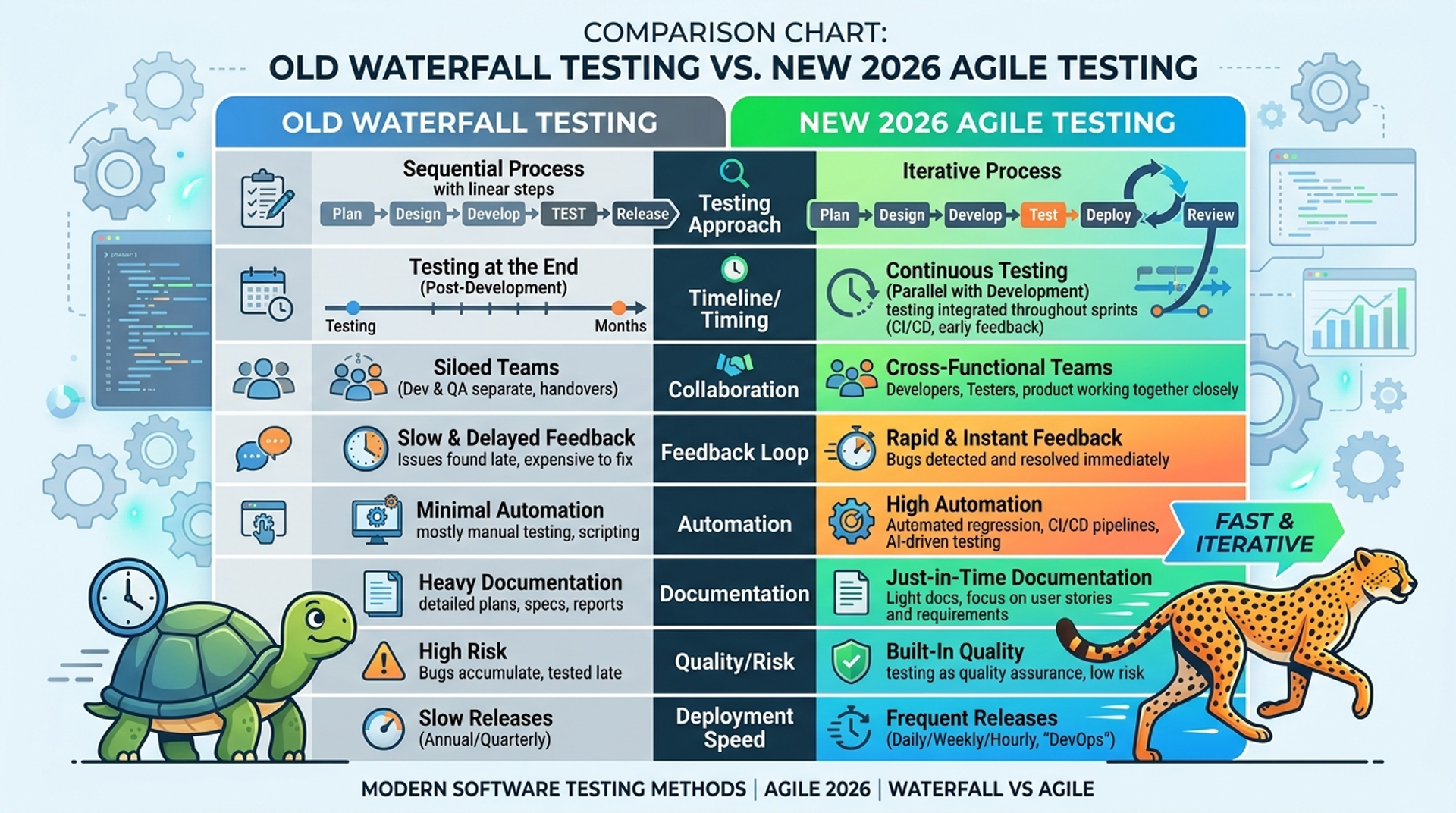
Ten years ago, software was built like a skyscraper. You planned for months, built for a year, and tested at the very end. If a bug was found at the end, the whole building might need to come down. This was the "Waterfall" model. In 2026, that model is a relic.
Today, software is built like a living organism. It grows, changes, and evolves every two weeks. This is Agile. Because software moves so fast, the "Tester" is no longer someone who sits in a corner at the end of the project. You are now a "Quality Advocate" who is involved from Day 1.
The "Humans-Required" Niche
While AI and Automation are massive trends, 2026 has proven one thing: AI cannot think like a human user. AI can check if a button works, but it cannot tell if a checkout process is frustrating, or if a new feature feels "clunky" to a customer in Mumbai versus a customer in New York.
Manual testing in an Agile environment is about Critical Thinking. It’s a high-demand, high-paying niche because it requires human intuition something AI simply cannot replicate.
Learn this skill step-by-step and you’ll find that you aren't just a "tester" you are a consultant for the product's success.
Career Opportunities & Salary Potential (The Reality Check)
Let’s talk about the "why" behind your learning. You want a career that offers stability, growth, and a paycheck that reflects your effort.
The Global Landscape
In 2026, the QA market has shifted. Remote work is the standard, meaning a student in Bangalore can easily work for a startup in Berlin or a tech giant in San Francisco.
- Junior QA Analyst (India): Starting salaries range from ₹4,50,000 to ₹8,00,000. With Agile expertise, you often start at the higher end of that bracket.
- Junior QA Engineer (Global/Remote): Starting salaries range from $40,000 to $65,000 USD.
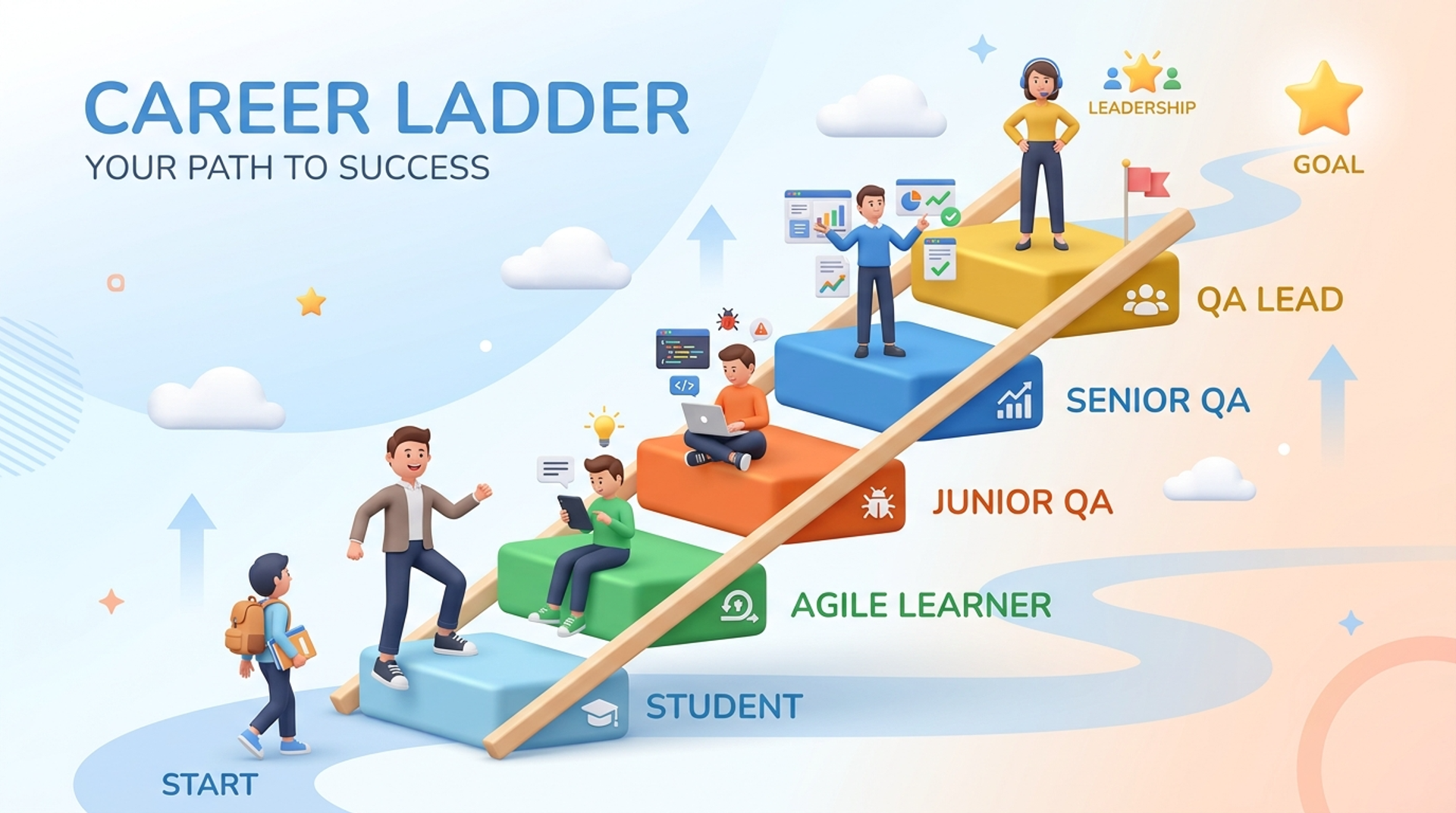
The Growth Ladder
The beauty of starting in Agile Manual Testing is the clear path forward. You don't stay a manual tester forever unless you want to.
- Junior Manual Tester: Learning the ropes, writing test cases.
- Senior QA Analyst: Leading a sprint, mentoring juniors.
- QA Lead/Manager: Strategy, resource management, and process improvement.
- Product Manager: Many testers move here because they understand the user better than anyone else.
The competition is fierce, but most applicants only have "book knowledge." By mastering the actual workflow, you become the top 1% of applicants. Join our beginner-friendly training to build a portfolio that proves your worth.
Common Mistakes Students Make (The "Silent" Career Killers)
After 25 years in SEO and tech strategy, I’ve seen thousands of resumes. Most students fail because of these three "silent" mistakes:
1. The "Wait and See" Approach
Most students wait until a feature is "finished" before they start testing. In Agile, if you wait until the feature is finished, the Sprint is already over. You’ve failed. You must learn to test "incrementally."
2. Poor Documentation Skills
A bug report that says "The login doesn't work" is useless. In 2026, developers have no time for back-and-forth. If your bug report isn't perfect including logs, screenshots, and clear steps you are slowing the team down.
3. Ignoring the "Business Logic"
Testers often focus on technical errors (404 pages) but ignore business errors. Does the discount code apply correctly for a first-time user in a specific region? That is where the real value lies.
The Easy 5-Step Agile Testing Roadmap
This is the core of your learning. If you can explain these five steps in an interview, you are already ahead of 90% of your peers.
Step 1: The Sprint Planning & Requirement Analysis
Agile work is divided into "Sprints" (usually 14 days). On Day 1, the team meets. You receive User Stories.

- What you do: You look at the User Story and ask "What could go wrong here?" You help define the Acceptance Criteria (the rules the feature must follow to be considered "done").
Step 2: Designing the "Lean" Test Plan
In Waterfall, test plans were 50 pages long. In Agile, they are "Lean." You focus on high-risk areas.
- What you do: Write short, punchy test cases. Focus on the "Happy Path" (the user does everything right) and the "Edge Cases" (the user does something weird).
Step 3: In-Sprint Testing (The Heart of the Process)
As soon as a developer finishes a small piece of code, you test it. You don't wait for the whole feature.
- What you do: Perform Smoke Testing to ensure the build isn't broken, then move into detailed manual testing. Use tools like Jira to track your progress in real-time.
Step 4: Regression & Exploratory Testing
This is where the "Expert" manual tester shines.
- Regression: Ensuring new code didn't break old features.
- Exploratory: This is "unscripted" testing. You use your intuition to "play" with the app like a real user would, trying to break it in ways no one thought of.
Step 5: The Sprint Retrospective & Release
Before the feature goes live, the team reviews what went well.
- What you do: Share your "Quality Metrics." How many bugs did we find? How many are still open? Is the product safe for the user?
Start your career with our course to practice these steps on a real project environment.
Tools of the Trade in 2026
You cannot be an Agile tester with just a pen and paper. You need to be comfortable with the digital ecosystem.
Don't be intimidated. You don't need to be an expert in all of them today. You just need to know how they fit into the workflow.
How to Build Your "QA Portfolio" from Scratch
One of the biggest questions students ask is: "How do I get experience if no one will hire me?"
In 2026, you don't wait for a job to get experience. You build it yourself.
- Crowdsourced Testing: Join platforms like uTest or Test IO. You get paid to find bugs in real apps like Facebook or Uber. This goes on your resume as "Experience."
- Open Source Projects: Go to GitHub, find a project, and offer to do the manual testing for them.
- The "Live Audit" Method: Pick your favorite app (e.g., Zomato). Write a professional 10-page "Bug Audit" and post it on LinkedIn. Tag the company’s QA Lead.
This proactive mindset is exactly what we teach in our training. Join our beginner-friendly training and we will help you build this portfolio step-by-step.
The "Free Roadmap" to Your First QA Job
To help you get started today, here is a 4-week self-study plan:
- Week 1: Foundations. Learn the difference between Functional and Non-Functional testing. Understand the SDLC (Software Development Life Cycle).
- Week 2: Agile Mastery. Study the Scrum Guide. Learn what a Scrum Master, Product Owner, and Developer do.
- Week 3: Practical Writing. Practice writing 50 test cases for a simple "Forgot Password" screen.
- Week 4: Tooling Up. Create a free Jira account. Practice moving "cards" from To-Do to Done.

Frequently Asked Questions (FAQ)
Q1: Is manual testing a "dead-end" job?
A: Only if you stop learning. Manual testing is the foundation. Most QA Directors and Product Managers started exactly where you are. It’s the best way to understand how software actually works.
Q2: I’m from a non-tech background. Can I do this?
Some of the best testers I’ve hired were former teachers, bankers, and retail workers. Why? Because they understand people. If you understand people, you can test software.
Q3: How do I handle a developer who says "It’s not a bug"?
This is where the Agile workflow helps. You refer back to the Acceptance Criteria we discussed in Step 1. Data and logic always win the argument.
Q4: Is the Indian job market too crowded for QA?
It’s crowded with people who have generic skills. It is empty of people who truly understand Agile manual workflows. Be the specialist, not the generalist.
Conclusion: The Door is Open. Will You Walk Through?
By the time you finish reading this, another 50 jobs for Agile Manual Testers have likely been posted online. The tech world isn't slowing down for anyone.
You have a choice: You can keep feeling "not ready," or you can accept that the best time to start was yesterday. The second best time is now.
Mastering the Agile manual testing workflow for beginners is more than just a technical skill it’s your ticket to a stable, high-growth, and exciting career. We’ve laid out the map. We’ve shown you the pitfalls. Now, all that’s left is for you to take the first step.
Take Action Now: Stop being a spectator in your own career. Enroll in our Professional Agile Testing Course and let's turn your student status into a professional QA title before the next Sprint ends.
Tags

A Manual Tester in TESTRIQ QA LLP and also as Corporate Trainer with CDPL. With a focused career in training and development.