
What is User Acceptance Testing (UAT)? Complete Guide with Examples, Process & Career Roadmap (2026)

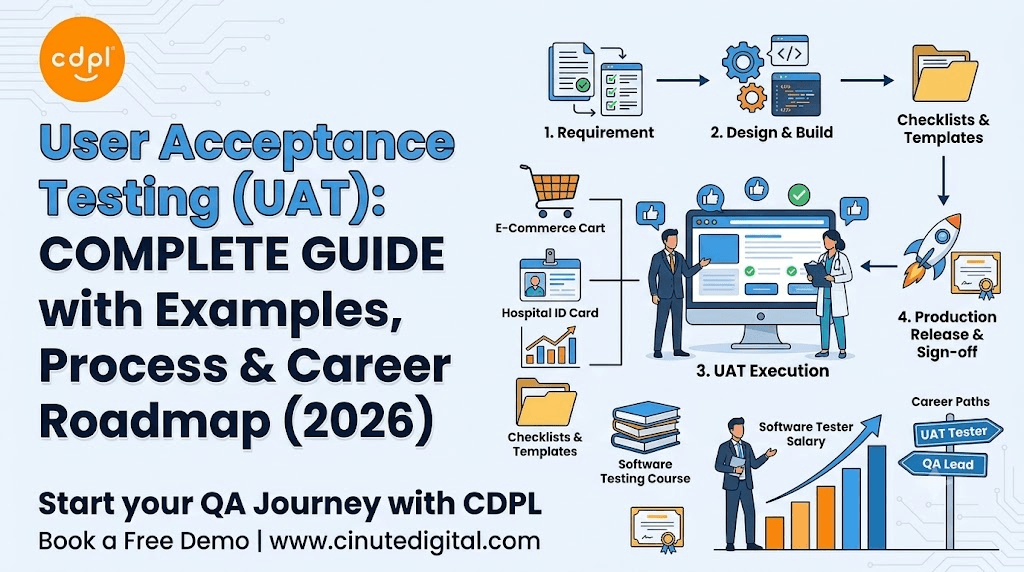
A complete, beginner-friendly guide to User Acceptance Testing (UAT): process, examples, checklist, template, interview questions, and a clear career roadmap to become a UAT tester or QA engineer.
Master User Acceptance Testing (UAT) with practical examples, checklists, templates, and interview prep plus a step-by-step roadmap to start your software testing career.
Introduction
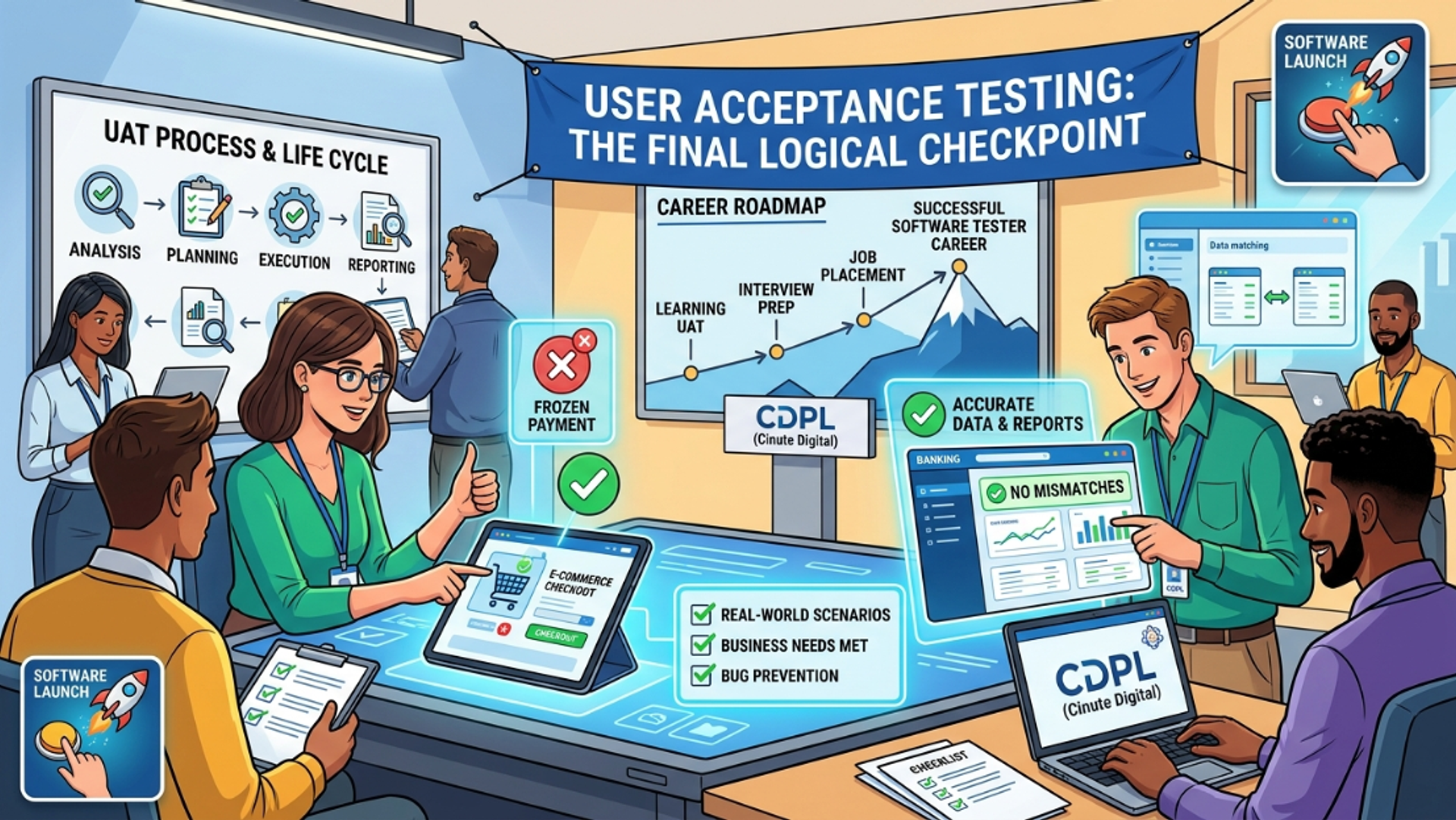
If you’ve ever used a banking app that froze at payment, an e-commerce site that didn’t save your cart, or a health portal that showed wrong data you’ve experienced the kind of issues User Acceptance Testing (UAT) is meant to catch before launch. cinutedigital
UAT is the final logical checkpoint where real users validate that software works as expected in their actual business environment. It’s not about “does it run?” but “does it solve the problem for the user?”
In this guide, you’ll get a complete, beginner-friendly explanation of what is User Acceptance Testing, how the UAT process and UAT life cycle work, real UAT examples, ready-to-use UAT checklists and templates, common UAT interview questions, and a clear roadmap to turn UAT skills into a software testing career with practical tips on how learning UAT from CDPL (Cinute Digital) can accelerate that journey.
What is UAT?
User Acceptance Testing (UAT), often called acceptance testing or end-user testing, is a type of software testing where actual users (clients, business stakeholders, or end users) test the system to confirm it meets their requirements and works in real-world scenarios. cinutedigital.edmingle
In simple terms:
- Developers and QA engineers test the system technically (functions, APIs, databases).
- UAT testers test the system from a business and usability perspective “Can I complete my task? Does the output match expectations? Is the workflow correct?”
UAT usually happens:
- After system testing and integration testing
- Before the final release to production
- In a environment that closely mirrors the real production setup
Key points:
- UAT is not about finding all bugs; it’s about validating that the software is acceptable for use.
- It’s typically manual, scenario-based, and focused on business processes.
- UAT results in a formal UAT sign-off, which is often a mandatory gate before launch.
If you’re starting your journey in testing, understanding UAT is essential because it sits at the boundary between technical quality and business value a key concept in any Software Testing Course or Manual Software Testing Course like those offered at CDPL.
Why is User Acceptance Testing Important?
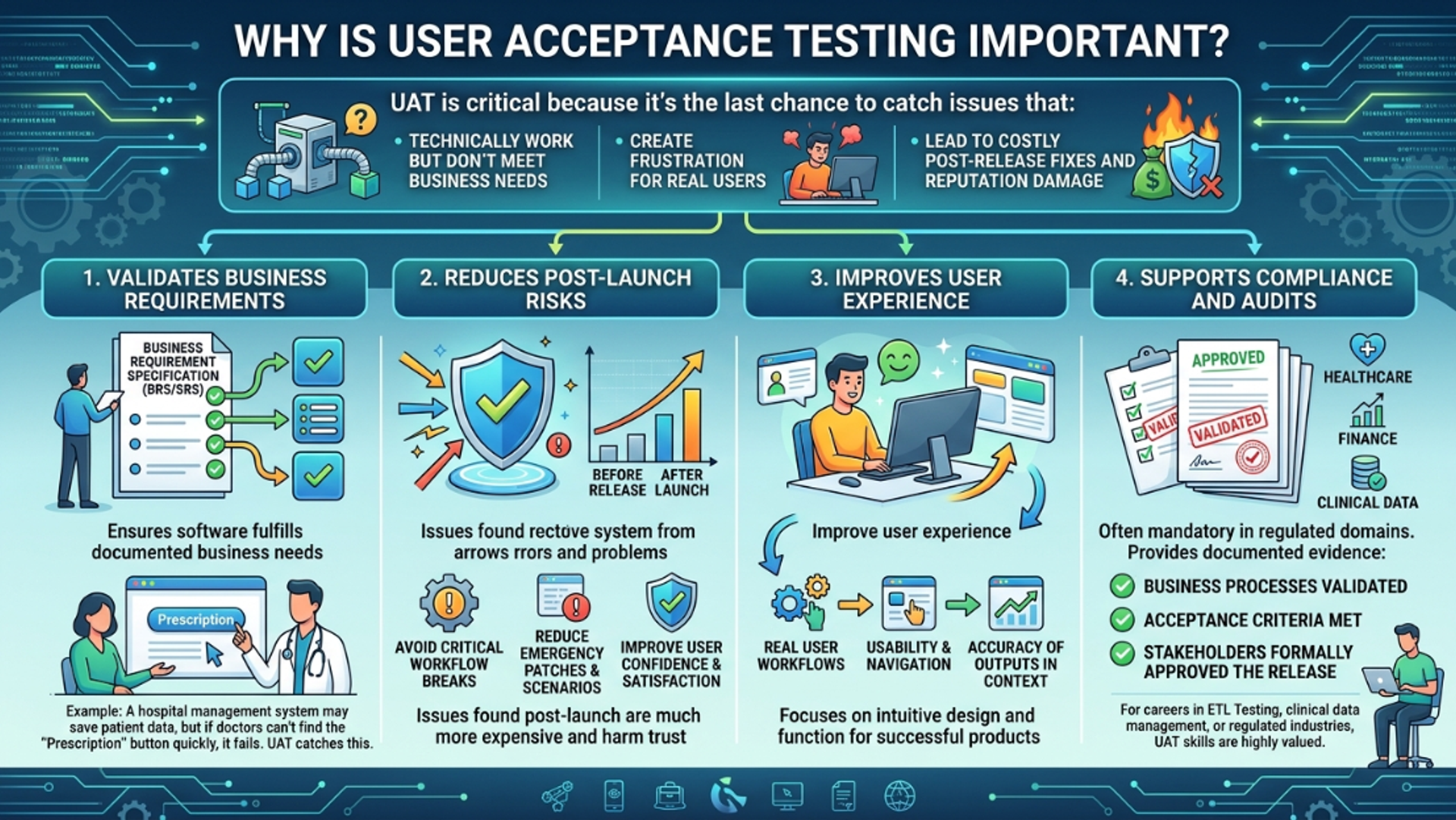
UAT is critical because it’s the last chance to catch issues that:
- Technically work but don’t meet business needs,
- Create frustration for real users,
- Or lead to costly post-release fixes and reputation damage.
1. Validates Business Requirements
UAT ensures that the software actually fulfills the business requirements documented in BRS (Business Requirement Specification) and SRS (Software Requirement Specification).cinutedigital.edmingle
Example:
A hospital management system may correctly save patient data (technical success), but if doctors can’t find the “Prescription” button quickly, the system fails its business purpose. UAT catches this.
2. Reduces Post-Launch Risks
Issues found after launch are much more expensive to fix and can harm customer trust. UAT helps:
- Avoid critical workflow breaks before release
- Reduce emergency patches and rollback scenarios
- Improve user confidence and satisfaction
3. Improves User Experience
UAT focuses on:
- Real user workflows
- Usability and navigation
- Accuracy of outputs in business context
This directly improves the end-user experience, which is often the difference between a successful product and one that gets rejected.
4. Supports Compliance and Audits
In regulated domains (healthcare, finance, clinical data), UAT is often a mandatory compliance step. It provides documented evidence that:
- Business processes were validated
- Acceptance criteria were met
- Stakeholders formally approved the release
For careers in ETL Testing, clinical data management, or regulated industries, UAT skills are highly valued.
Objectives of UAT
The main objectives of User Acceptance Testing are:
- Confirm that the system meets business requirements
- Validate that all critical business processes work as expected.
- Ensure the system is usable by real users
- Check usability, navigation, clarity of messages, and workflow efficiency.
- Verify that outputs and data are correct in business terms
- Example: Reports, invoices, calculations, and approvals match expectations.
- Identify gaps between expected and actual behavior
- Focus on business logic, not just technical correctness.
- Obtain formal UAT sign-off
- A documented approval that the system is ready for production.
These objectives are part of the QA lifecycle and Software Testing Life Cycle (STLC), which you’ll study in depth in any good Manual Testing Course or Software Testing Training program.cinutedigital+1
Who Performs UAT?
UAT is typically performed by:
- End users – people who will actually use the system daily.
- Business analysts – who understand requirements and business processes.
- Product owners / stakeholders – who represent the business side.
- QA testers (in some organizations) – acting as proxy users when real users are not available.
Ideal UAT Team
- 2–5 business users per major module
- 1 business analyst to clarify requirements
- 1 QA lead to coordinate test execution and defect tracking
In many companies, especially smaller ones, QA engineers help design UAT scenarios and support execution, but the final acceptance decision is taken by business stakeholders.
If you aim for UAT jobs or roles like QA Engineer, understanding who performs UAT and how they collaborate with QA is crucial for interviews and real projects.
Types of User Acceptance Testing
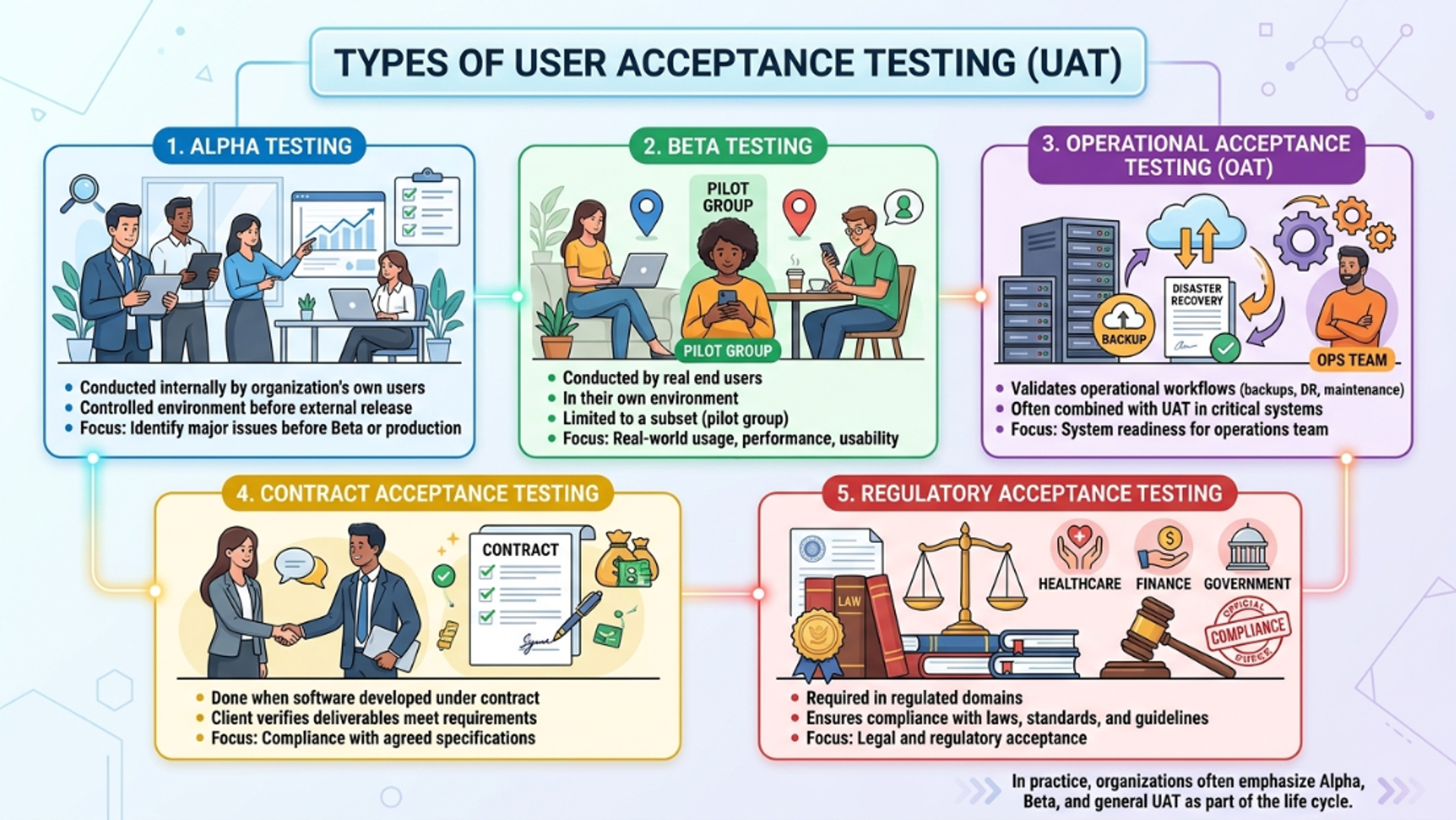
There are several types of User Acceptance Testing, each with a specific focus:
1. Alpha Testing
- Conducted internally by the organization’s own users (not external customers).
- Done in a controlled environment before releasing to external users.
- Focus: Identify major issues before beta or production.
2. Beta Testing
- Conducted by real end users in their own environment.
- Usually limited to a subset of users (pilot group).
- Focus: Real-world usage, performance, and usability.
3. Operational Acceptance Testing (OAT)
- Validates operational workflows like backups, disaster recovery, and maintenance.
- Often combined with UAT in critical systems.
- Focus: System readiness for operations team.
4. Contract Acceptance Testing
- Done when software is developed under a contract.
- The client verifies that deliverables meet contractual requirements.
- Focus: Compliance with agreed specifications.
5. Regulatory Acceptance Testing
- Required in regulated domains (healthcare, finance, government).
- Ensures compliance with laws, standards, and guidelines.
- Focus: Legal and regulatory acceptance.
In practice, many organizations mainly talk about Alpha, Beta, and general UAT as part of the UAT life cycle.
User Acceptance Testing Process
The UAT process is a structured approach to ensure that acceptance testing is effective and documented. A typical UAT process includes:
- Define UAT Scope and Objectives
- Identify which modules, processes, and business scenarios will be tested.
- Identify UAT Participants
- Select end users, business analysts, and stakeholders.
- Define Acceptance Criteria
- Clear, testable conditions that determine if a feature is accepted.
- Create UAT Test Scenarios and Test Cases
- Based on real business workflows.
- Prepare UAT Environment and Data
- Ensure environment mirrors production and data is realistic.
- Execute UAT
- Users run test cases, record results, and report issues.
- Track and Resolve Defects
- QA and developers fix issues; UAT users re-test.
- Obtain UAT Sign-Off
- Formal approval that the system is ready for release.
This process aligns with the QA lifecycle and SDLC, and is often covered in Software Testing Courses and Manual Testing Training programs.
Acceptance Criteria
Acceptance criteria are the specific conditions that a software product must meet to be accepted by users or stakeholders.
Characteristics of Good Acceptance Criteria
- Clear and unambiguous – No room for interpretation.
- Testable – Can be verified with a test case.
- Business-focused – Based on requirements, not technical details.
- Complete – Cover all critical scenarios.
Example
Feature: Online Payment
Acceptance criteria:
- User can select a payment method (Credit Card, UPI, Wallet).
- For valid payment details, the transaction is successful and an order is created.
- For invalid details, a clear error message is shown and the order is not created.
- Payment confirmation email is sent within 2 minutes.
These criteria become the basis for UAT test cases and UAT scenarios.
UAT Checklist
A UAT checklist helps ensure that all critical aspects are covered before and during UAT.
Common UAT Checklist Items
- UAT scope and objectives clearly defined
- Relevant business users identified and available
- Acceptance criteria documented per feature/module
- UAT test scenarios and test cases prepared
- UAT environment configured and stable
- Realistic test data prepared
- Defect tracking tool (e.g., JIRA) ready
- Roles and responsibilities communicated
- UAT execution plan and timeline agreed
- Communication process for reporting issues defined
- Sign-off criteria and format defined
- Backup plan for critical user availability
Using such a checklist reduces the risk of missing important steps and improves the quality of UAT. This is a practical skill you’ll practice in live projects during courses like the Manual Software Testing Course at CDPL.cinutedigital+1
UAT Template
A simple UAT template can be used to document test cases and results. Below is a basic structure you can adapt in Excel or a test management tool.
UAT Test Case Template
You can use this template as part of your UAT documentation and include it in your portfolio when applying for UAT jobs or QA Engineer roles. CDPL’s Manual Software Testing and Advanced Software Testing courses include such practical templates and project exercises.cinutedigital+1
Real-Life UAT Examples
Example 1: E-Commerce Order Flow
Scenario: A user places an order and pays online.
UAT Test Cases:
- User adds products to cart and proceeds to checkout.
- User enters valid shipping details and selects a payment method.
- For valid payment, order is created and confirmation email is sent.
- For invalid payment, order is not created and an error message is shown.
- User can view order history with correct status.
Acceptance Criteria:
- Order must be created only after successful payment.
- Email must be sent within 2 minutes.
- Wrong details must show clear error messages.
This is a classic UAT example used in many Software Testing Training programs.
Example 2: Hospital Patient Registration
Scenario: Front desk staff registers a new patient.
UAT Test Cases:
- Staff enters patient name, age, gender, and contact details.
- System validates mandatory fields.
- System generates a unique patient ID.
- Patient can be searched by name and ID.
- Duplicate registration is prevented.
Acceptance Criteria:
- Patient ID must be unique.
- Mandatory fields must not be empty.
- Search must return correct records.
Example 3: Banking Loan Approval
Scenario: A loan officer approves a loan application.
UAT Test Cases:
- Officer views pending loan applications.
- Officer checks customer details and credit score.
- Officer approves/rejects the application.
- System updates status and sends notification to customer.
- Approved loans appear in the “Approved Loans” dashboard.
Acceptance Criteria:
- Only authorized officers can approve loans.
- Status must update immediately.
- Notification must be sent within 5 minutes.
These examples show how UAT test cases and UAT scenarios are derived from real business processes a key skill in any Software Testing Course.
User Acceptance Testing in Agile
In Agile, UAT is not a separate phase at the end; it’s continuous and integrated into each sprint.
Key Points
- Acceptance criteria are defined for each user story before development starts.
- Product owners or business representatives perform UAT as part of sprint review.
- UAT happens before the story is marked as “Done”.
- Feedback is immediate, and defects are fixed in the next sprint.
Agile UAT Process
- Requirement refinement → define acceptance criteria.
- Development → unit and system testing by QA.
- Sprint review → business users perform UAT.
- If UAT passes → story marked Done.
- If UAT fails → defects logged and reworked.
Understanding UAT in Agile is important for modern QA roles, and this is often covered in advanced modules of Advanced Automation Testing and Manual + Automation Testing programs at CDPL. cinutedigital
User Acceptance Testing in Clinical Data Management
In clinical data management and healthcare systems, UAT in clinical data management is critical due to regulatory and compliance requirements.
Why It’s Important
- Patient data must be accurate and secure.
- Systems must comply with regulations (e.g., HIPAA, GDPR).
- Any error can impact patient safety and research outcomes.
Typical UAT Scenarios
- Patient registration and ID generation.
- Data entry for clinical trials.
- Report generation for study results.
- Audit trail verification (who changed what and when).
- Data export and import validation.
UAT Documentation
In regulated domains, UAT documentation must include:
- Test plans
- Test cases
- Execution logs
- Defect reports
- Final UAT sign-off document
This structured approach is part of ETL Testing and data validation workflows, which are covered in CDPL’s ETL Testing Course.cinutedigital+1
UAT Tools
While UAT is mostly manual, several tools help manage the process:
1. Test Management Tools
- JIRA – For defect tracking and UAT workflow.
- TestRail – For managing UAT test cases and results.
- MantisBT – Lightweight bug tracking.
2. Collaboration Tools
- Confluence – For UAT plans and documentation.
- SharePoint / Google Sheets – For UAT templates and checklists.
3. API & Automation Support (Optional)
- Postman – To validate API responses during UAT (especially for backend-heavy systems).
- REST Assured / Selenium – For limited automation of repetitive UAT checks.
CDPL’s API Testing using POSTMAN and Rest APIs course helps you understand how to validate APIs, which can be useful in modern UAT scenarios.
Common Challenges in UAT
Some common UAT challenges include:
- Lack of user availability
- Business users are busy; UAT gets delayed.
- Poorly defined requirements
- Acceptance criteria are vague or missing.
- Unrealistic test data
- Data doesn’t match real-world scenarios.
- Environment issues
- UAT environment is unstable or different from production.
- Unclear defect ownership
- Who fixes what, and how quickly?
How to Overcome
- Plan UAT timelines early and involve stakeholders.
- Use clear, testable acceptance criteria.
- Prepare realistic data and validate environment stability.
- Define roles, responsibilities, and SLAs for defect resolution.
Understanding and addressing these challenges is a key part of UAT best practices and is often discussed in Software Testing Classes and QA Training Institute programs like CDPL.cinutedigital.edmingle+1
UAT Best Practices
Here are some UAT best practices to improve the quality and effectiveness of your acceptance testing:
- Start UAT planning early
- Involve UAT participants during requirement discussions.
- Define clear acceptance criteria
- Make them testable and business-focused.
- Use real-world scenarios
- Base test cases on actual user workflows.
- Prepare realistic test data
- Avoid synthetic or too-simple data.
- Keep UAT environment close to production
- Reduce environment-related surprises.
- Document everything
- Test cases, results, defects, and sign-off.
- Communicate frequently
- Daily or weekly status updates with stakeholders.
- Prioritize critical issues
- Focus on business-impact defects first.
- Re-test after fixes
- Ensure resolved issues don’t break other flows.
- Get formal sign-off
- Never release without documented UAT approval.
These practices are part of standard QA certification frameworks like ISTQB, and CDPL prepares students for such certifications while teaching practical UAT skills.cinutedigital+1
User Acceptance Testing vs System Testing
Many people confuse UAT vs System Testing. Here’s a clear comparison:
In short:
- System testing ensures the system works correctly.
- UAT ensures the system is acceptable for real use.
Both are essential parts of the QA lifecycle and are covered in-depth in Manual Software Testing and Advanced Software Testing courses.cinutedigital+1
User Acceptance Testing vs SIT (System Integration Testing)
UAT vs SIT is another common interview question.
Understanding UAT vs SIT is important for roles like QA Engineer, Test Lead, and UAT tester, and is often part of UAT interview questions for freshers and experienced candidates.
Career in UAT
A career focusing on UAT can grow into broader Software Testing and Quality Assurance roles.
Common Roles
- UAT Tester
- QA Engineer
- Manual Test Engineer
- Automation Test Engineer (with UAT experience)
- Test Lead / QA Lead
- Business Analyst (with testing background)
Typical Responsibilities
- Designing UAT test scenarios and UAT test cases.
- Coordinating UAT with business users.
- Tracking and reporting defects.
- Validating fixes and re-testing.
- Preparing UAT documentation and obtaining UAT sign-off.
If you’re exploring how to become a UAT tester, the first step is to build strong manual testing skills and understand SDLC, STLC, and defect lifecycle all core topics in CDPL’s Manual Software Testing Course and Advanced Software Testing programs.cinutedigital+2
Software Tester Salary
Software tester salary in India varies by experience, skills, and location.
Approximate Ranges (INR)
- Fresher / UAT Tester: ₹2.5L – ₹4.5L per annum
- Manual QA Engineer (1–3 years): ₹4L – ₹8L per annum
- Automation QA Engineer (2–5 years): ₹6L – ₹12L per annum
- Test Lead / QA Lead (5+ years): ₹12L – ₹20L+ per annum
Salaries are higher in:
- Metro cities (Mumbai, Bangalore, Pune, Hyderabad)
- Companies with strong QA practices
- Roles combining UAT + automation + API testing
UAT skills alone may not define pay, but combining UAT with automation, API testing, and database testing significantly improves your market value. This is exactly why CDPL’s Manual + Automation Testing Master Program and API Testing courses are designed to make you job-ready for higher-paying roles.
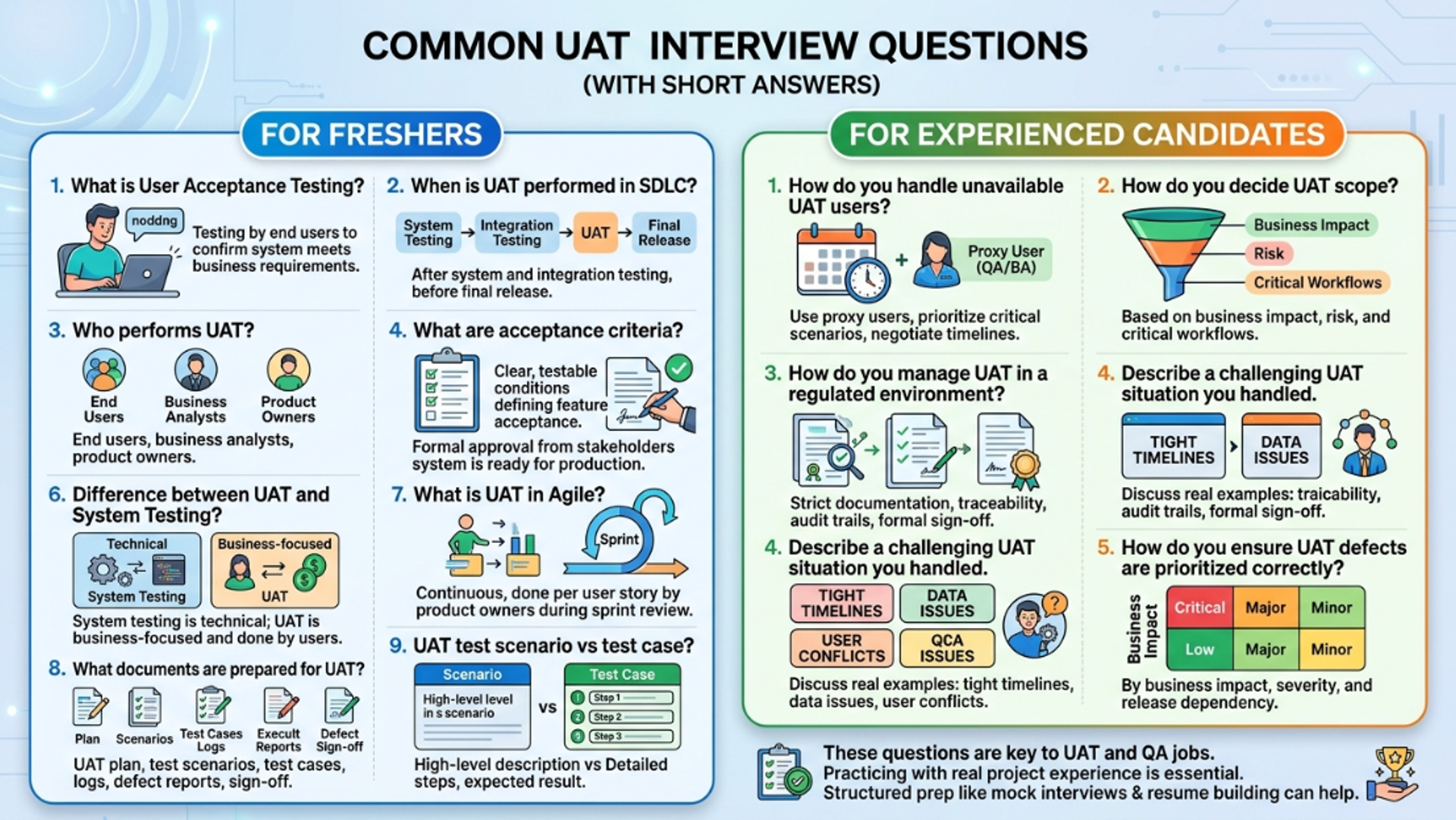
User Acceptance Testing Interview Questions
Here are common UAT interview questions (with short answers) for freshers and experienced candidates.
For Freshers
- What is User Acceptance Testing?
- UAT is testing by end users to confirm the system meets business requirements and is ready for use.
- When is UAT performed in SDLC?
- After system testing and integration testing, before final release.
- Who performs UAT?
- End users, business analysts, product owners; sometimes QA as proxy users.
- What are acceptance criteria?
- Clear, testable conditions that define when a feature is accepted.
- What is UAT sign-off?
- Formal approval from stakeholders that the system is ready for production.
- Difference between UAT and System Testing?
- System testing is technical; UAT is business-focused and done by users.
- What is UAT in Agile?
- UAT is continuous, done per user story by product owners during sprint review.
- What documents are prepared for UAT?
- UAT plan, test scenarios, test cases, execution logs, defect reports, sign-off document.
- What is a UAT test scenario?
- A high-level description of a business workflow to be tested.
- What is a UAT test case?
- Detailed steps, expected result, and actual result for a specific scenario.
For Experienced Candidates
- How do you handle unavailable UAT users?
- Use proxy users (QA/BAs), prioritize critical scenarios, and negotiate timelines.
- How do you decide UAT scope?
- Based on business impact, risk, and critical workflows.
- How do you manage UAT in a regulated environment?
- Strict documentation, traceability, audit trails, and formal sign-off.
- Describe a challenging UAT situation you handled.
- Discuss real examples: tight timelines, data issues, user conflicts, etc.
- How do you ensure UAT defects are prioritized correctly?
- By business impact, severity, and release dependency.
These questions are often part of UAT interview questions for freshers and experienced QA profiles. Practicing them along with real project experience is key to landing UAT jobs and QA Engineer roles.
If you want structured interview prep, CDPL’s placement support includes mock interviews, resume building, and career guidance tailored for testing roles.
Why Learn UAT from CDPL?
Mastering UAT is not just about reading definitions; it’s about:
- Understanding real business workflows,
- Practicing on live projects,
- Learning how to coordinate with users and developers,
- And building a portfolio that proves you can deliver.
CDPL (Cinute Digital) is an India-based EdTech institute that offers industry-focused training in Software Testing, Data Science, AI/ML, and Business Intelligence, with a strong emphasis on live projects, expert mentorship, and placement assistance.
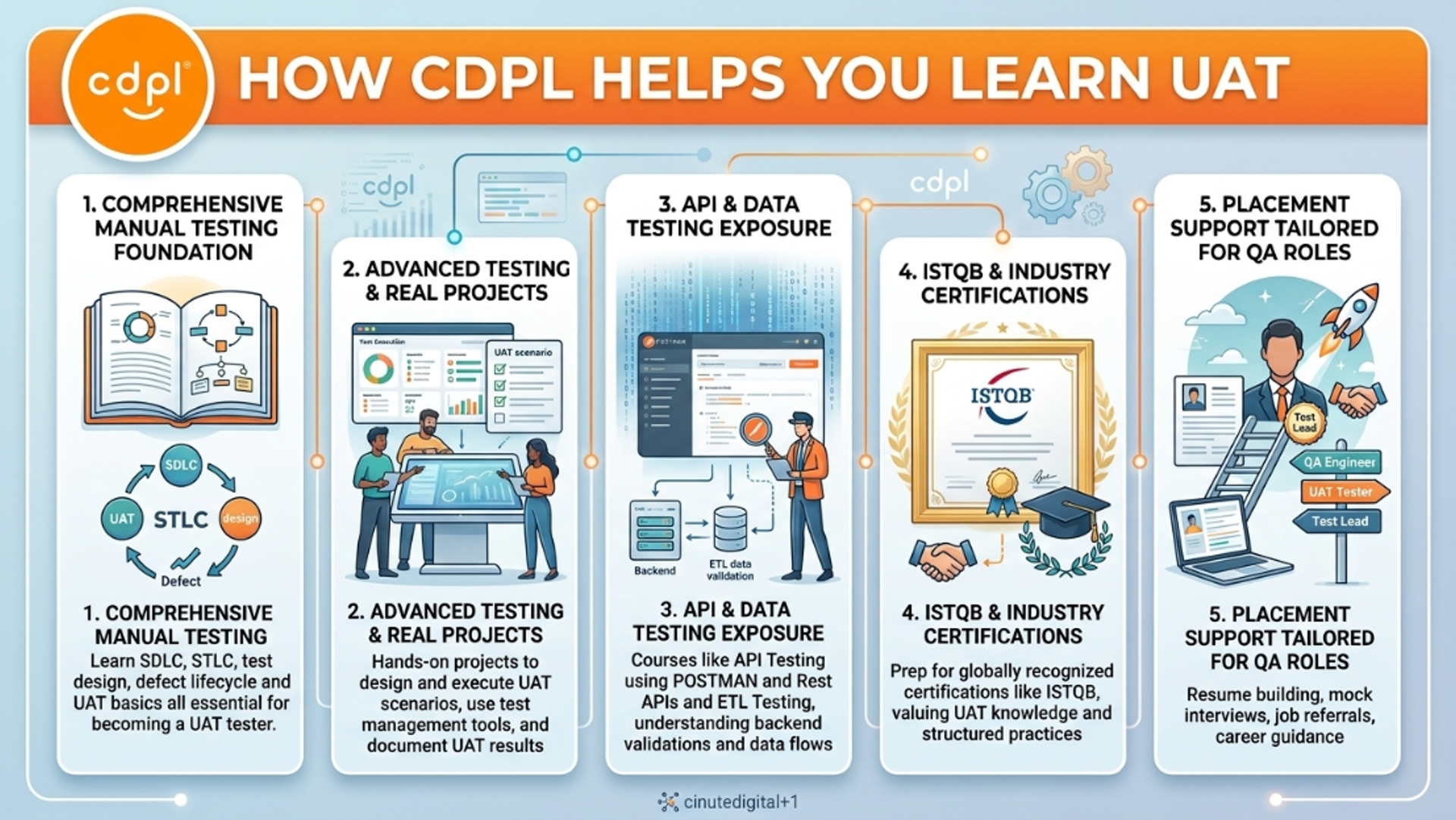
How CDPL Helps You Learn UAT
- Comprehensive Manual Testing Foundation
- In the Manual Software Testing Course, you learn SDLC, STLC, test design, defect lifecycle, and UAT basics all essential for becoming a UAT tester.
- Advanced Testing & Real Projects
- The Advanced Software Testing and Manual + Automation Testing Master Program include hands-on projects where you design and execute UAT scenarios, use test management tools, and document UAT results like in real jobs.
- API & Data Testing Exposure
- With courses like API Testing using POSTMAN and Rest APIs and ETL Testing, you understand how backend validations and data flows impact UAT, making you a more complete QA professional.
- ISTQB & Industry Certifications
- CDPL prepares students for globally recognized certifications like ISTQB, which value UAT knowledge and structured testing practices.
- Placement Support Tailored for QA Roles
- Resume building, mock interviews, job referrals, and career guidance specifically for QA Engineer, UAT Tester, and Test Lead roles.
Ideal For
- Students starting their career in Software Testing.
- Professionals looking to switch to QA / UAT roles.
- Anyone who wants practical, project-based learning instead of just theory.
If you’re ready to turn UAT knowledge into a job, you can explore CDPL’s Software Testing courses and book a free demo class to understand the training approach before enrolling.cinutedigital+2
Explore CDPL’s Software Testing Courses & Book a Free Demo
https://www.cinutedigital.com/
Frequently Asked Questions (FAQs)
1. What is User Acceptance Testing?
User Acceptance Testing (UAT) is the final phase of testing where real users validate that the software meets business requirements and is ready for production use. cinutedigital.edmingle
2. Why is User Acceptance Testing important?
UAT ensures that the system works in real business scenarios, reduces post-launch risks, improves user experience, and supports compliance in regulated domains.
3. What is the UAT process?
The UAT process includes defining scope, selecting users, setting acceptance criteria, creating test cases, executing tests, tracking defects, and obtaining sign-off. cinutedigital.edmingle
4. What is the UAT life cycle?
The UAT life cycle typically follows: Planning → Scenario/Test Case Design → Environment Setup → Execution → Defect Tracking → Re-testing → Sign-off.
5. What are UAT test cases and UAT test scenarios?
- UAT test scenario: High-level business workflow (e.g., “Place an order”).
- UAT test case: Detailed steps, expected result, and actual result for that scenario.
6. What is UAT sign-off?
UAT sign-off is a formal approval from stakeholders that the system is acceptable for release, usually documented in a sign-off report or email.
7. What is a UAT template?
A UAT template is a structured document (often in Excel) to record UAT test cases, results, defects, and sign-off comments.
8. What is a UAT checklist?
A UAT checklist is a list of critical items to verify before and during UAT, such as scope, environment, data, roles, and sign-off criteria.
9. What is UAT in Agile?
In Agile, UAT is done continuously per user story by product owners during sprint review, with acceptance criteria defined before development.
10. What is UAT in clinical data management?
UAT in clinical data management validates that clinical systems handle patient and trial data correctly, securely, and in compliance with regulations.
11. What are UAT interview questions?
Common UAT interview questions include: “What is UAT?”, “When is UAT performed?”, “Who performs UAT?”, “Difference between UAT and System Testing?”, and “Explain UAT process”.
12. What are UAT jobs?
UAT jobs include roles like UAT Tester, QA Engineer, Manual Test Engineer, and Test Lead, where acceptance testing is a key responsibility.
13. How to become a UAT tester?
- Learn manual testing fundamentals (SDLC, STLC, test design).
- Understand UAT process, acceptance criteria, and UAT documentation.
- Practice on real projects (via courses like CDPL’s Manual Software Testing Course).
- Prepare for interviews using UAT interview questions and build a portfolio.
14. What is the difference between UAT and System Testing?
- System testing is technical, done by QA.
- UAT is business-focused, done by end users, and leads to sign-off. cinutedigital.edmingle
15. What is the difference between UAT and SIT?
- SIT verifies integration between components.
- UAT verifies business acceptance and is done after SIT. cinutedigital.edmingle
Conclusion + CTA
User Acceptance Testing (UAT) is the bridge between technical quality and business value. It ensures that software not only works but also solves real problems for real users.
By mastering:
- The UAT process and UAT life cycle,
- How to create UAT test scenarios, UAT test cases, UAT checklists, and UAT templates,
- And understanding UAT in Agile, UAT in clinical data management, and UAT vs System Testing / SIT,
you can position yourself strongly for UAT jobs, QA Engineer roles, and broader Software Testing careers.
If you want to turn this knowledge into practical skills and real project experience, the next step is structured, project-based training with placement support.
Start your UAT & Software Testing journey with CDPL
Explore courses like Manual Software Testing, Advanced Software Testing, API Testing, and ETL Testing, and book a free demo class to see how CDPL’s live, project-driven approach works.
Tags

Cezzane Khan is a dedicated and innovative Data Science Trainer committed to empowering individuals and organizations.