
Easy Advanced Testing Metrics for Students


Mastering software testing isn't just about finding bugs; it's about proving your value. Learn the easy advanced testing metrics that will help you land your first QA job in 2026.
A comprehensive, friendly, and motivational guide designed specifically for students and IT beginners. Breaks down complex QA industry metrics into simple, actionable concepts to help secure high-paying jobs in software testing.
Let’s be honest for a second. You’re looking at software testing job descriptions, and you’re feeling a little overwhelmed.
You know what a "bug" is. You understand basic manual testing. But then you see terms like "Defect Density," "Test Execution Coverage," and "Automation ROI" in the requirements. Suddenly, the imposter syndrome kicks in. You might be wondering, “Is software testing getting too hard? Will I be able to compete with hundreds of other applicants?”
Take a deep breath.
The truth is, the IT industry in 2026 has evolved. Basic manual testing isn't always enough to make your resume jump to the top of the pile. Companies don't just want testers who can find bugs; they want testers who can prove their value using data. But here is the secret most seniors won't tell you: these metrics sound incredibly complicated, but they are actually very easy to understand.
In this guide, we are going to break down easy advanced testing metrics for students. We’ll strip away the jargon, look at real-life examples, and show you exactly how mastering these simple numbers can fast-track your career from a struggling beginner to a highly-paid QA professional.
If you are ready to stop guessing and start learning, let's dive in. (And if you want a structured path to mastering these skills practically, you can always start your career with our complete software testing course).
What Are Testing Metrics and Why Do They Matter in 2026?
Imagine you are trying to lose weight. If you never step on a scale, never track your calories, and never measure your daily steps, how do you know if your diet is working? You don't. You are just guessing.
Software testing is exactly the same. Testing metrics are simply the "scale" we use to measure the health of our software and the quality of our testing team.
In 2026, companies are obsessed with speed and efficiency. They are releasing new software updates every single week. Because of this, QA managers are actively looking for candidates who understand metrics. Why?
- It proves you are a professional: Anyone can click buttons. A professional measures the impact.
- It saves money: Metrics help teams find out where bugs are hiding, saving the company thousands of dollars.
- It guarantees job security: When you can show a boss a chart that proves your testing increased software quality by 40%, you become irreplaceable.
Breaking Down "Advanced" Metrics (The Easy Way)
Let's look at the core metrics you need to know. Don't worry about the complex names; focus on the simple concepts.
1. Defect Density (Where are the bugs hiding?)
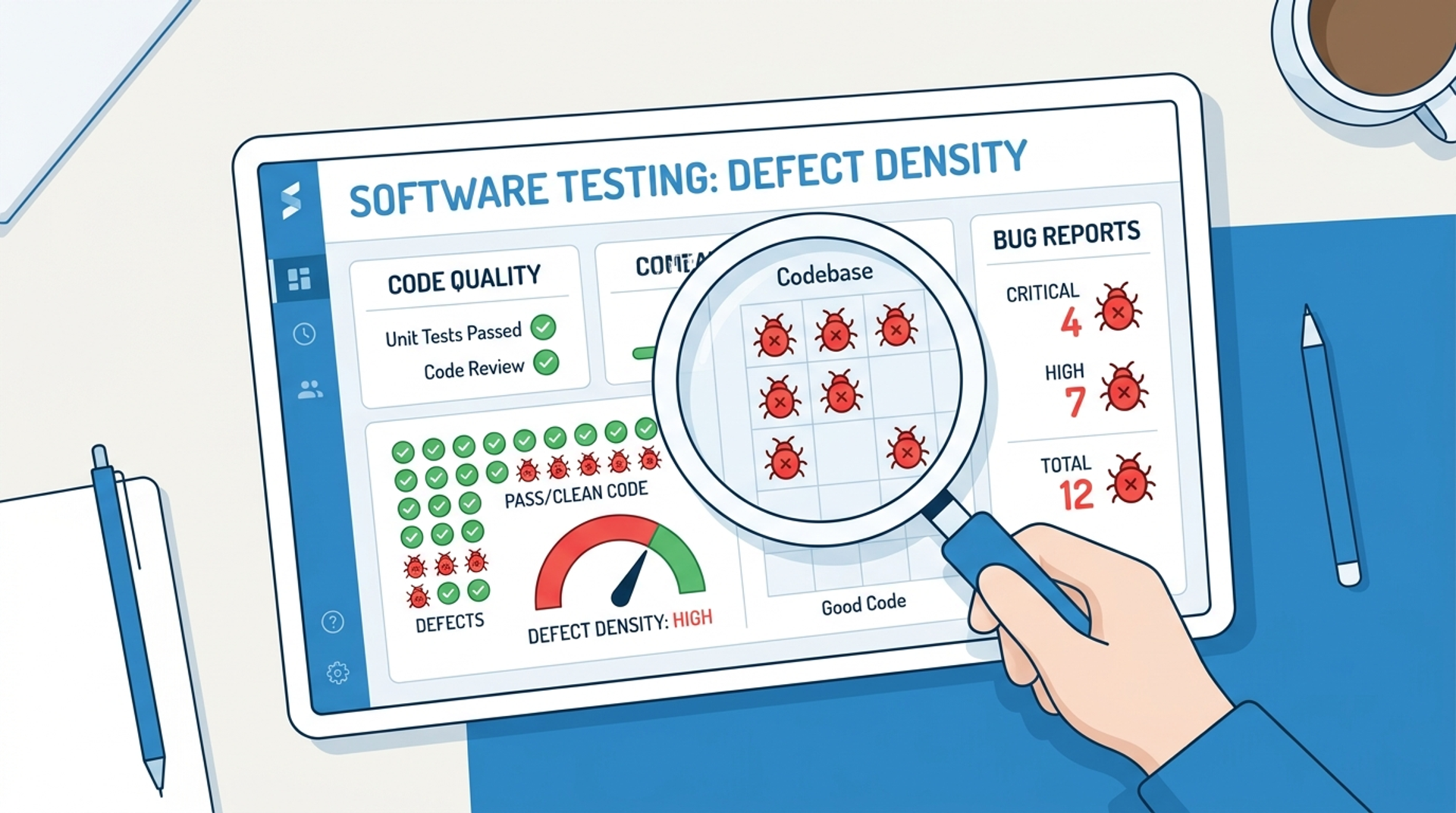
What it sounds like: A complex mathematical physics formula. What it actually is: How many bugs exist in a specific piece of the software?
Imagine you have a 10-page website. You find 20 bugs.
- 18 bugs are on the "Checkout Page."
- 2 bugs are on the "Contact Us" page.
The Defect Density of the Checkout Page is massive. This tells developers, "Hey, whatever code you used for the checkout is broken. We need to focus our attention there."
Real-Life Student Example: You test a mobile calculator app. The addition, subtraction, and multiplication work flawlessly. But every time you press division, it crashes. The defect density for the division module is high. (Want to learn how to track this in real industry tools like Jira? Join our beginner-friendly QA training to get hands-on experience).
2. Defect Leakage / Escape Ratio (Did we mess up?)
What it sounds like: A chemical spill. What it actually is: How many bugs sneaked past the QA team and reached the actual customers?
This is the scariest metric for a tester, but the most important to track. If your team finds 90 bugs before the software launches, but customers find 10 bugs after they download it... your Defect Leakage is 10%.
Why it matters: If this number goes up, it means your testing strategy has a hole in it. You need to update your test cases. Understanding this metric shows interviewers that you care about the end-user experience, not just ticking boxes.
3. Test Execution Coverage (Did we check everywhere?)
What it sounds like: Insurance policy jargon. What it actually is: Out of all the things we planned to test, how many did we actually test?
If you wrote 100 test cases for a new login screen, but you only had time to run 80 of them before the deadline, your Test Execution Coverage is 80%.
Why it matters: It tells the project manager the level of risk. If coverage is only 50%, releasing the software is a huge gamble.
4. Mean Time to Detect (MTTD) & Mean Time to Resolve (MTTR)
What it sounds like: Advanced server management. What it actually is: How fast did we find the bug (MTTD), and how fast did the developers fix it (MTTR)?
Companies want these numbers to be as low as possible. If it takes your team 3 weeks to realize a shopping cart is broken, the company loses a lot of money.
(Learning how to reduce these times using automation is a highly paid skill. You can learn automation step-by-step in our advanced modules).
Career Opportunities & Salary Potential

You might be asking, "If I learn this, what's in it for me?"
The gap between a "Manual Tester" and a "QA Analyst" usually comes down to understanding data and metrics.
- The Competition: Right now, thousands of freshers are applying for entry-level testing jobs with the exact same resume: "I know manual testing and SDLC."
- The Opportunity: If your resume says: "Proficient in calculating Defect Density, tracking Test Coverage, and utilizing QA metrics to improve release cycles," you instantly jump into the top 5% of candidates.
Because metric-driven testers bring strategic value, they transition much faster into roles like QA Lead, Automation Engineer, or QA Manager, where salaries are significantly higher and career stability is guaranteed.
Common Mistakes Students Make with Metrics
Before you start dropping these terms in an interview, be careful to avoid these classic beginner traps:
- Trying to memorize the formulas instead of the concept: Interviewers don't want you to recite a math equation. They will ask, "If our defect leakage is high, what would you do?" They want to see your problem-solving skills, not your memorization.
- Tracking everything: Beginners think tracking 50 metrics is better than 5. It's not. "Metric overload" leads to confusion. Focus on 3 to 5 key metrics that actually impact the business.
- Failing to learn the tools: You don't calculate these on a piece of paper. You use tools. If you don't know how to generate a metrics report in bug-tracking software, the theory won't help you much. (We cover exactly how to generate these reports in our corporate-level testing syllabus).
Step-by-Step Roadmap to Start Learning Today
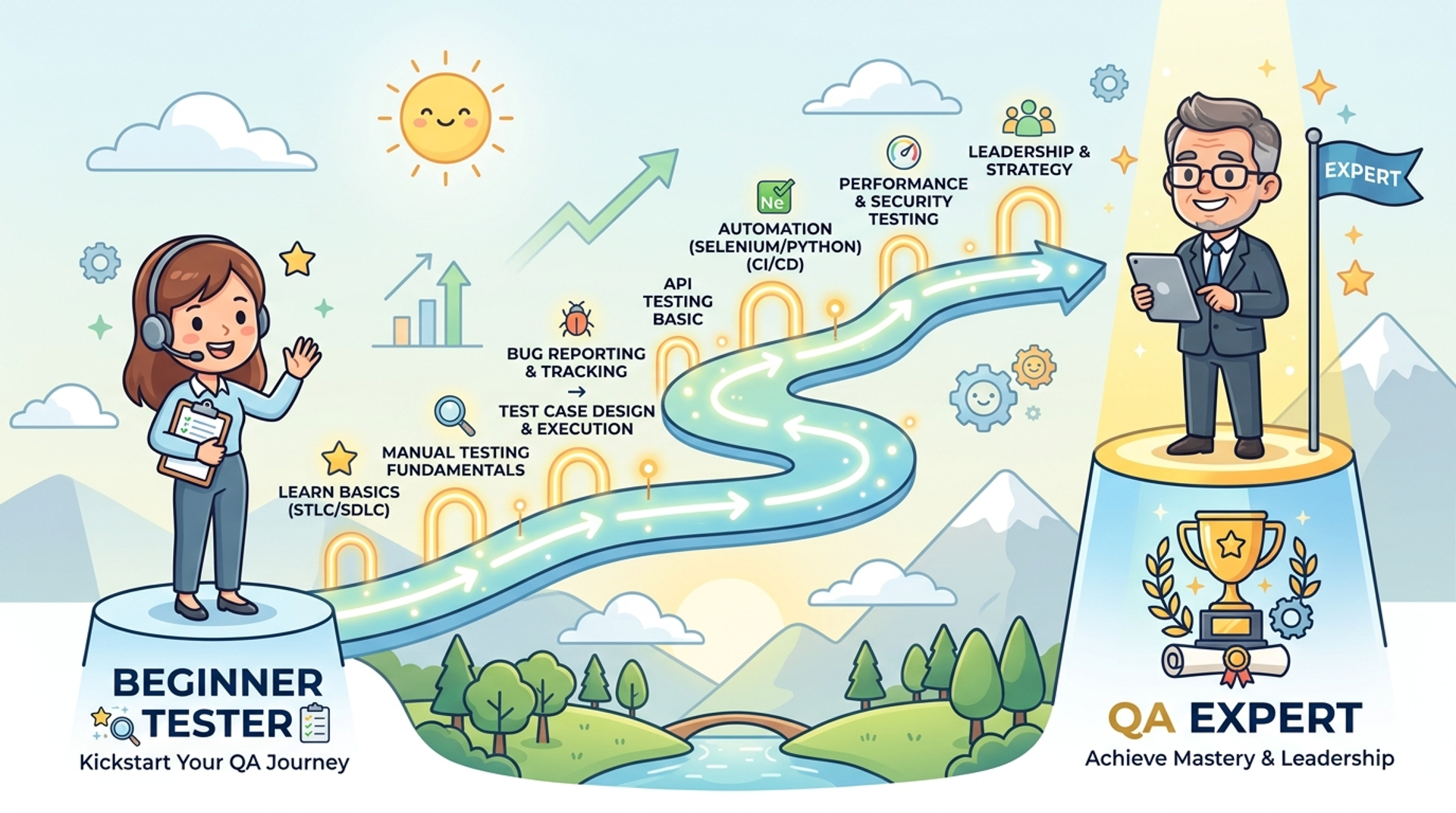
Ready to take action? Here is a simple, zero-overwhelmed roadmap for beginners:
- Step 1: Grasp the Fundamentals. Don't rush. Make sure you deeply understand the Software Testing Life Cycle (STLC) first. You can't measure a process you don't understand.
- Step 2: Master Jira or BugZilla. These are the industry standard tools. Learn how to log a bug properly, assign it, and change its status.
- Step 3: Create a Mock Project. Take a website you use every day (like Amazon or a local food delivery site). Write 20 test cases. Execute them. Now, calculate your Test Execution Coverage and Defect Density on paper.
- Step 4: Learn to build a Dashboard. Look into tools like Jira Dashboards to see how metrics are visualized into pie charts and graphs for managers.
- Step 5: Get Professional Guidance. Self-learning is great, but having an expert review your work speeds up your job hunt by months. Enroll in our dedicated QA placement program to get your hands on real, live projects.
Top Tools to Learn for QA Metrics

You don't need to buy expensive software. Start with these standard tools:
- Jira: The absolute king of bug tracking and Agile metrics.
- TestRail / Zephyr: Excellent for managing test cases and tracking coverage.
- Excel / Google Sheets: Never underestimate the power of a good spreadsheet for calculating defect density!
Frequently Asked Questions (Student Focus)
Q1. Do I need to be good at math to understand testing metrics?
Not at all! Basic addition, subtraction, and simple percentages are all you need. The software tools do the heavy lifting for you.
Q2. Can I get an entry-level job without knowing advanced metrics?
Yes, it is possible. However, knowing these metrics helps you beat the massive competition and often allows you to negotiate a better starting salary.
Q3. Are testing metrics used in Agile or Waterfall?
They are heavily used in Agile! Because Agile moves so fast (in sprints), metrics are vital to ensure quality isn't dropping as the team speeds up.
Q4. Where can I practice creating these reports?
You can set up a free Jira account for yourself and practice logging fake bugs, or you can join a guided training program, like our Advanced Software Testing Certification, where we provide live sandbox environments.
Conclusion: Don't Let the Jargon Stop You
The IT industry is filled with scary-sounding words designed for simple concepts. "Advanced software testing metrics" are nothing more than simple ways to prove that you are doing a great job.
By taking the time to learn these concepts now, while you are still a student or beginner, you are building a massive competitive advantage. You aren't just learning how to break software; you are learning how to improve the entire engineering process.
The best time to start was yesterday. The second best time is today.
If you are serious about building a high-paying, stable career in IT, we are here to help. Join our comprehensive software testing course today, and let us help you turn these theories into practical skills that get you hired.
Tags

A Manual Tester in TESTRIQ QA LLP and also as Corporate Trainer with CDPL. With a focused career in training and development.