
What is AI Citation? Complete Guide to Getting Cited by ChatGPT, Gemini & AI Overviews (2026)
AI search is replacing clicks with citations. Here's what AI citation (GEO/AEO) really means, how ChatGPT and Google AI Overviews decide what to quote, and the steps to get your content cited in 2026.
How ChatGPT, Gemini, and Google AI Overviews decide what to cite and how to get your content featured in 2026.
Search behavior has quietly changed. A growing share of people no longer type a query into Google and scroll through ten blue links they ask ChatGPT, Perplexity, or Google's AI Overview a question and expect a direct, cited answer. When that answer includes your brand name, your data, or a link to your website, that's called an AI citation.
If you work in marketing, content, or SEO or you're planning to understanding AI citation isn't optional anymore. It's becoming as fundamental as keyword research was in 2015.
In this guide, we'll break down what AI citation actually means, why it's replacing parts of traditional SEO, exactly how large language models (LLMs) decide what to cite, and a step-by-step framework to get your own content cited. We'll also look at what this shift means for your career if you're considering a role in digital marketing or AI-driven content strategy.
What is AI Citation?
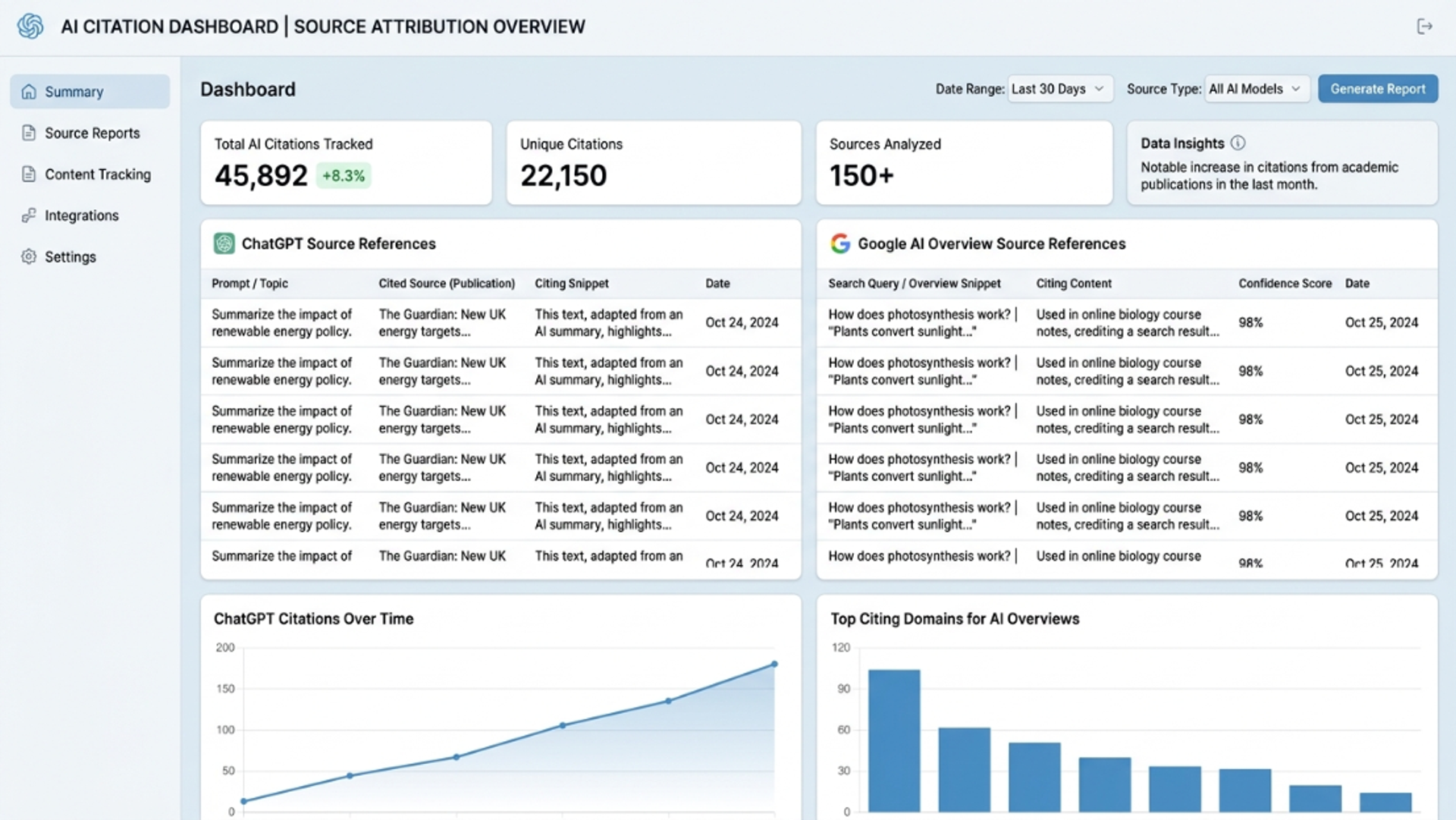
AI citation refers to the moment a generative AI tool such as ChatGPT, Google's AI Overviews, Microsoft Copilot, Perplexity, or Gemini references, quotes, or links to your website, brand, or content while answering a user's question.
Unlike a traditional search ranking, an AI citation doesn't just place your page in a list. It embeds your brand's information directly inside the AI's generated answer, often with a clickable source link. This is why the discipline built around earning these citations is called:
- GEO (Generative Engine Optimization) - optimizing content so generative AI tools surface it in their answers
- AEO (Answer Engine Optimization) - optimizing content to directly answer questions AI systems are likely to be asked
- LLM SEO - the broader practice of making content readable, trustworthy, and extractable by large language models
These terms are often used interchangeably, but they all point to the same goal: being the source an AI trusts enough to mention.
Why AI Citation Matters More in 2026
A few years ago, AI citation was a nice-to-have. In 2026, it's become central to visibility for three clear reasons:
- Zero-click answers are the new normal. Users increasingly get their answer inside the AI Overview or chat response itself, without clicking through which means if you're not cited, you're invisible for that query entirely.
- AI tools are becoming the first stop for research. Students, professionals, and buyers are asking AI assistants before they open a search engine, especially for "how to," comparison, and career-related queries.
- Citations carry more trust than ranking position. Being named as a source inside an AI-generated answer signals authority in a way a page-three Google ranking never could.
For businesses and for marketers building a career in this space the practical upshot is simple: if your content isn't structured to be understood, extracted, and trusted by AI models, you're losing visibility even if your traditional SEO is strong.
How AI Models Decide What to Cite
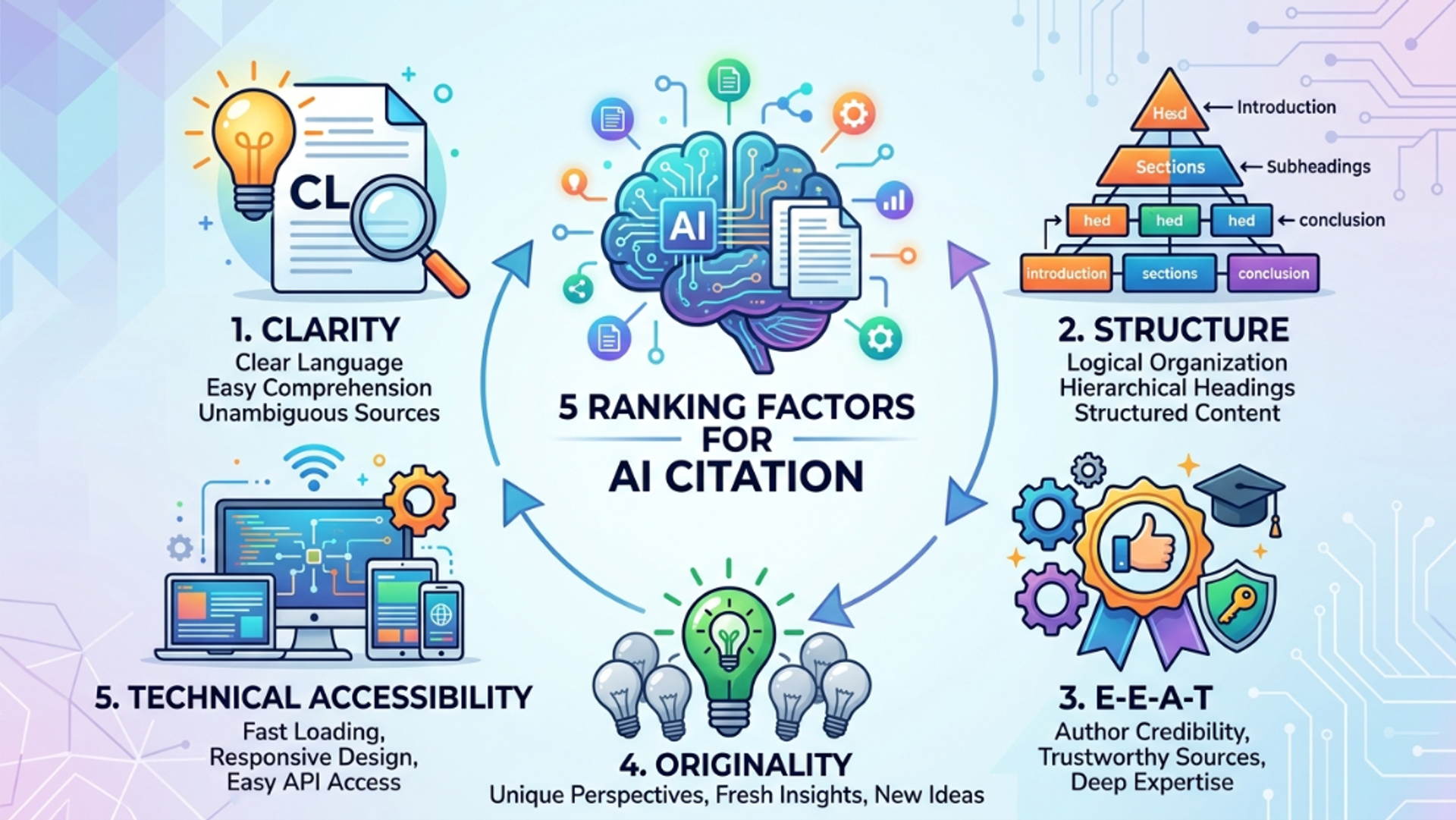
Large language models don't rank pages the way Google's algorithm does. When an AI tool answers a question, it typically pulls from a combination of its training data and live web retrieval, then decides which sources are reliable enough to cite. Research and industry testing point to a consistent set of factors:
1. Clarity and directness of the answer
AI models favor content that answers a question in the first few sentences, in plain language, without requiring the reader to infer meaning. Burying the answer under long introductions hurts your citation chances.
2. Structured, scannable formatting
Headers, bullet points, numbered steps, tables, and FAQ sections make it far easier for an AI model to extract a clean, quotable answer. Unstructured walls of text are much harder to cite accurately.
3. Demonstrated E-E-A-T
This is where Experience, Expertise, Authoritativeness, and Trustworthiness come in the same framework Google has used for years, now equally critical for AI systems:
- Experience: First-hand knowledge, real examples, or original case studies
- Expertise: Content written or reviewed by someone with credible subject knowledge
- Authoritativeness: Recognition from other trusted sites, mentions, and backlinks
- Trustworthiness: Accurate, up-to-date, transparent information with clear sourcing
4. Original data and unique insight
AI tools are trained to avoid repeating the same generic explanation every other page already gives. Original statistics, proprietary research, first-hand case studies, or unique frameworks significantly increase citation likelihood.
5. Technical accessibility
If an AI crawler can't easily read your page due to heavy JavaScript rendering, blocked crawlers, or missing structured data it can't cite you, no matter how good the content is.
AI Citation vs. Traditional SEO: What's Different
Importantly, AI citation doesn't replace SEO it builds on it. Strong technical SEO, backlinks, and site authority still matter because they're part of what AI systems use to judge trustworthiness. Think of GEO as the next layer on top of solid SEO fundamentals, something CDPL covers in depth inside its Digital Marketing and Analytics Master Program.
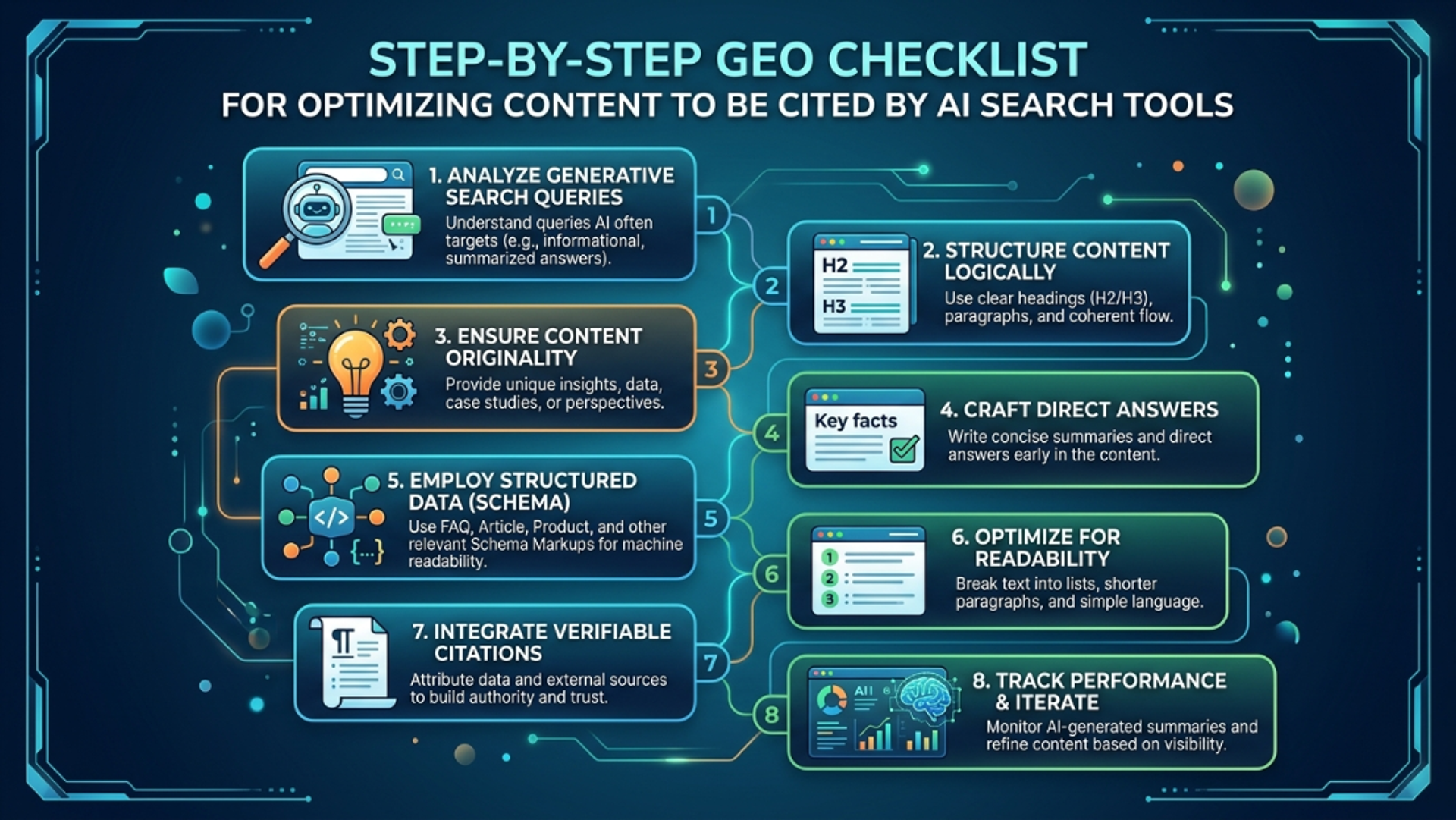
Step-by-Step: How to Optimize Your Content for AI Citations
Step 1: Answer the question in the first 2–3 sentences
Structure every page or blog post so the core answer appears immediately after the heading, before background or context. AI models frequently lift this opening section verbatim as the cited snippet.
Step 2: Use clear, semantic headers (H2/H3)
Break content into logical sections using descriptive headers that mirror how people actually phrase questions "What is X," "How does X work," "Why does X matter." This mirrors how AI models parse and retrieve information.
Step 3: Add FAQ sections with structured data
FAQ blocks marked up with schema (FAQPage schema) are among the most frequently cited content formats by AI Overviews and chatbots, because they're already formatted as direct question-answer pairs.
Step 4: Include original data, examples, or case studies
Wherever possible, add a statistic you've calculated, a mini case study, or a first-hand example. Generic, recycled explanations rarely get picked over content that offers something new.
Step 5: Strengthen author and reviewer credibility
Add a visible author bio with relevant credentials, and where possible, a "reviewed by" line from a subject expert. This is a direct E-E-A-T signal AI systems increasingly weigh when evaluating trustworthiness.
Step 6: Earn mentions on high-authority third-party sites
Digital PR, guest contributions, and citations from respected publications feed both traditional backlink authority and the broader "authoritativeness" signal AI models draw on when cross-referencing sources.
Step 7: Keep technical SEO clean
Ensure fast load times, proper indexing, clean HTML structure, and schema markup (Article, FAQ, HowTo, Organization) so AI crawlers can access and parse your content without friction.
Step 8: Monitor and iterate
Regularly test your target queries inside ChatGPT, Perplexity, and Google AI Overviews to see whether and how your brand is being cited, then refine underperforming pages.
Tools Marketers Use to Track AI Citations
As GEO has matured, a new category of monitoring tools has emerged alongside traditional SEO platforms, generally used to:
- Track how often a brand or domain is cited across ChatGPT, Gemini, Perplexity, and AI Overviews
- Compare citation share of voice against competitors
- Identify which pages are being pulled into AI answers and which are being ignored
- Flag content gaps where competitors are cited but your brand isn't
Pairing these tools with standard analytics (to track referral traffic from AI platforms) gives a fuller picture of how AI citation is affecting real business outcomes not just visibility, but actual visits and conversions.
Common Mistakes That Hurt AI Citation
- Writing keyword-stuffed intros - instead of directly answering the query AI models skip past fluff
- Ignoring schema markup - making it harder for crawlers to understand page structure
- Ignoring author credibility signals - which weakens E-E-A-T evaluation
- Publishing without updating - since AI tools favor current, well-maintained information over outdated pages
- Blocking AI crawlers accidentally - through overly restrictive robots.txt rules
What This Means for Your Career
AI citation optimization is fast becoming a specialized, in-demand skill inside digital marketing teams sitting somewhere between SEO, content strategy, and AI literacy. Recruiters are increasingly looking for marketers who can:
- Audit content for AI-readiness alongside traditional SEO
- Apply structured data and schema strategically
- Use AI tools themselves to research, draft, and optimize content
- Understand E-E-A-T at a practical, applied level, not just theoretically
If you're building a career in this space, it's worth pairing core digital marketing skills with hands-on AI training. CDPL's Digital Marketing With AI Bootcamp and Prompt Engineering with Gen AI course are both designed around exactly this shift combining traditional marketing fundamentals with the AI-first skills employers are now screening for.
Show Image Image 4 alt text: "Digital marketing student learning AI-driven SEO and GEO strategies in a live classroom"
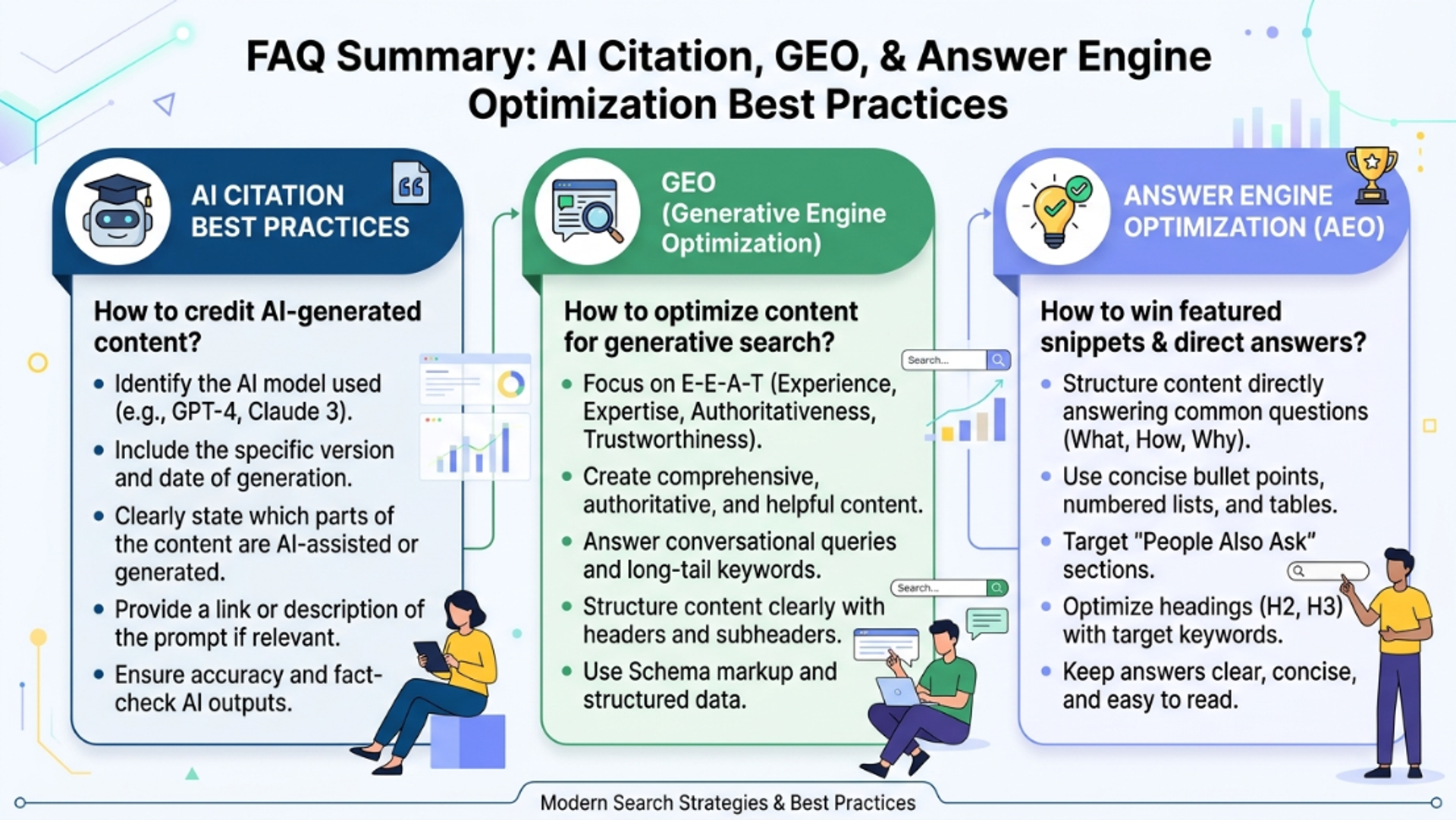
Frequently Asked Questions
Q1. Is AI citation the same as SEO?
No, but they're closely related. Traditional SEO focuses on ranking in search engine results, while AI citation (GEO/AEO) focuses on being quoted or referenced inside an AI-generated answer. Strong SEO fundamentals site speed, backlinks, structured data support AI citation, but the content structure itself needs additional optimization to be "extractable" by LLMs.
Q2. Can I track whether my website is being cited by ChatGPT or Google AI Overviews?
Yes. You can manually test relevant queries inside each AI tool and note whether your brand or URL appears, or use dedicated AI-citation tracking platforms that monitor this at scale across multiple AI engines.
Q3. Does AI citation replace the need for backlinks?
No. Backlinks remain an important authority signal that AI models factor into how trustworthy a source appears. GEO adds an additional content-structure layer on top of, not instead of, backlink-building.
Q4. How long does it take to start getting AI citations?
It varies by domain authority and content quality, but well-structured, original content on a credible site can start appearing in AI answers within weeks, especially for niche or specific queries with less competition.
Q5. What's the single most important factor for AI citation?
Directly and clearly answering the query within the first few sentences, backed by credible, well-sourced information, consistently ranks as the most influential factor across GEO research and testing.
Final Thoughts
AI citation isn't a passing trend it's a structural shift in how information gets discovered and trusted. Brands and marketers who adapt their content strategy now, by prioritizing clarity, structure, originality, and genuine expertise, will be the ones AI tools reach for when answering the questions your future customers are already asking.
If you want to build these skills professionally combining digital marketing fundamentals with practical AI and prompt engineering training explore CDPL's Digital Marketing and AI courses or browse more guides on our Digital Marketing blog and AI & Machine Learning blog.
Tags

SEO Analyst & Digital Marketing Specialist helping brands grow organically through smart strategy, data-driven insights, and powerful content.