
Email Marketing Automation: The Complete 2026 Guide to Boosting Engagement, Conversions & Career Opportunities
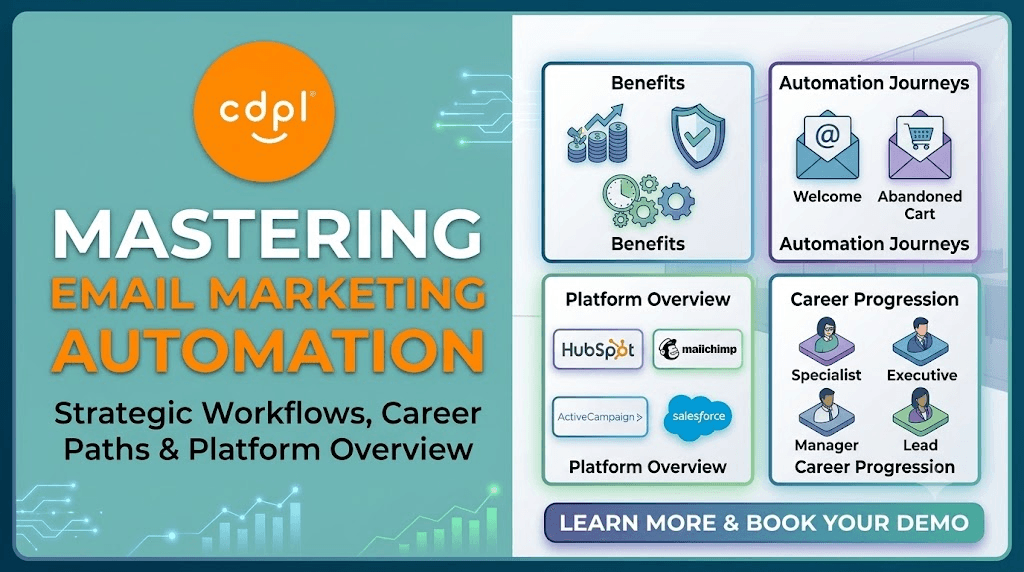
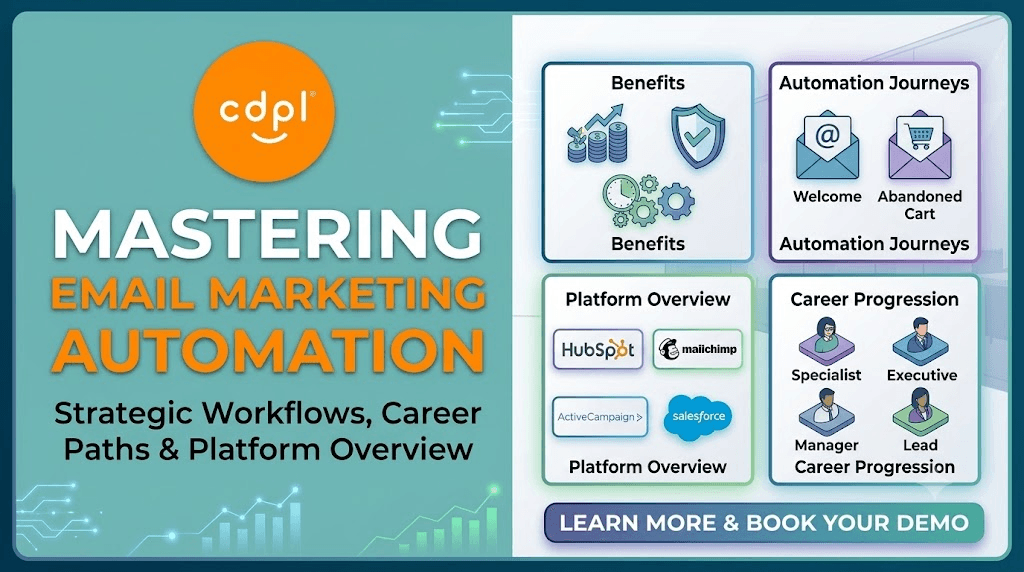
Discover how email marketing automation helps businesses send the right message at the right time and how you can build a career mastering it.
Learn how email marketing automation works, the best tools to use, and how mastering this in-demand skill can launch your digital marketing career.
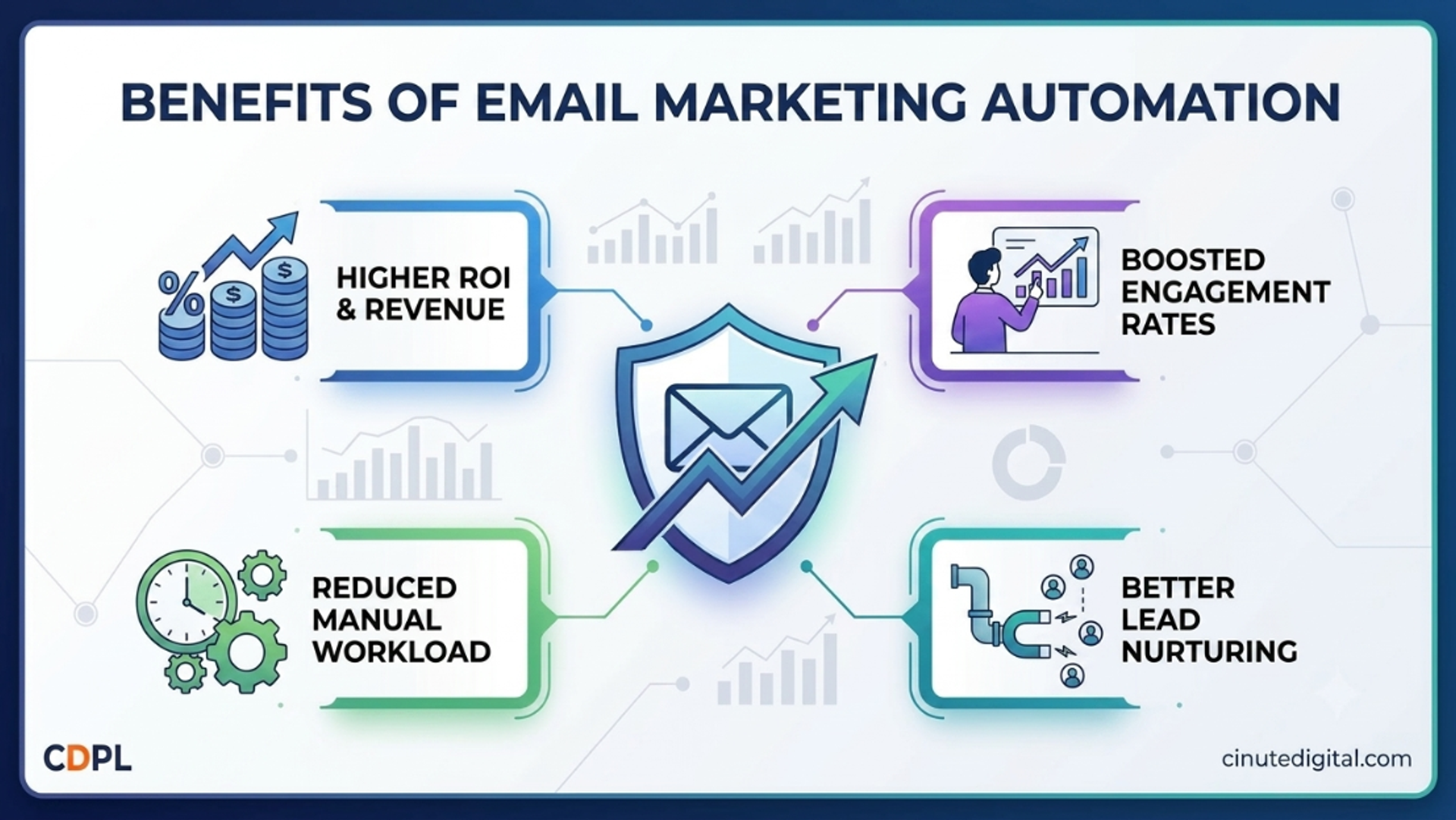
If you've ever wondered how brands seem to send you the exact email you needed a discount right when you abandoned your cart, a birthday offer on your special day, or a friendly nudge to finish signing up you've experienced email marketing automation in action. It isn't magic. It's a smart, data-driven system that runs quietly in the background, nurturing leads and driving revenue 24/7 without a marketer lifting a finger every single time.
In this comprehensive guide, we'll break down what email marketing automation really is, why it has become the backbone of modern digital marketing, how it works, the best tools to use, and most importantly for students and career switchers how you can build a thriving career around this in-demand skill.
What Is Email Marketing Automation?
Email marketing automation refers to the use of software to send targeted, timely, and personalized emails to subscribers based on triggers, behaviors, or predefined schedules without manual intervention for every single send. Instead of a marketer hitting "send" one email at a time, automation platforms use workflows, segmentation, and rules to deliver the right message to the right person at the right moment.
Think of it as a digital sales and engagement assistant. Once you set up the rules for example, "send a welcome email the moment someone subscribes" the system takes over and executes it flawlessly for thousands of subscribers simultaneously.
This concept is a core module inside CDPL's Digital Marketing and Analytics Master Program, where students learn to build these very campaigns from scratch using real industry tools.
Why Email Marketing Automation Matters in 2026
Email isn't dead it's evolving. Despite the rise of social media and instant messaging, email remains one of the highest-ROI marketing channels available. Businesses that automate their email marketing typically see:
- Higher engagement rates because messages are personalized and timely
- Reduced manual workload, freeing marketers to focus on strategy
- Better lead nurturing, guiding prospects smoothly through the sales funnel
- Improved customer retention through consistent, relevant communication
- Scalable growth automation works the same whether you have 100 or 100,000 subscribers
As more companies shift budgets toward performance-driven digital marketing, professionals who understand marketing automation tools are becoming indispensable. This is precisely why CDPL's Digital Marketing course overview places heavy emphasis on automation, analytics, and AI-driven personalization.
How Email Marketing Automation Works
At its core, automation runs on triggers, workflows, and segmentation. Let's break each down.
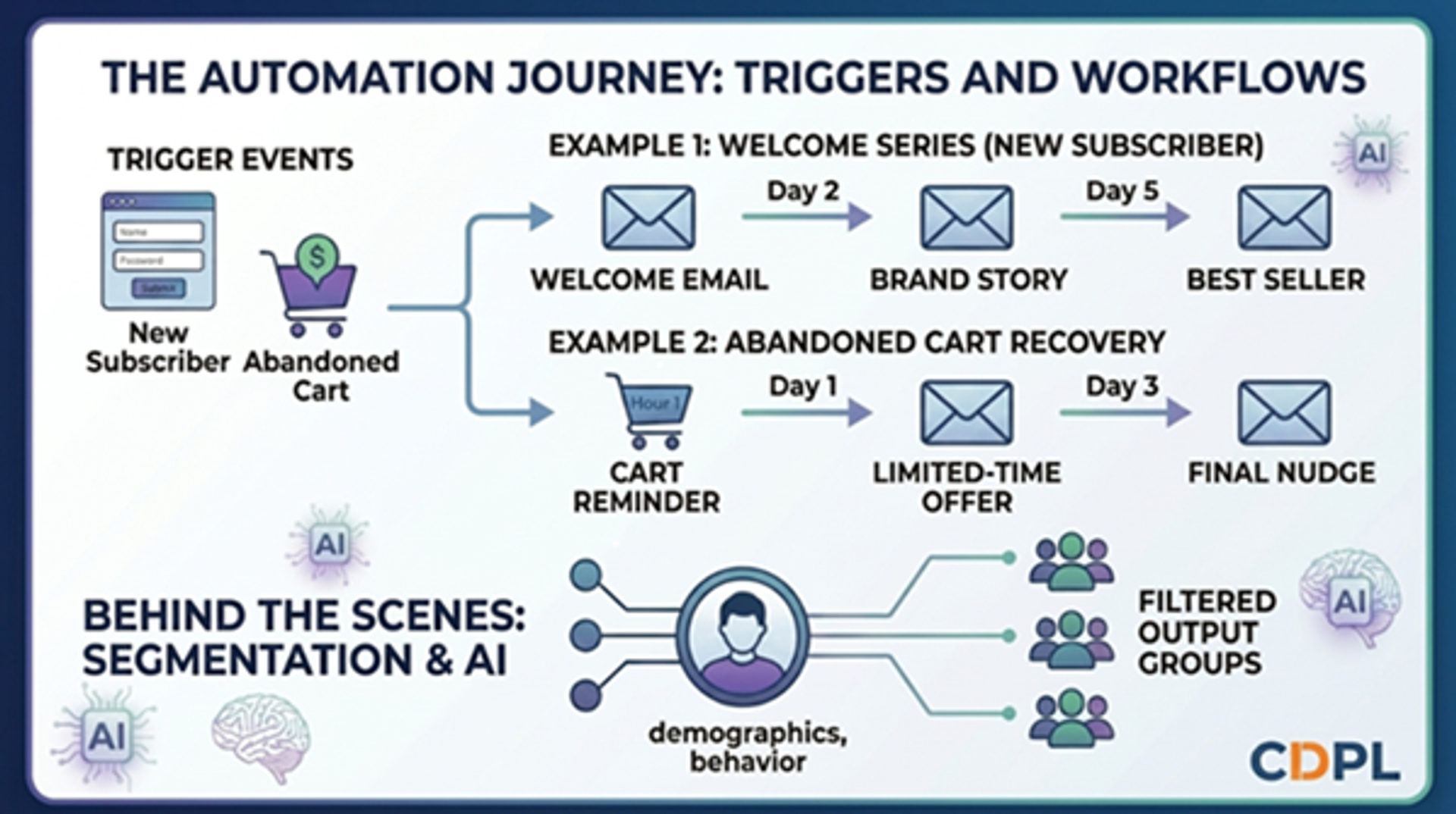
1. Triggers
A trigger is the event that starts an automated email or sequence. Common triggers include:
- A new subscriber joining your list
- A visitor abandoning their shopping cart
- A customer completing a purchase
- A user not opening emails for 30+ days (a "win-back" trigger)
- A specific date, like a birthday or subscription renewal
2. Workflows (Email Sequences)
Once triggered, a workflow also called a drip campaign sends a series of pre-written emails over time. For instance, a welcome workflow might look like:
- Immediate welcome email with a discount code
- Day 2: Introduce your brand story
- Day 5: Share bestsellers or popular content
- Day 7: Offer a limited-time incentive to convert
3. Segmentation & Personalization
Not every subscriber should get the same email. List segmentation allows marketers to group subscribers by behavior, demographics, purchase history, or engagement level ensuring every email feels personally relevant rather than generic.
4. Analytics & Optimization
Automation platforms provide dashboards tracking open rates, click-through rates, conversions, and unsubscribes. Marketers use this data to run A/B tests and continuously refine subject lines, send times, and content.
Understanding data interpretation is crucial here, which overlaps significantly with skills taught in CDPL's Data Analytics & Visualization courses a great complementary skill set for aspiring marketers.
Key Types of Automated Email Campaigns
Here are the most common (and effective) automated campaigns every marketer should know:
- Welcome Series - First impressions matter; onboard new subscribers warmly
- Abandoned Cart Emails - Recover lost sales by reminding shoppers what they left behind
- Re-engagement Campaigns - Win back inactive subscribers before they churn
- Post-Purchase Follow-ups - Encourage reviews, cross-sells, and repeat purchases
- Lead Nurturing Sequences - Educate and warm up prospects who aren't ready to buy yet
- Event-Triggered Emails - Birthdays, anniversaries, renewal reminders
- Newsletter Automation - Consistent, scheduled content to stay top-of-mind
Each of these campaign types requires a blend of copywriting, strategy, and technical tool proficiency exactly the kind of practical, project-based learning offered in CDPL's hands-on Digital Marketing with AI Bootcamp.
Best Email Marketing Automation Tools in 2026
There's no shortage of platforms to choose from, but here are the industry favorites:
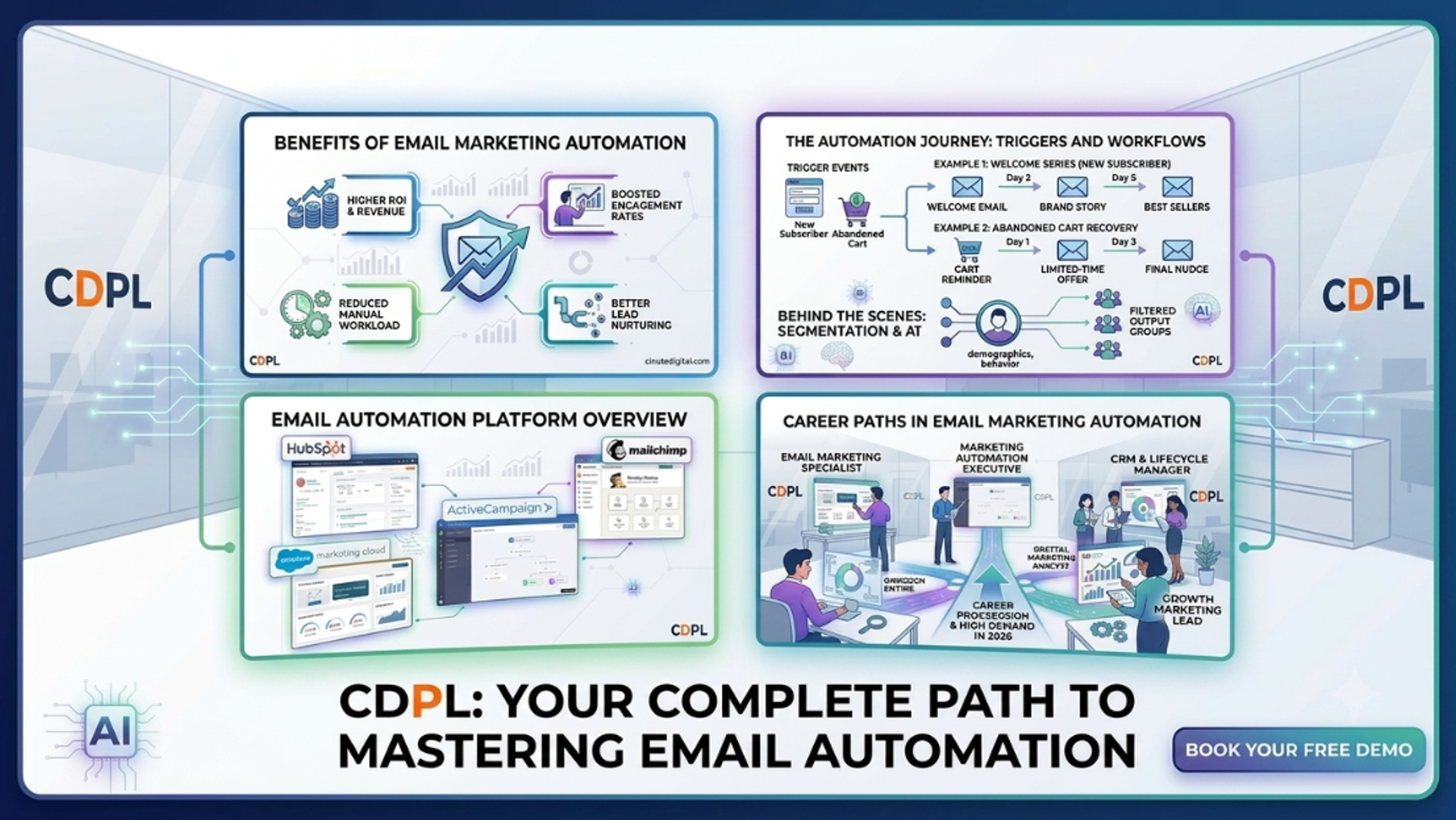
Learning to navigate these email automation software platforms hands-on is one of the biggest advantages CDPL students get real tool exposure, not just theory.
Email Marketing Automation Best Practices
To truly master this skill, keep these principles in mind:
- Always personalize - Use the subscriber's name, past behavior, and preferences.
- Keep subject lines compelling but honest - Avoid clickbait; it damages trust and deliverability.
- Segment aggressively - A relevant email to 100 people beats a generic one to 10,000.
- Test everything - Subject lines, send times, CTAs - A/B test regularly.
- Monitor deliverability - Clean your email list periodically to avoid spam traps.
- Respect compliance - Follow GDPR, CAN-SPAM, and India's IT Act guidelines for consent-based marketing.
- Balance automation with authenticity - Don't let every email feel robotic; inject brand personality.
These practices are covered in depth through live projects in CDPL's comprehensive Digital Marketing courses, ensuring students don't just learn concepts but apply them on real campaigns.
Common Mistakes to Avoid
- Over-automating - bombarding subscribers with too many emails kills engagement
- Ignoring mobile optimization - most emails are opened on phones
- Not cleaning your list - sending to inactive or fake addresses hurts sender reputation
- Skipping analytics - automation without measurement is just guesswork
- Weak CTAs - every email needs one clear, obvious next action
Email Marketing Automation vs. Manual Email Marketing
This comparison highlights exactly why nearly every modern business — from startups to enterprises is investing in marketing automation platforms and, by extension, in professionals who know how to run them.
The Role of AI in the Future of Email Marketing Automation
Artificial intelligence is rapidly reshaping what "automation" even means. Where traditional workflows relied on simple if-this-then-that logic, AI-powered platforms can now:
- Predict the best send time for each individual subscriber based on past behavior
- Generate subject lines and copy variations automatically, then test them at scale
- Score leads dynamically, adjusting nurture sequences in real time based on engagement signals
- Personalize product recommendations inside emails using purchase and browsing history
- Detect churn risk before a customer actually unsubscribes, triggering win-back sequences proactively
This shift means marketers of tomorrow need more than just "email marketing" skills they need to understand data, machine learning basics, and AI tools working alongside traditional campaign strategy. That's exactly why CDPL integrates AI concepts directly into its marketing curriculum, rather than treating them as a separate, optional add-on. Students who understand both the marketing fundamentals and the underlying data science principles have a significant edge in the job market.
If this intersection of AI and marketing excites you, it's also worth exploring how automation logic overlaps with broader tech skills taught across CDPL's Artificial Intelligence courses many marketing automation platforms today are essentially applied AI systems.
Building Your First Email Automation Campaign: A Simple Framework
If you're just starting out, here's a practical framework to build your first automated campaign, whether it's for a college project, an internship, or a live client:
Step 1: Define Your Goal Are you trying to onboard new users, recover abandoned carts, or re-engage dormant subscribers? Every automation workflow should start with one clear, measurable objective.
Step 2: Map the Customer Journey Sketch out every touchpoint a subscriber has with your brand signup, first purchase, repeat purchase, inactivity and identify where automated emails naturally fit.
Step 3: Choose Your Trigger Decide precisely what action or condition starts the automation: a form submission, a purchase, a specific date, or inactivity after a set number of days.
Step 4: Write the Sequence Draft each email in the sequence with a single clear purpose and call-to-action. Avoid cramming multiple messages into one email.
Step 5: Set Up Segmentation Rules Ensure different subscriber segments new leads vs. loyal customers, for example receive tailored versions of the sequence where relevant.
Step 6: Test Before Launch Send test emails to yourself and colleagues, check formatting across devices, and verify all links and personalization tags work correctly.
Step 7: Launch, Monitor, and Refine Once live, track open rates, click-through rates, and conversions weekly. Use this data to refine subject lines, timing, and content over time.
Practicing this exact framework on live tools is a core part of the project-based learning inside CDPL's Digital Marketing and Analytics Master Program, so students graduate with a portfolio, not just a certificate.
Frequently Asked Questions
Q1. Is email marketing automation only for large companies?
Not at all. Even solo entrepreneurs and small businesses can benefit from simple welcome sequences and abandoned cart emails using affordable tools like Mailchimp or Zoho Campaigns.
Q2. Do I need coding skills to learn email marketing automation?
No. Most modern platforms use visual, drag-and-drop workflow builders. However, understanding basic HTML and data analytics gives you a strong advantage.
Q3. How long does it take to learn email marketing automation?
With structured, hands-on training like CDPL's digital marketing programs, most learners become job-ready within a few months, combining theory with live projects.
Q4. What industries use email marketing automation the most?
E-commerce, SaaS, education, real estate, healthcare, and finance are among the top industries relying heavily on automated email strategies to nurture leads and retain customers.
Q5. Can email marketing automation replace a marketing team?
No, automation handles repetitive execution, but strategy, creativity, copywriting, and campaign optimization still require skilled human marketers.
Career Opportunities in Email Marketing Automation
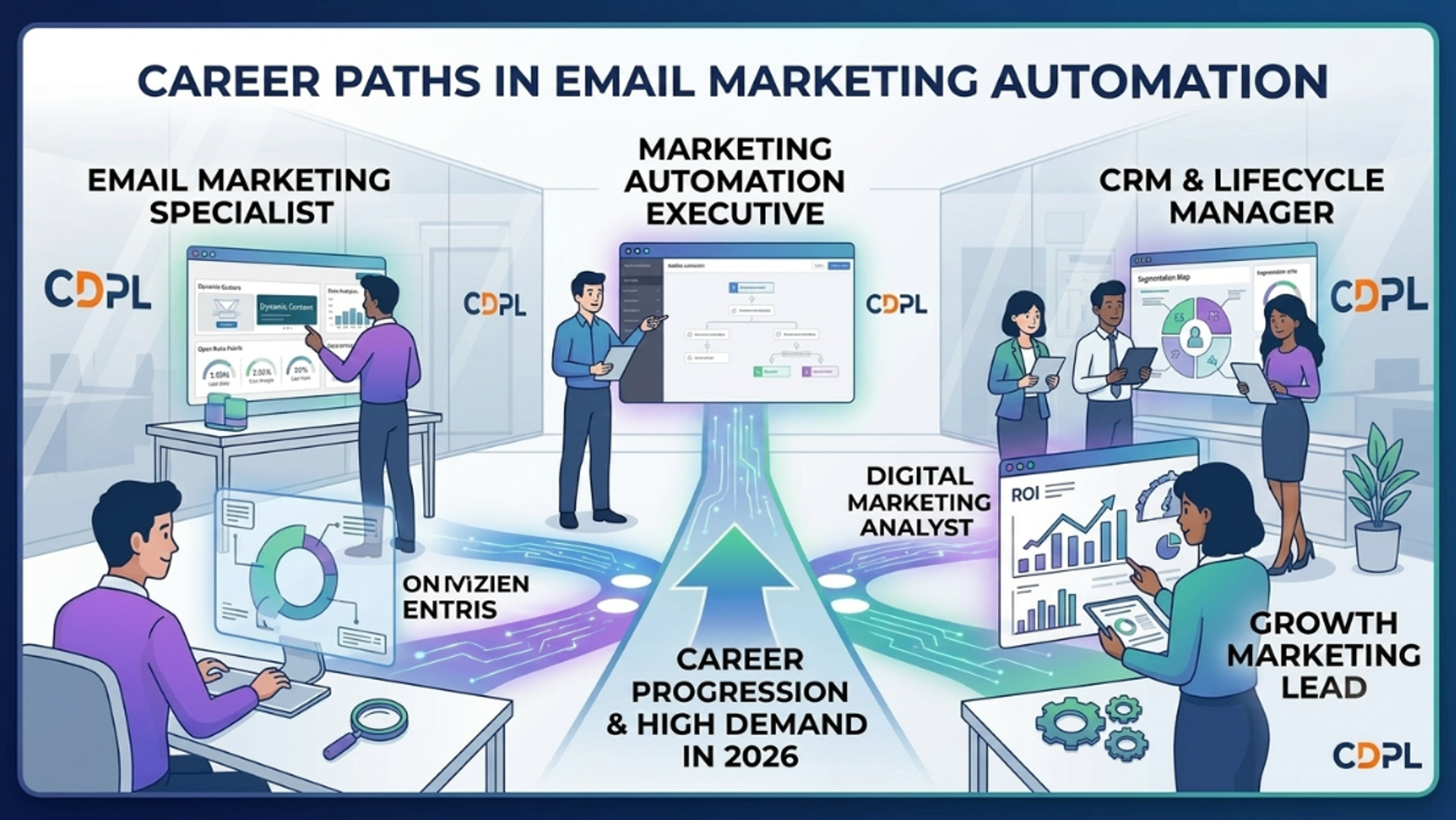
Here's the exciting part for students: email marketing automation isn't just a marketing tactic it's a genuine career path. Companies across every industry, from e-commerce to SaaS to edtech, need skilled professionals who can design, execute, and optimize automated campaigns.
Potential roles include:
- Email Marketing Specialist
- Marketing Automation Executive
- CRM & Lifecycle Marketing Manager
- Digital Marketing Analyst
- Growth Marketing Lead
These roles command competitive salaries and are in growing demand as companies double down on data-driven, performance marketing. If you're a student, fresh graduate, or professional looking to pivot, this is a genuinely future-proof skill to add to your resume. Curious what real career transformation looks like? Check out CDPL's student placement success stories for inspiration.
CDPL's Digital Marketing and AI course for business owners and full Digital Marketing Master Program are designed precisely to take you from beginner to industry-ready with live projects, expert mentorship, and placement support to help you land your first (or next) marketing role.
For businesses and agencies looking for hands-on execution support alongside talent development, CDPL's sister company Cinute Infomedia also offers specialized digital marketing and content services a great resource for real-world case studies and industry insight.
How CDPL Helps You Master Email Marketing Automation
At CDPL (Cinute Digital Pvt. Ltd.), we don't just teach theory we build job-ready marketers. Here's what makes our training different:
- 100% Live Interactive Classes with industry experts
- 90+ real-world projects, including live email automation campaigns
- Small batch sizes for personalized mentorship
- Placement support with resume building, mock interviews, and job referrals
- Flexible weekday/weekend batches to fit your schedule
Whether you're a complete beginner or looking to upskill, CDPL's Digital Marketing courses are structured to make you confident and capable in tools like Mailchimp, HubSpot, and ActiveCampaign the very platforms top companies use every day.
Final Thoughts
Email marketing automation has transformed from a "nice-to-have" into an absolute necessity for businesses that want to scale efficiently while staying personal with their audience. From welcome sequences to abandoned cart recovery, the strategic use of automated, triggered, and segmented emails drives measurable ROI and the professionals who can build these systems are in high demand.
If you're ready to turn this in-demand skill into a rewarding career, there's no better time to start than now. Explore CDPL's full course catalog, talk to our advisors, and take the first step toward becoming a job-ready digital marketing professional.
Ready to launch your career in digital marketing? Get in touch with CDPL today and book your free demo class.
Keywords covered: email marketing automation (primary), marketing automation tools, automated email campaigns, email marketing software, drip campaigns, lead nurturing, email segmentation, digital marketing courses, marketing automation platforms, email marketing strategy, career in digital marketing.
Tags

Seasoned Business Intelligence and learning and development professional with over 11 years of experience empowering students and professionals to unlock career success through data-driven skills. Specializing in Power BI, Tableau, and Prompt Engineering, Ashish is known for delivering practical, high-impact workshops and training programs across academic and corporate sectors.