
ISTQB CTFL Prep Guide: Pass on Your First Attempt


Pass your exam with our ultimate ISTQB certification prep guide. Unlock a 4-week study plan, K-level question breakdowns, and expert tips to ace the CTFL exam on your first attempt
Unlock your potential with our comprehensive ISTQB certification prep guide. From mastering the 7 testing principles to solving complex K-level questions, this guide offers a proven 4-week study plan to help you pass the CTFL exam on your first attempt and boost your QA career
In the rapidly evolving world of software testing, credibility is everything. Whether you are a fresh graduate or an experienced QA professional, the ISTQB certification prep guide is your roadmap to global recognition. The International Software Testing Qualifications Board (ISTQB) offers a standardized qualification that is recognized in over 120 countries, making it the gold standard for testing professionals.
Achieving this certification proves you possess the fundamental knowledge and vocabulary to communicate effectively with IT teams worldwide. However, the exam is known for its tricky wording and rigorous syllabus. This guide is designed to cut through the noise, offering you a structured, step-by-step preparation strategy that covers everything from the Foundation Level (CTFL) syllabus to advanced exam techniques. By following this blueprint, you will not only understand the core concepts but also master the art of answering K-level questions correctly.
What is ISTQB and Why Does It Matter?
The ISTQB (International Software Testing Qualifications Board) is a not-for-profit organization that has defined the "standard" for software testing. But why should you invest time and money into this?
- Global Recognition: It is the standard language of testing. Terms like "boundary value analysis" or "equivalence partitioning" mean the same thing in Mumbai as they do in New York.
- Career Advancement: Many top-tier companies use automated filters to scan resumes. Keywords like "ISTQB Certified" often bypass these filters, putting your profile in front of hiring managers.
- Standardized Vocabulary: It eliminates confusion in projects by ensuring all team members use the same terminology.
The ISTQB Certification Hierarchy
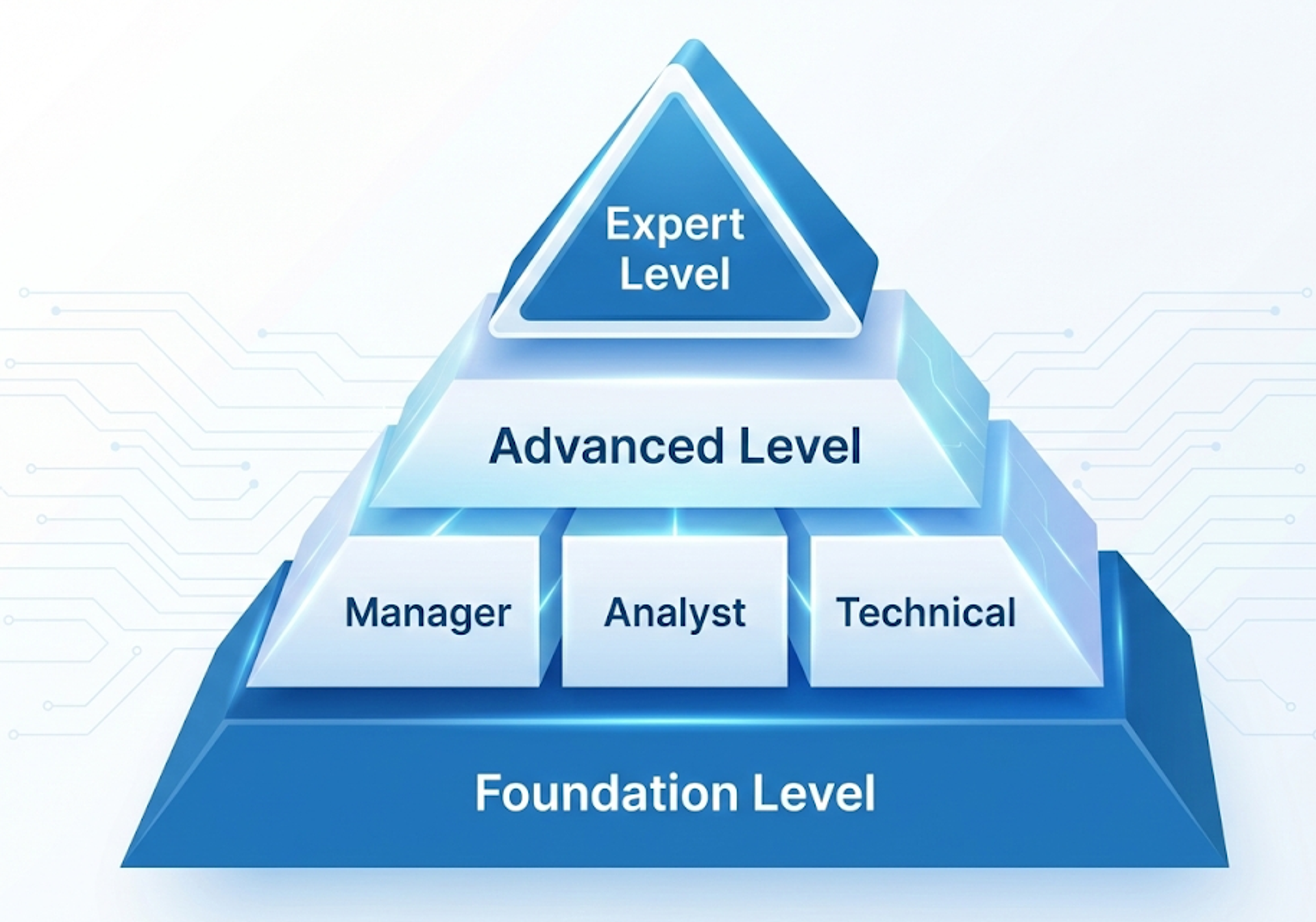
To navigate your career, you must understand the three main levels:
- Foundation Level (CTFL): The entry-level exam required for all other certifications.
- Advanced Level (CTAL): Includes Test Manager, Test Analyst, and Technical Test Analyst.
- Expert Level: For seasoned professionals with deep specialization.
Detailed Breakdown: ISTQB Foundation Level (CTFL)
Most readers of this ISTQB certification prep guide will be targeting the Foundation Level. This exam consists of 40 multiple-choice questions to be completed in 60 minutes. You need 65% (26/40) to pass.
The 6 Chapters of Success
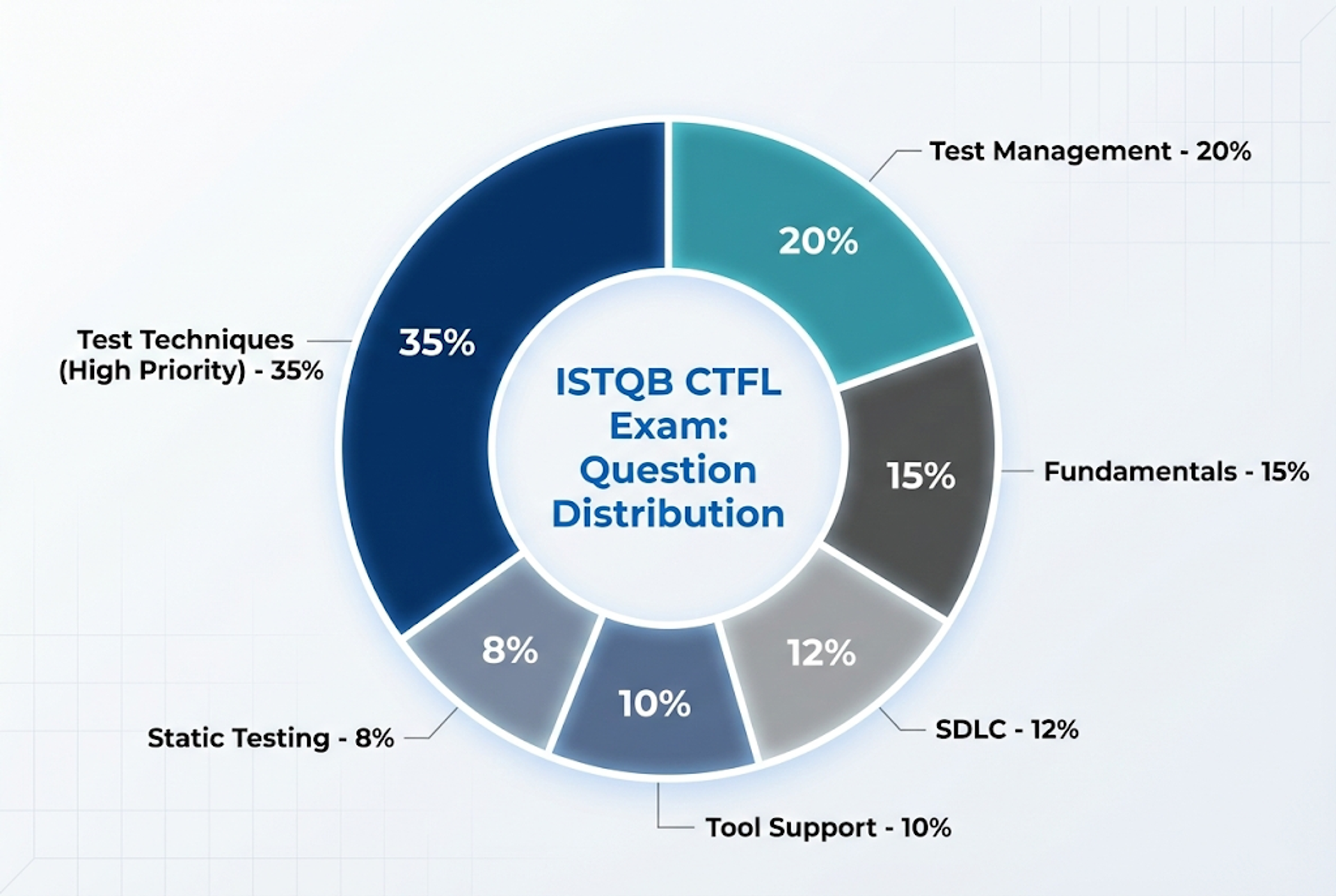
The syllabus is divided into six chapters. Understanding the weightage of each is critical for your study plan.
- Fundamentals of Testing: (7 Questions)
- Understand why testing is necessary.
- Learn the seven testing principles (e.g., "Testing shows the presence of defects").
- Distinguish between debugging and testing.
- Testing Throughout the Software Development Lifecycle (SDLC): (6 Questions)
- Know the difference between Component, Integration, System, and Acceptance testing.
- Understand the value of static testing vs. dynamic testing.
- Static Testing: (3 Questions)
- Reviews and the test process.
- Roles and responsibilities in a formal review.
- Test Techniques: (12 Questions - High Priority)
- This is the mathematically heavy section. You must master Equivalence Partitioning, Boundary Value Analysis, Decision Table Testing, and State Transition Testing.
- Pro Tip: This section often contains K3 and K4 level questions (application and analysis), which are harder than simple definitions.
- Test Management: (8 Questions)
- Test organization (Independent testing).
- Test planning and estimation.
- Configuration management and risk-based testing.
- Tool Support for Testing: (4 Questions)
- Classifying test tools (e.g., management tools vs. execution tools).
- Benefits and risks of test automation.
Strategic Preparation Plan (4-Week Schedule)
To avoid burnout and ensure retention, follow this structured timeline.
Week 1: The Basics (Chapters 1 & 2)
- Focus: Read the official syllabus definitions carefully.
- Activity: Create flashcards for terms like "Error," "Defect," and "Failure."
- Resource: If you are new to the field, consider enrolling in a dedicated Manual Software Testing course to get hands-on explanations of these concepts.
Week 2: The Core Mechanics (Chapters 3 & 4)
- Focus: Master the Black-box testing techniques.
- Activity: Practice calculating boundary values. If a field accepts 1-100, know that 0, 1, 100, and 101 are your key test data points.
- Tip: Do not ignore White-box testing (Statement and Decision coverage).
Week 3: Management & Tools (Chapters 5 & 6)
- Focus: Learn the hierarchy of test teams and the risks of automation.
- Activity: Differentiate between "Project Risks" and "Product Risks."
- Context: For those looking to move into leadership, exploring Advanced Software Testing concepts can provide deeper context here.
Week 4: Mock Exams & Revision
- Focus: Speed and accuracy.
- Activity: Take at least 5 full-length mock exams. Time yourself strictly.
- Analysis: Review every wrong answer. Did you misread the question, or did you lack knowledge?

Mastering K-Levels (Cognitive Levels)
The ISTQB exam uses "K-levels" to indicate difficulty. Ignoring this is a common rookie mistake.
- K1 (Remember): Simple definitions. Ex: "What is a defect?"
- K2 (Understand): Compare and contrast. Ex: "Explain the difference between re-testing and regression testing."
- K3 (Apply): Use a technique. Ex: "Calculate the minimum test cases needed for 100% statement coverage."
- K4 (Analyze): Break down a problem. Ex: "Given this scenario, which test strategy is most appropriate?"
Crucial Advice: Do not skim Chapter 4 (Test Techniques). It is the only chapter heavily focused on K3 and K4 questions. If you are struggling with the logic here, you might benefit from Advanced Automation Testing training, which reinforces logic and structural analysis.
Common Pitfalls to Avoid
- Relying Only on Experience: The ISTQB exam answers are based on the syllabus, not your company's specific practices. Forget how "Company X" does it; answer based on the ISTQB glossary.
- Ignoring the Glossary: Words like "Priority" and "Severity" have very specific meanings in the ISTQB world.
- Over-analyzing Questions: ISTQB questions are not meant to trick you with hidden information. Read the question literally. If it doesn't say the system crashed, do not assume it did.
Beyond Foundation: What’s Next?
Once you pass the CTFL, the door opens to specialization.
- Agile Tester Extension: Essential for those working in Scrum teams.
- Technical Test Analyst: Deep dive into white-box testing and API Testing using POSTMAN
- Test Automation Engineer: For those who want to build frameworks using tools like Selenium or Cypress.
Frequently Asked Questions (FAQ)
Q1: Is the ISTQB certification valid forever
Yes, the Foundation Level (CTFL) certification has lifetime validity and does not require renewal. However, Advanced Level certifications may require keeping up with industry trends.
Q2: Can I take the exam online from home?
Yes, ISTQB offers remote proctored exams via approved exam providers. You will need a webcam and a stable internet connection.
Q3: How much time is required to prepare for ISTQB CTFL?
For a beginner, we recommend 3 to 4 weeks of dedicated study (approx. 2 hours per day). Experienced testers may only need 2 weeks to align their knowledge with the syllabus
Q4: Is coding knowledge required for the ISTQB Foundation exam?
No, the Foundation Level does not require coding skills. However, understanding basic logic is helpful for the White-box testing section. For coding-heavy roles, consider Software Testing courses that include Java or Python.
Q5: What is the passing score for the ISTQB exam?
You must score at least 65%, which translates to 26 correct answers out of 40 questions.
Conclusion
Passing the ISTQB exam is about discipline, not just intelligence. By following this ISTQB certification prep guide, focusing on the high-yield chapters, and practicing your K3/K4 application skills, you are setting yourself up for success. Remember, this certification is just the beginning of your journey. Whether you plan to dive into Database Management System using MySQL for backend testing or explore AI-driven QA, the foundation you build today will support your entire career.
Start your preparation today, stick to the syllabus, and approach the exam with confidence. Good luck!
Tags

A Manual Tester in TESTRIQ QA LLP and also as Corporate Trainer with CDPL. With a focused career in training and development.