
What Are OOP Concepts in Java? Beginner’s Guide (2026)
OOP concepts in Java are the foundation of almost every Java interview and project. This beginner’s guide explains classes, objects, encapsulation, inheritance, polymorphism and abstraction in plain language. You will also see a job-focused learning roadmap for freshers.
Learn how classes, objects and the four pillars of OOP work in Java, using one simple bank-account example and a clear roadmap for freshers.
What Are OOP Concepts in Java? Beginner’s Guide (2026)
Picture this. You have cleared the aptitude round for a Java role at a Mumbai IT firm. In the technical interview, the panel asks, “Explain OOP concepts in Java with an example.” You know the four big words, but your answer comes out as a memorized definition, and the interviewer’s face says it all.
This happens to many fresh graduates, even after years of engineering or BSc classes. The problem is rarely intelligence. Nobody showed you the idea behind the words.
In this guide from Cinute Digital, you will learn what object-oriented programming means, how its four pillars work, and why employers keep asking about them. You will also run one small bank-account example that ties everything together. By the end, you should be able to explain each concept to a friend over chai.
Once you see the idea behind the keywords, Java stops feeling like a wall of rules.
OOP concepts in Java are the principles of object-oriented programming: classes and objects, plus four pillars called encapsulation, inheritance, polymorphism and abstraction. They help you organize code into reusable objects that mirror real-world things, making programs easier to build, test, reuse and maintain as they grow larger.
What Is Object-Oriented Programming in Java?
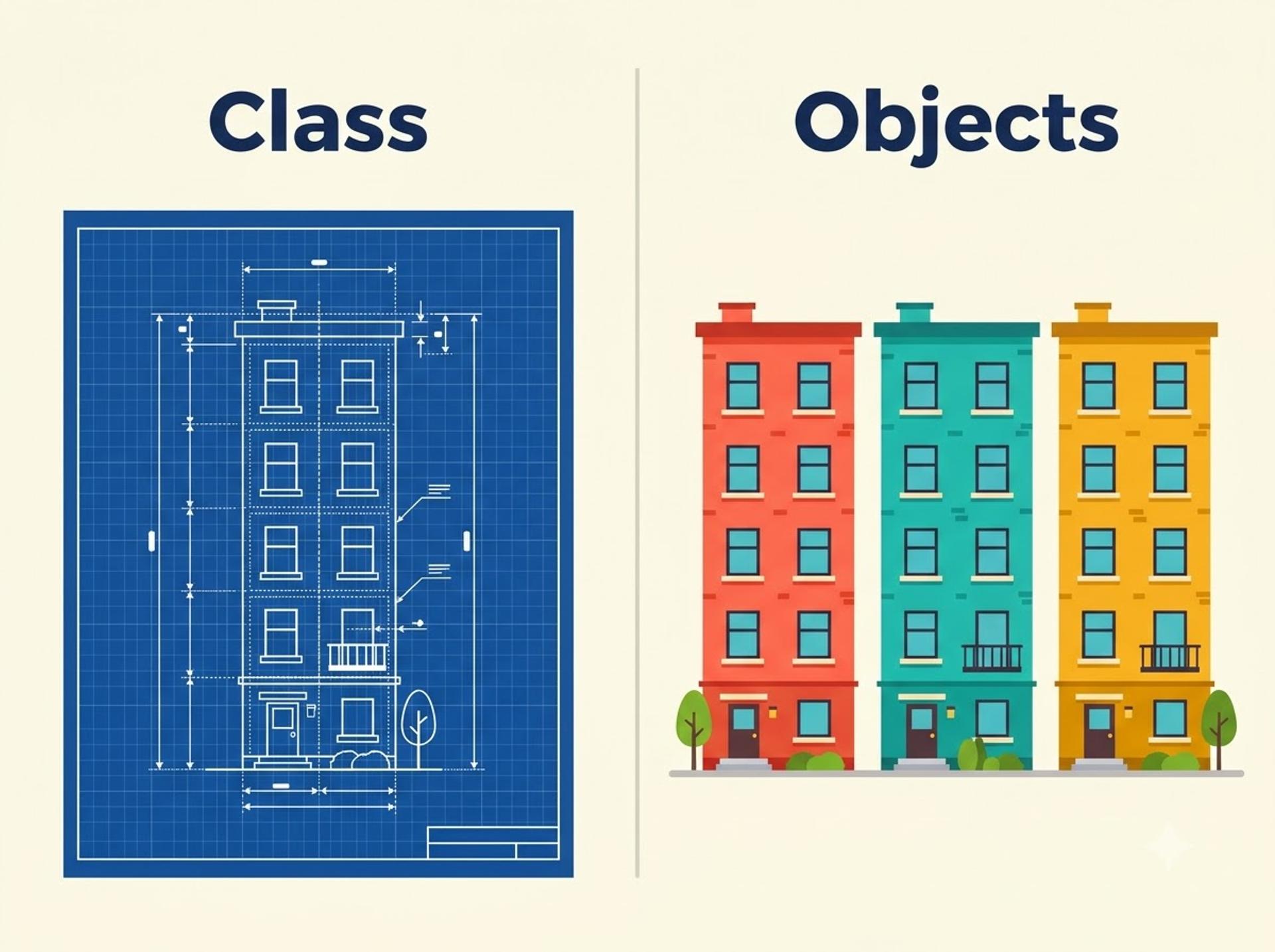
Think of a housing society in Mira Road. The builder draws one blueprint of a 2BHK flat. From that single blueprint, the society gets dozens of real flats. Each flat has the same structure, but each has its own owner, color and furniture.
In Java, that blueprint is a class, and each real flat is an object. A class describes what something has (its fields, such as owner name or balance) and what it can do (its methods, such as deposit or withdraw). An object is one actual copy built from that class, holding its own values.
Object-oriented programming in Java simply means you build programs from such objects instead of one long list of instructions. A banking app, for example, would have Account, Customer and Transaction objects. Each object looks after its own data and behavior. That is why large Java applications in banks, insurers and e-commerce firms stay manageable even when many developers work on them.
Once you understand classes and objects in Java, four ideas sit on top of them. These are the four pillars of OOP in Java:
- Encapsulation: keep data private and allow access only through controlled methods.
- Abstraction: show what something does and hide how it does it.
- Inheritance: let a child class reuse and extend a parent class.
- Polymorphism: let one method call behave differently for different objects.
If you have already written classes in Python, you are ahead. Python and Java share the same OOP thinking, and Java simply asks you to be stricter about types and structure. Many learners pick up both languages, and a beginner-friendly Python programming course is a sensible companion if you want a second language later.
Key Takeaway: A class is the blueprint, an object is the real thing built from it, and OOP means building programs from such objects.
Why OOP Concepts in Java Matter for Freshers in 2026
Java remains a mainstay in India’s banking, insurance, fintech and enterprise software teams, including many employers in Mumbai and Navi Mumbai. (This is general market observation. Verify with the latest industry reports and current job listings.) Entry-level hiring is competitive, so interviewers use OOP as a quick filter. That is why OOP concepts in Java for freshers commonly appear in technical screenings. A candidate who explains polymorphism with their own example stands out from one who recites a definition.
AI coding assistants can now generate boilerplate Java in seconds. That makes fundamentals more important, not less. You still need to read the code, spot a weak design and explain why a class is built a certain way.
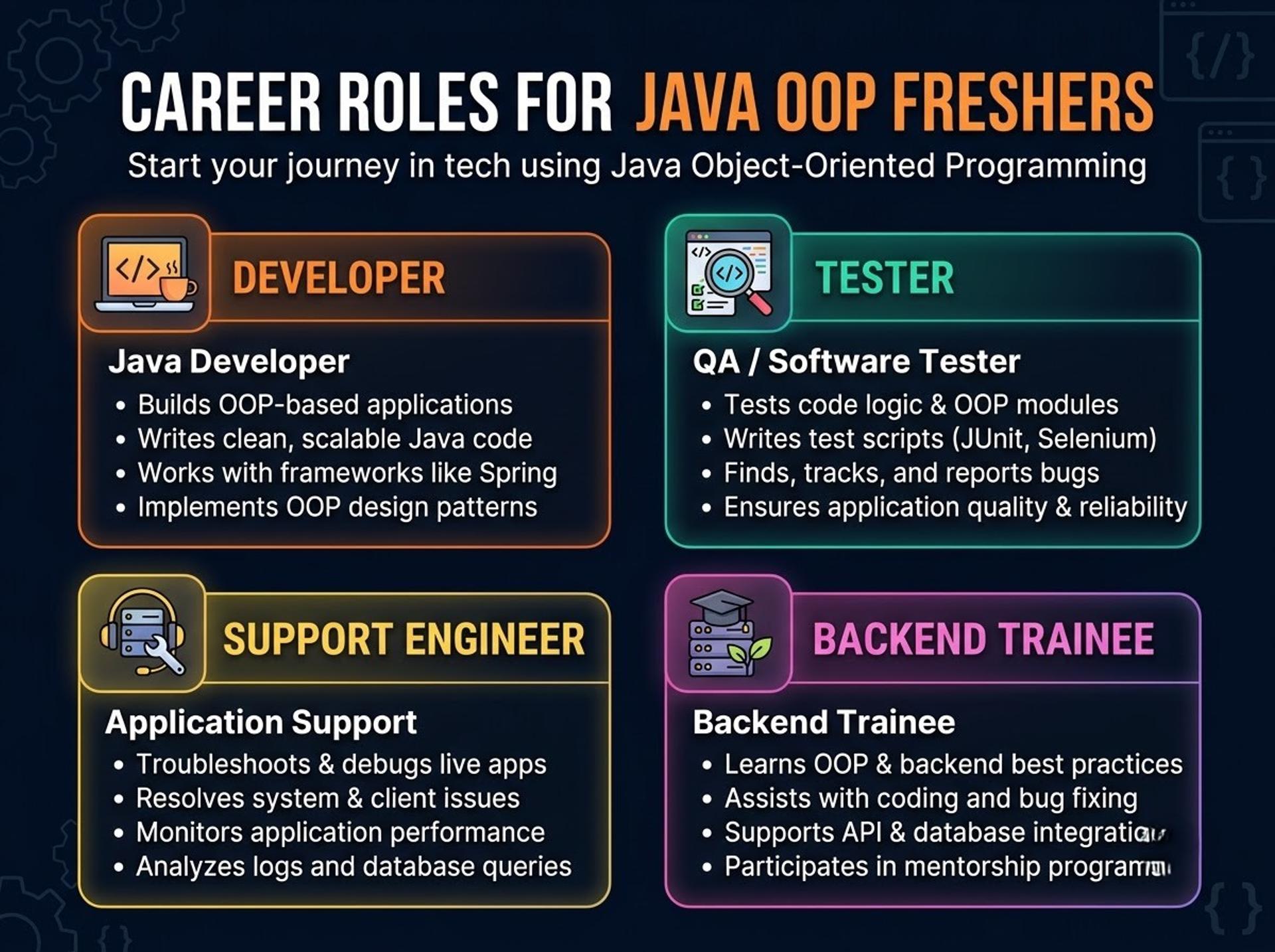
Here are roles where OOP concepts in Java are used daily. The salary ranges are approximate verify with a current industry source, because pay varies by company, city, skills and interview performance.
If testing interests you, note that many QA automation teams build their frameworks in Java, so strong OOP makes you far more employable there. A structured automation testing training programme shows how such frameworks are built. Check the course page for the exact tools it covers.
Key Takeaway: Employers use OOP questions to test whether you can think in objects, not just recite definitions.
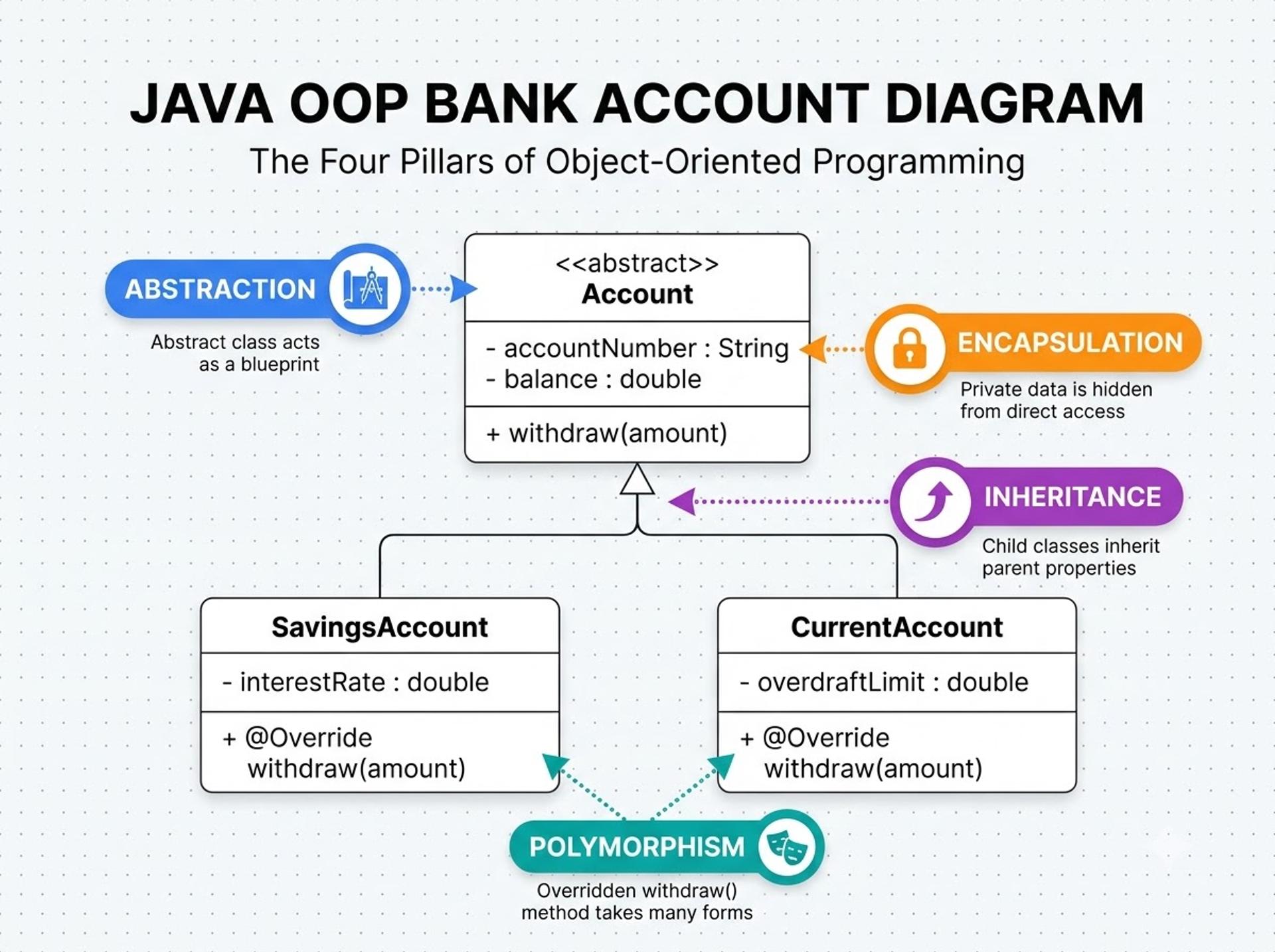
How the Four Pillars Work: One Bank Account Example
Let’s build one tiny program. Everyone understands bank accounts, so each pillar will appear naturally. This is the quickest way to see OOP concepts in Java working together.
Follow these four steps:
- Encapsulation: Make
balanceprivate. Change it only through methods likedeposit(). - Abstraction: Create an abstract class
Accountwith an abstract methodmonthlyInterest(). It says what every account must do, not how. - Inheritance: Let
SavingsAccountandCurrentAccountextendAccountand reuse its balance logic. - Polymorphism: Each child class writes
monthlyInterest()its own way. Java picks the right version at run time.
Expected output:
Line by line:
private double balancehides the data. Other classes must usegetBalance()ordeposit().deposit()checksamount > 0, so invalid input is rejected.abstract class Accountcannot be created directly.monthlyInterest()has no body, so every child class must supply one.extends Accountis inheritance, andsuper(openingBalance)calls the parent constructor.@Overridetells Java that the child replaces the parent’s method. A wrong signature becomes a compile error.Account[] accounts = {a, b}holds two different child objects through one parent type. The loop calls the same method, and each object answers in its own way. That is polymorphism.- The 3% rate is only illustrative, not a real bank rate.
The four pillars at a glance:
Once you can write classes like these, you can build services that other programs call through REST APIs, and those APIs need testing. That makes API testing with Postman a logical next skill after Java basics, because it shows how your classes behave when real requests arrive.
Key Takeaway: Encapsulation protects data, abstraction defines what must be done, inheritance reuses code, and polymorphism lets one call behave differently for different objects.
Common Mistakes Beginners Make with OOP (and How to Avoid Them)
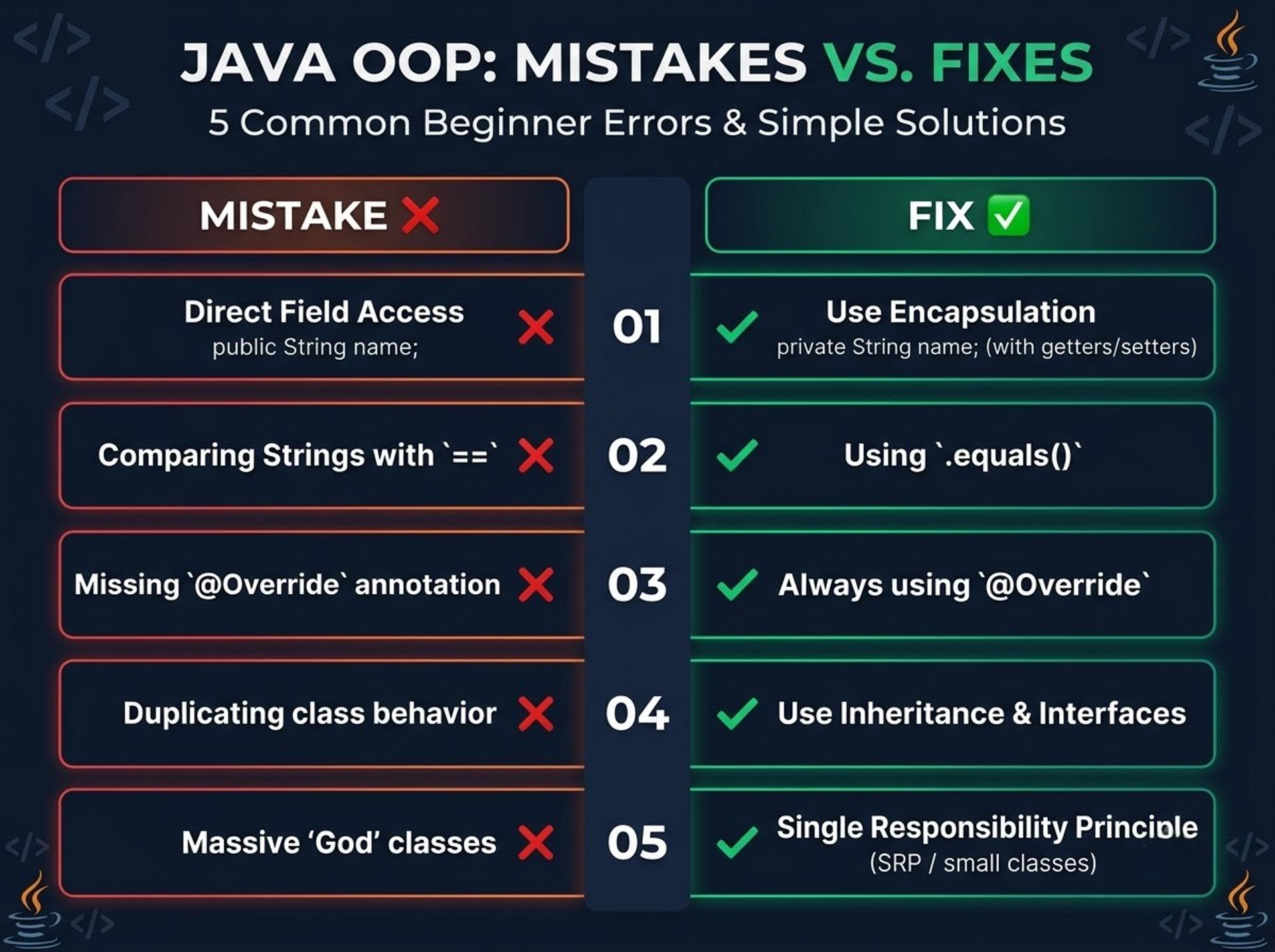
- Memorising without coding. Reading definitions does not build skill. Type each example yourself, change it, and break it on purpose.
- Making every field public. Default to
privateand add methods that protect your rules. - Overusing inheritance. Ask whether the relationship is “is-a” or “has-a”. A
SavingsAccountis anAccount, so inherit. ACarhas anEngine, so hold an engine object instead. - Mixing up overloading and overriding. Overloading means the same method name with different parameters in one class. Overriding means a child class redefines a parent method.
- Ignoring data. Real applications store information, so practise databases early.
Most real Java applications read and write data in a database, so learning MySQL and SQL fundamentals alongside OOP makes your projects far more realistic.
A note on responsible practice: AI tools can write Java for you, but copying code you cannot explain will show in an interview or on the job. Use AI to learn, for instance by asking it to explain an error, and then rewrite the solution in your own words. Never present someone else’s project as your own.
Key Takeaway: Write code, keep fields private, and choose inheritance only when the “is-a” test passes.
Career Path and Learning Roadmap for Java Freshers
Java opens doors to junior developer, automation tester, application support and backend trainee roles. Follow this order so each skill supports the next:
- Core Java basics: variables, loops, arrays and strings.
- OOP: classes, the four pillars, interfaces and abstract classes.
- Collections, exceptions and file handling.
- SQL and JDBC: connect your programs to a database.
- Interview practice: work through Java OOP interview questions for freshers, such as abstract class vs interface and overloading vs overriding.
- One mini project: a library or bank management app you can explain line by line.
- Choose a path: backend frameworks or test automation with Selenium.
If you practise daily, many freshers need approximately 3–5 months to become interview-ready for junior roles. This is approximate, and it depends on your background, time and consistency.
If you prefer guided learning over self-study, CDPL’s structured Java Programming course is available in live online and classroom options. It includes hands-on projects, mock interviews, resume support and placement assistance. Check the course page for the current syllabus, duration and batch details. Placement assistance means support with your job search, not a guaranteed job.
Key Takeaway: Master the basics, then OOP, then databases, and prove it with one project you can explain.
Conclusion
OOP concepts in Java are less about memorising four words and more about learning to think in objects. Three points are worth remembering. First, a class is a blueprint and an object is the real thing built from it. Second, the four pillars solve real problems: encapsulation protects data, abstraction defines what must be done, inheritance reuses code, and polymorphism lets one call behave in many ways. Third, you learn OOP by writing code, breaking it and explaining it aloud.
Take the bank-account example, change the interest rule, add a FixedDepositAccount class, and explain your changes to a friend. If you would like a mentor to guide you through projects and mock interviews, you can book a free demo class and see whether the learning style suits you.
Every good Java developer once stared at the same four words. Keep practising, and they will make sense sooner than you expect.
Frequently Asked Questions
1. What are OOP concepts in Java?
OOP concepts in Java are the ideas behind object-oriented programming. They include classes and objects, plus four pillars: encapsulation, inheritance, polymorphism and abstraction. Together they let you organise code into reusable objects that model real-world things, which makes large programs easier to build, test, change and maintain over time.
2. What are the 4 pillars of OOP in Java?
The four pillars are encapsulation, abstraction, inheritance and polymorphism. Encapsulation keeps data private behind methods. Abstraction shows what an object does and hides how. Inheritance lets a child class reuse a parent class using extends. Polymorphism lets one method call behave differently for different objects. Together they make code reusable, safer and easier to maintain.
3. What is the difference between a class and an object in Java?
A class is a blueprint that defines fields (data) and methods (behaviour). An object is a real instance created from that class using the new keyword, with its own values. Think of one flat blueprint producing many flats. One Account class can create many account objects, each holding its own balance.
4. What is the difference between abstraction and encapsulation in Java?
Abstraction is about design: it shows only what an object does and hides how it does it, using abstract classes and interfaces. Encapsulation is about protection: it bundles data with methods and restricts direct access using private fields. In the bank example, monthlyInterest() shows abstraction, and the private balance shows encapsulation.
5. What is the difference between method overloading and overriding in Java?
Overloading means the same method name with different parameters inside one class, and Java decides which version to call at compile time. Overriding means a child class replaces a parent class method with the same signature, and Java decides at run time. Overloading is a form of compile-time polymorphism, and overriding gives run-time polymorphism.
Tags

A visionary data scientist dedicated to unlocking the potential of data to drive informed decision-making and spark innovation. With a strong foundation in Data Science.