
Python Projects for Beginners: 10 Job-Ready Resume Ideas
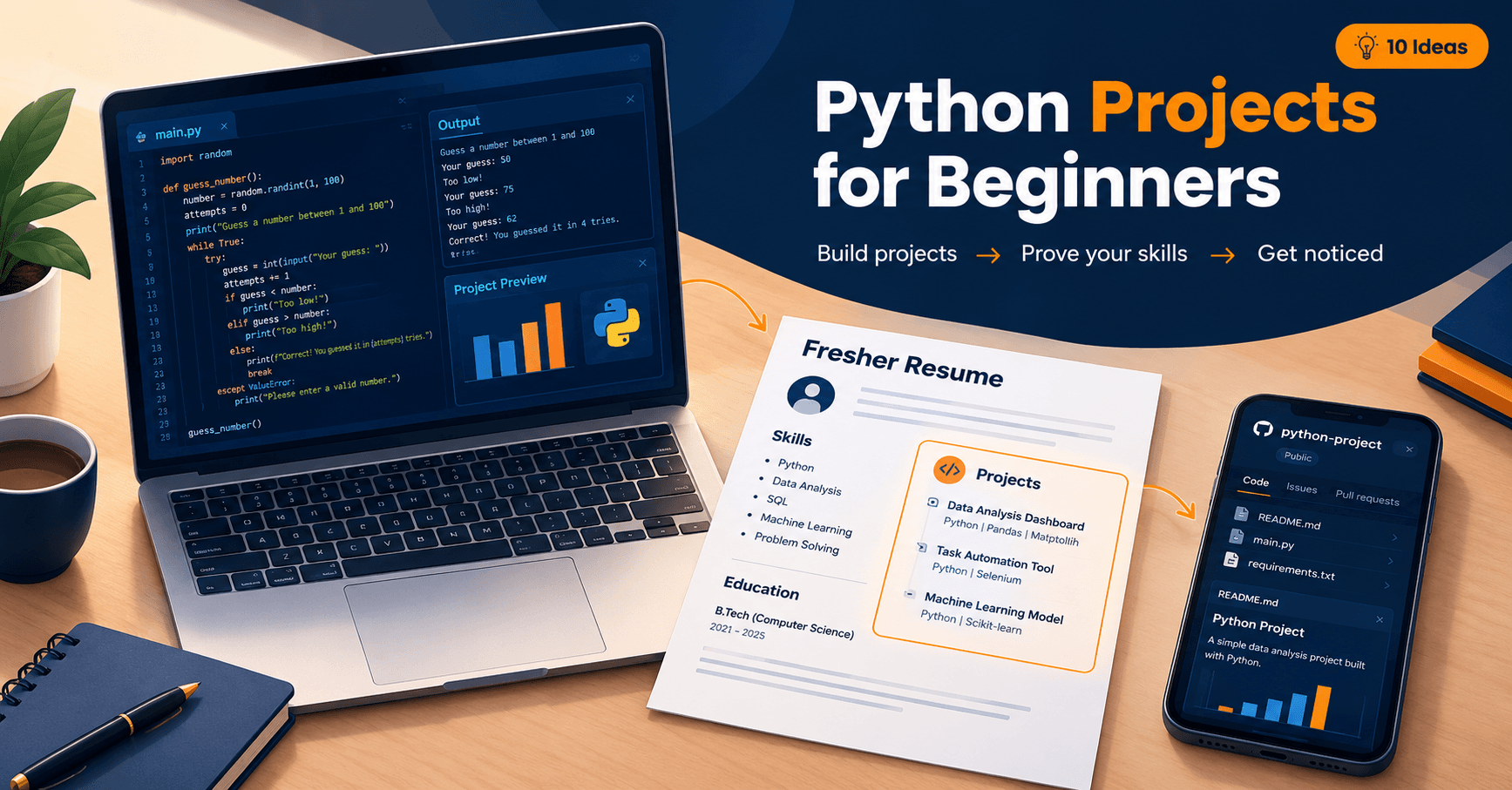
Looking for Python projects for beginners that actually strengthen your resume? This guide shares 10 practical ideas, a short code demo and a simple way to present each project on GitHub. It is written for fresh graduates in Mumbai and across India.
Pick the right Python projects for your resume, build them step by step, and present each one on GitHub so recruiters can verify your skills.
Python Projects for Beginners: 10 Ideas for Your Resume
Imagine this. You finish your degree, complete a Python tutorial and add "Python" to your skills list. You apply to thirty jobs from your home in Thane, Vasai or Mira Road, and only two companies reply. Your marks are fine. The real problem is that recruiters see "Knows Python" on hundreds of resumes and cannot verify any of them.
Python projects for beginners solve exactly this problem. A small, finished project proves you can turn a skill into a working program. This guide, written by the trainers at Cinute Digital, gives you 10 resume-ready ideas, a simple method to choose the best three, and a short code demo you can run today. You will also learn how to write each project as a resume line, and which mistakes make recruiters scroll past.
One rule matters more than any idea on the list: a finished project beats ten abandoned ones. Ready to pick your first?
The best Python projects for beginners are small, finishable programs that prove real skills: an expense tracker, marks analyser, password generator, to-do app with SQLite, web scraper, weather app, Pandas sales analysis, chat analyser, Excel report automation and a price predictor. Upload each to GitHub with a clear README.
What Makes Python Projects for Beginners Resume-Worthy?
A resume-worthy Python project is a small, working program that solves one clear problem, sits on GitHub with a README, and can be explained by you line by line. That is the whole definition. It does not need a fancy interface, thousands of lines or a cloud server.
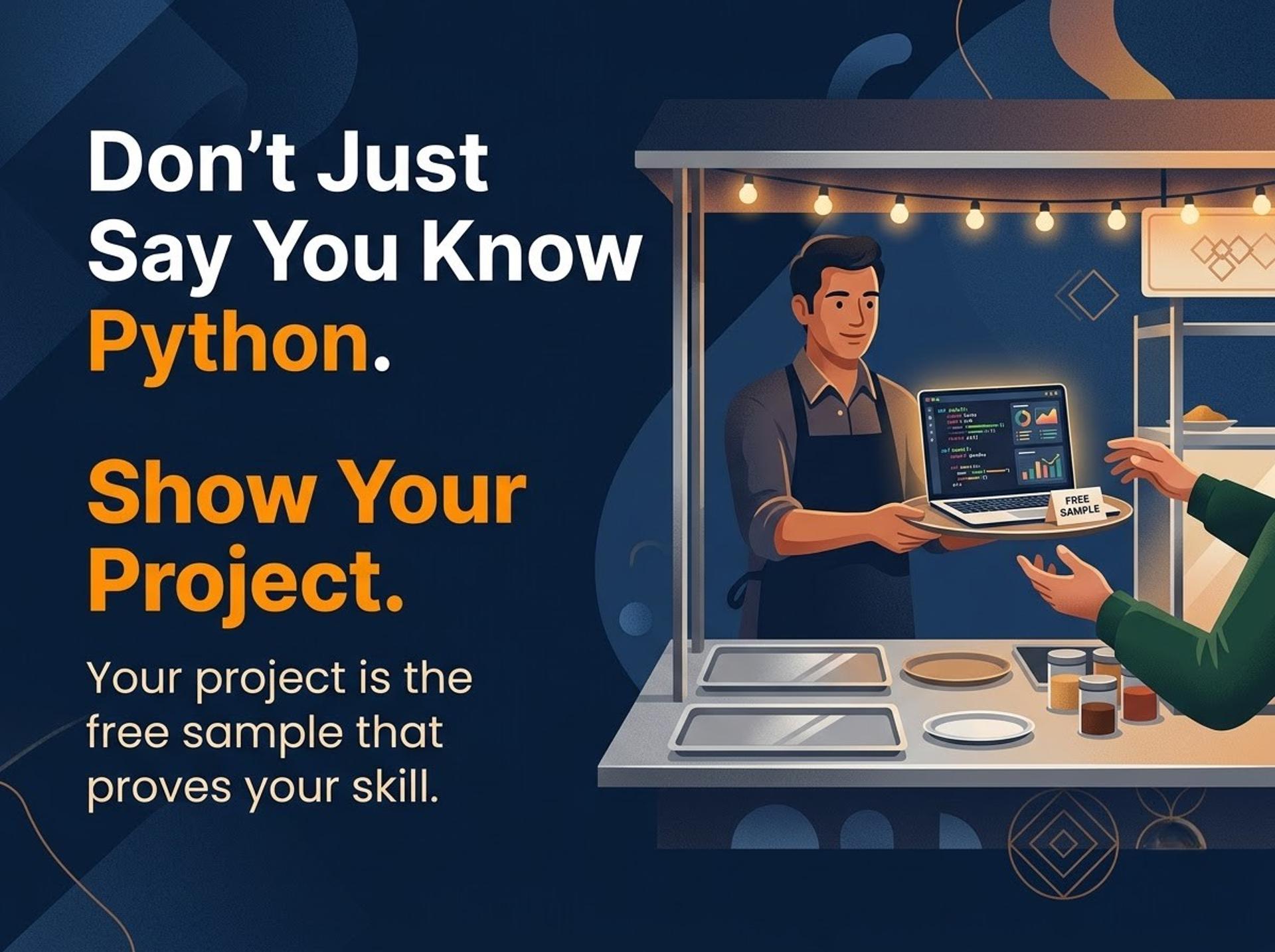
Think of the vada pav stall outside your local station. The vendor never writes "tasty" on a board and hopes you believe it. He hands you a hot one, and you decide. A project works the same way for a recruiter. Your resume claims a skill, and your project is the free sample they can taste in two minutes.
Before you call a project resume-worthy, run it through three tests:
- It works. It runs from start to finish without errors on a fresh computer.
- You can explain it. You can say why each function exists and what breaks if you remove it.
- Others can see it. It has a public GitHub link, a README and sample output.
Size is the trap here. A 150-line program you fully understand beats a 3,000-line clone you copied from a video. Interviewers rarely ask how big your project is. They ask, "Why did you write it this way?" If you can answer, you pass the real test.
Python also helps because one language leads to many careers. Data analytics, automation, software testing and machine learning all use it. So your project can point towards the job you want, which we cover in the next sections.
If loops, functions and file handling still feel shaky, fix that first. A structured Python programming course with hands-on projects gives you the base you need before you build anything bigger.
Why Python Projects Matter for Freshers in India's 2026 Job Market
Entry-level hiring in India remains competitive in 2025–2026. Large applicant pools mean a recruiter may spend only a short time on each resume, so anything verifiable stands out. A project link is verifiable. A skills list is not. For current hiring numbers, check the latest NASSCOM reports, because this article does not quote figures it cannot verify.
AI coding assistants have also changed the conversation. Anyone can now generate a working script in seconds. In our view, employers therefore care more about whether you can explain, debug and extend what you built. A project you wrote and understood shows exactly that.
Mumbai adds its own angle. Finance, logistics, media and IT services employers around Andheri, Powai, Navi Mumbai and Thane often need people who can automate reports and analyse data. If you come from a BCom, BSc or BA background, strong python projects for resume screening can say what your degree title cannot.
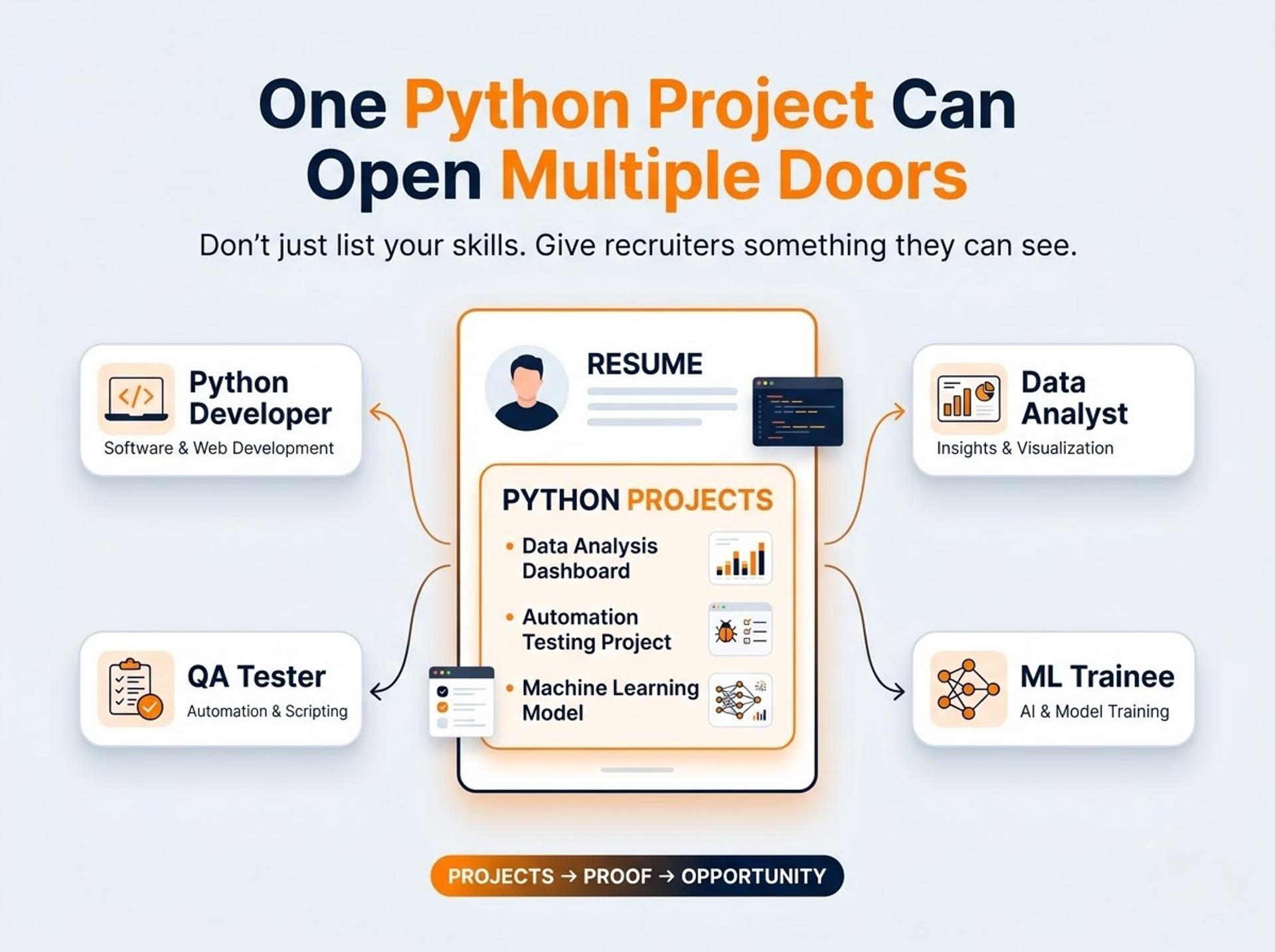
Here is how projects connect to common fresher roles:
Salary ranges are approximate — verify with a current industry source such as NASSCOM reports or job portals. Pay varies widely by company, city, skills and interview performance.
Many freshers aim for data analyst roles because their projects map neatly to that work. If that is you, learning Python libraries for data analytics, especially Pandas and NumPy, will make python projects for data analyst resume goals (projects 7 and 9 below) far easier.
10 Python Project Ideas for Your Resume (Plus a Short Demo)
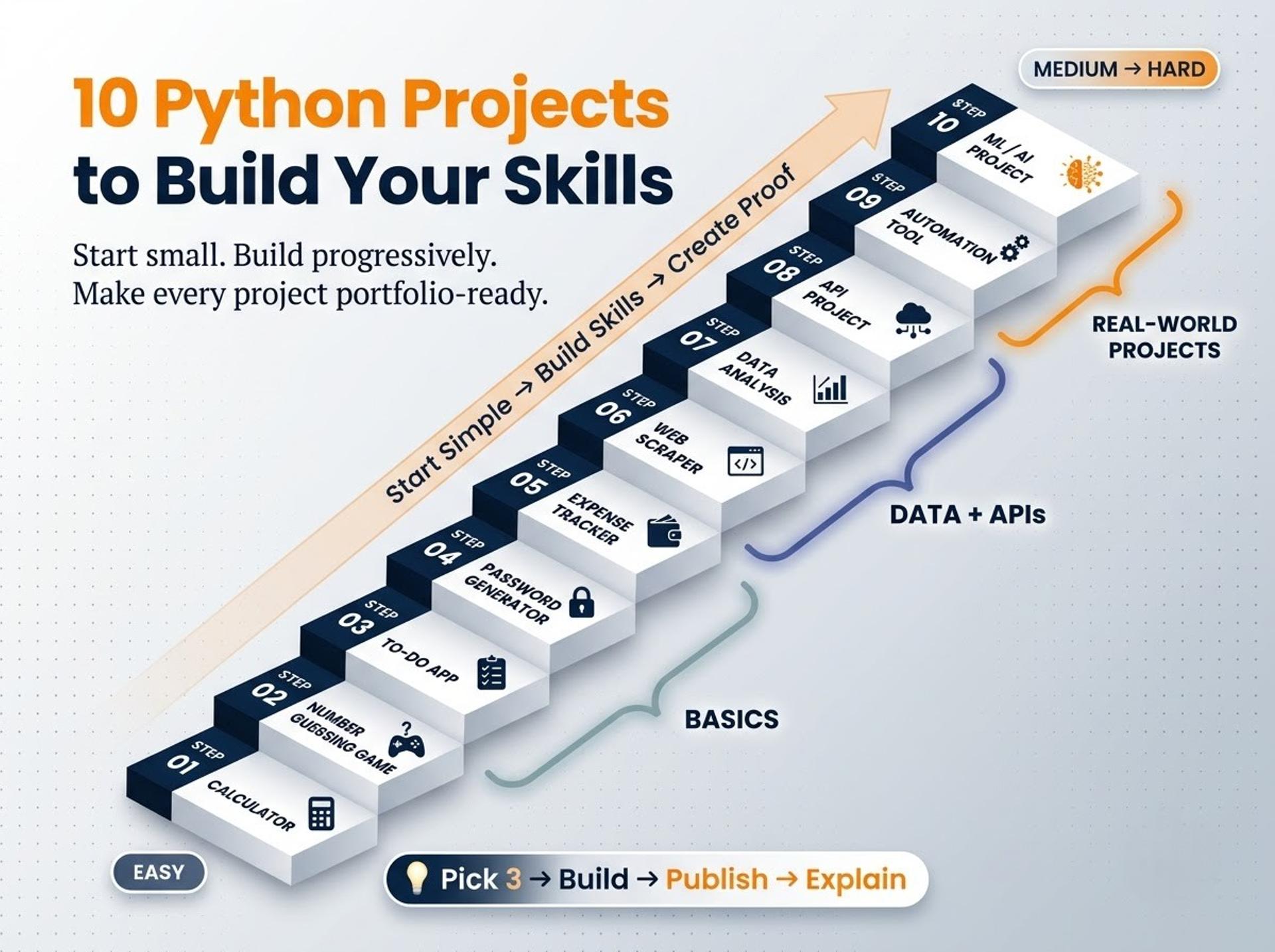
Here are 10 python project ideas for freshers, ordered from easiest to hardest. You do not need all ten.
Pick three, not ten: one from projects 1–4 (basics), one from 7–9 (data and automation), and one from 5, 6 or 10 (API, scraping or machine learning). These python mini projects for beginners fit into a few weekends.
Short concept demo: the engine of an expense tracker
This is the core logic of project 1. The amounts are made-up sample data.
Line by line:
- Lines 1–5:
expensesis a list. Each entry is a dictionary holding an item, an amount and a category. - Line 7:
totals = {}creates an empty dictionary to collect one total per category. - Lines 8–9: The loop visits each expense.
totals.get(e["category"], 0)returns the running total for that category, or 0 if the category is new. We add the amount and store it back. - Lines 11–12: A second loop prints each category with its total. If your terminal shows a garbled ₹, replace it with "Rs."
To make this a real project, add input() for new expenses, save records to a CSV file, and print a monthly summary.
Project 10 introduces scikit-learn and the idea of training a model. If that excites you, a guided path in machine learning with Python can take you from a first predictor to evaluated, explainable models.
How to turn any project into a resume line
- Build the smallest working version first. Add features later, one at a time.
- Push it to GitHub with a README. Include the problem, how to run it, sample output and a screenshot. This is how you build python projects for github portfolio credibility.
- Write one resume bullet using action verb + tool + outcome. Example: "Built a command-line expense tracker in Python that groups spending by category and saves records to a CSV file."
- Prepare a 60-second explanation. Say what it does, why you built it and what you would improve.
Common Mistakes, Tips and Ethics for Python Projects
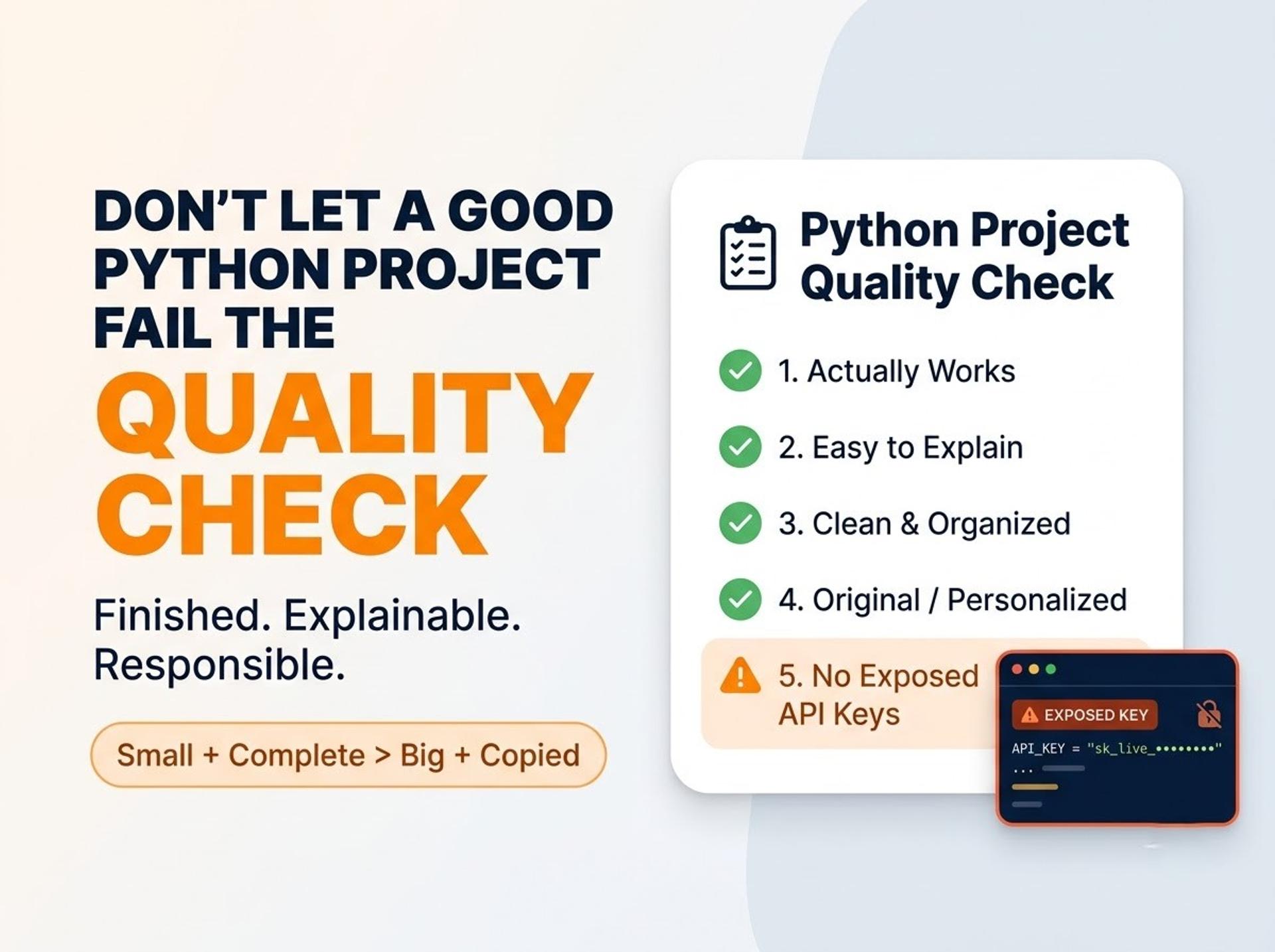
Python mini projects for beginners usually fail for predictable reasons. Avoid these five:
- Copying a tutorial line by line. Change the dataset or add one feature of your own, so the project becomes yours.
- Skipping the README. A project without instructions looks unfinished, however good the code is.
- Starting many, finishing none. Three finished projects beat ten half-built ones.
- Hard-coding passwords or API keys. Never push secrets to a public repository. Use environment variables and a
.gitignorefile. - Being unable to explain your code. Practise out loud. If you cannot explain a line, rewrite it until you can.
Most beginner projects start with a CSV file and then outgrow it. That is the moment SQL helps. SQL is how real applications store and query the data your Python code produces, so learning MySQL and SQL fundamentals makes projects 4 and 7 far more convincing.
A note on responsible practice. Web scraping and chat analysis touch real people's data, so treat them carefully.
- Check a website's terms of use and
robots.txtbefore scraping. Avoid login-protected pages and scrape slowly. - Never publish personal data. Use only your own chat exports for project 8, and remove names and phone numbers before sharing results.
- Prefer open datasets with clear licences and credit the source.
- India's Digital Personal Data Protection Act, 2023 makes personal data handling a serious matter. This is general information, not legal advice.
Your Learning Roadmap: From Projects to Job-Ready
Strong projects open doors to junior Python developer, data analyst, QA automation and machine learning trainee roles. Which one fits depends on the projects you choose and the tools you add next.
A realistic roadmap looks like this. The timeline is approximate and depends on how many hours you practise each day:
- Month 1: Python basics, then projects 1–3.
- Month 2: SQL and project 4.
- Month 3: Pandas, then projects 7 and 9.
- Months 4–5: APIs or machine learning basics, then polish your best three on GitHub.
- Month 6: Resume, mock interviews and applications.
Most beginners need roughly three to six months of steady practice to become interview-ready for entry-level roles. Some need longer, and that is normal.
After Python and SQL, many analyst roles ask for a dashboard tool. Power BI turns the output of your Pandas projects into visuals a manager can read in seconds, so Power BI dashboard training is a logical next skill.
If you prefer guided learning, Cinute Digital offers live online and classroom options with hands-on projects, resume support, mock interviews and placement assistance. No institute can guarantee a job. Your projects, practice and interview skills decide the outcome.
Conclusion
Here are the three points to remember:
- Finish a few small projects instead of starting many big ones.
- Make them visible and explainable with a GitHub link, a README and a 60-second explanation.
- Match projects to your target role, whether that is development, analytics, automation or machine learning.
Python projects for beginners are not about impressing anyone with complexity. They show that you can learn, build and explain, and that is what employers want from a fresher.
If you would like guidance on choosing your first three projects, you can book a free demo class and ask the team about batch options. Whatever you decide, open your editor tonight and write the first ten lines. Every working developer started exactly there.
FAQ Section
1. What are the best Python projects for beginners to put on a resume?
Choose small projects that run end to end and that you can explain. Good starters are an expense tracker, student marks analyser, password generator and to-do app with SQLite. For data roles, add a Pandas sales analysis or Excel report automation. Aim for three finished projects that match the job you want, each with a GitHub link and README.
2. How do I add Python projects to my resume?
Create a Projects section below your skills or education. For each project, write one or two bullets: an action verb, the tools used and what the program does. Add the GitHub link. Two to four relevant projects is usually enough for a fresher, so quality matters more than quantity. Keep bullets honest and be ready to explain every line in an interview.
3. Is web scraping legal for a Python project in India?
It depends on what you scrape and how. Public, non-personal data is generally lower risk, but you should read the website's terms of use and robots.txt, avoid login-protected pages, and never collect personal data. Scraping at high speed can also harm a site. India's Digital Personal Data Protection Act, 2023 adds weight to personal data handling. This is general information, not legal advice. When unsure, use official APIs or open datasets.
4. How long does it take to build a beginner Python project?
Simple projects such as an expense tracker or password generator can take a few hours to a weekend once you know loops, functions and files. Data or API projects may take a week or two of part-time work. These timings are approximate and depend on your practice hours. Finish a basic version first, then add features one by one.
5. How much do freshers with Python skills earn in India?
Pay varies widely by role, company, city and interview performance. As a rough, approximate guide, entry-level Python, data analyst and QA automation roles often fall around ₹3–6 lakh per year, while junior machine learning roles can be higher. These are approximate figures; verify with current NASSCOM reports or job portals. Strong projects can help your case but never guarantee a salary.
Tags

A visionary data scientist dedicated to unlocking the potential of data to drive informed decision-making and spark innovation. With a strong foundation in Data Science.