
Flask or Django? Which Python Framework to Learn in 2026
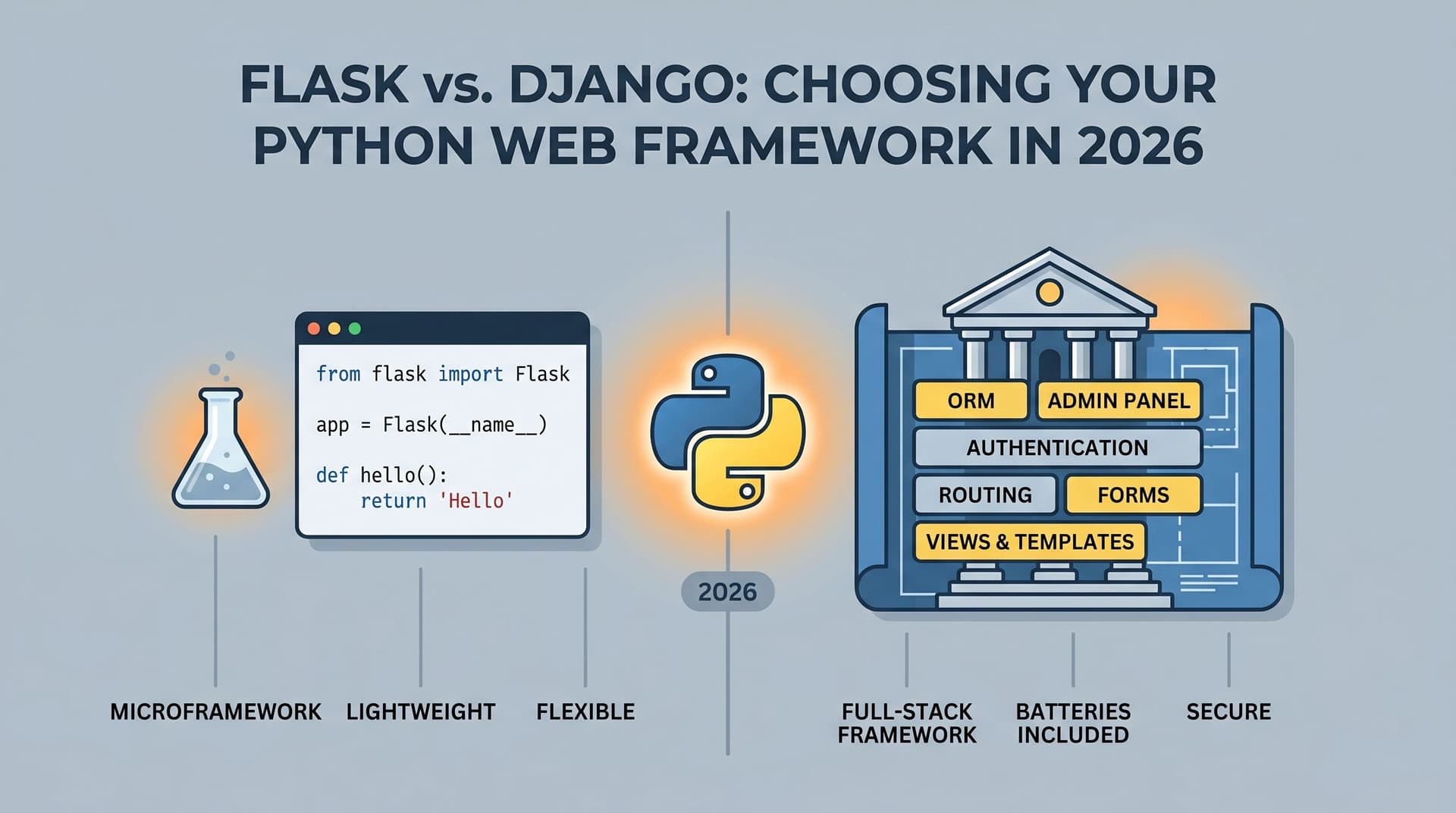
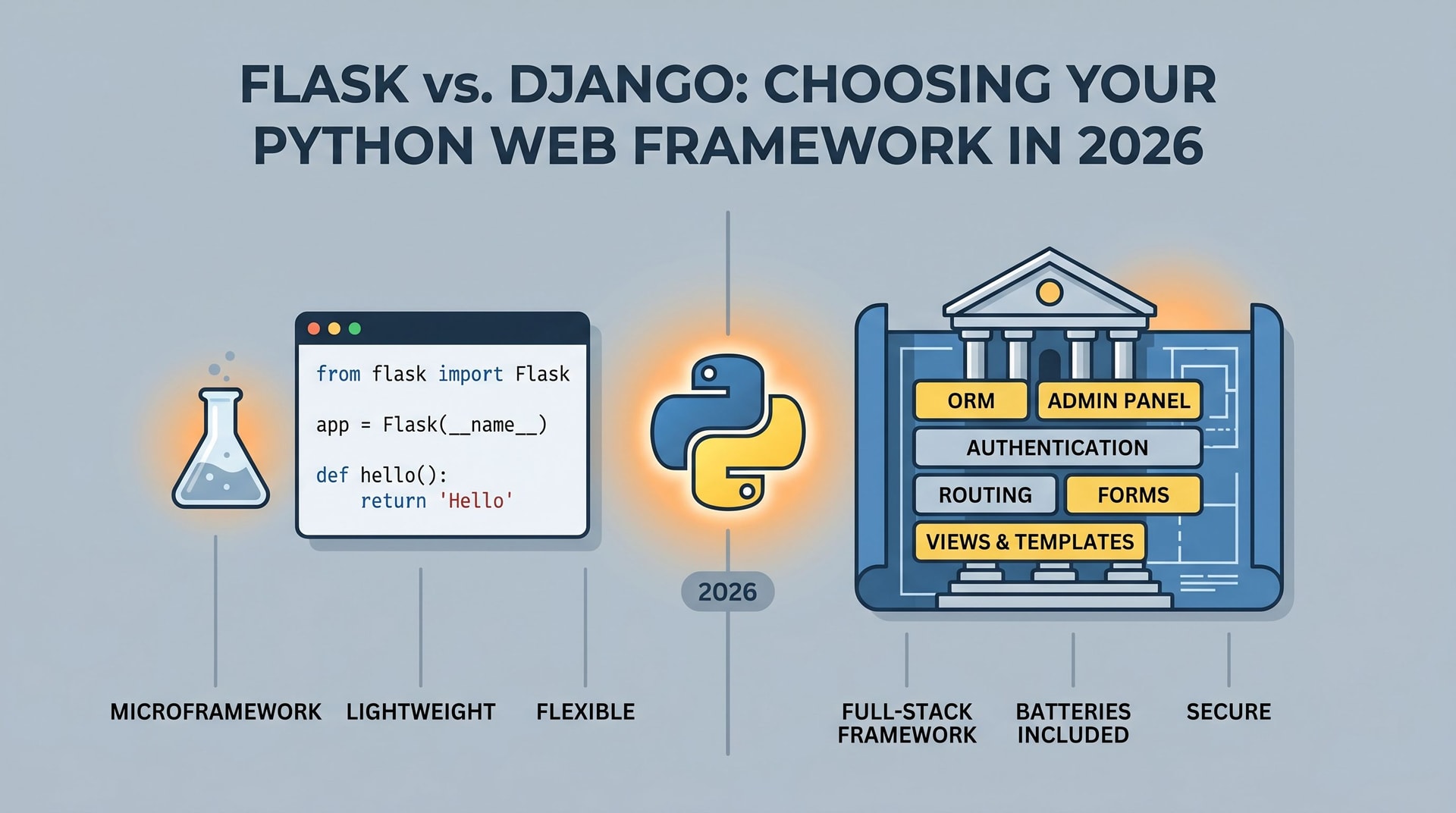
Choosing between Flask and Django is one of the first real decisions in Python web development. This guide compares both frameworks on speed, structure, jobs and salary, and gives you a clear roadmap to job-readiness in 2026.
Confused between Flask and Django? This 2026 guide breaks down both Python frameworks in plain English so you can pick the right one and start building career-ready projects today.
You've learned Python. You can write loops, functions, maybe even pull data from an API. Then you decide to build something real a web app and Google hits you with the same question everyone faces: Flask or Django?
For thousands of fresh graduates and career switchers across Indian metros, this single choice quietly stalls progress. People spend weeks reading opinions instead of building. That stops today.
This guide settles the Flask vs Django question for 2026 not as a code-snob debate, but as a career decision. You'll learn what each framework actually is, how they differ in real projects, what the Indian job market wants, and most importantly, which one you should learn first based on your goal and timeline.
By the end, you won't just have an answer. You'll understand the reasoning well enough to explain it to a junior yourself.
Let's start where most guides skip with what these tools really are.
Flask and Django are both Python web frameworks, but they take opposite approaches. Flask is a lightweight "micro-framework" that gives you the basics and lets you add features as needed. Django is a "batteries-included" framework that ships with almost everything database tools, admin panel, authentication built in.
What Are Flask and Django?
A web framework is a toolkit that handles the repetitive plumbing of building a website routing URLs, talking to a database, rendering pages so you write features instead of reinventing wheels.
Think of it like ordering food in India. Flask is a thali where you start with rice and add only the dishes you want full control, but you assemble the meal. Django is a pre-set combo meal everything arrives together, balanced and ready, but the menu is decided for you.
Flask gives you a minimal core: URL routing and a request system. Want a database, login system, or forms? You choose and plug in libraries yourself. This means freedom and responsibility.
Django arrives loaded. It includes an Object-Relational Mapper (ORM) to talk to databases, a ready-made admin dashboard, user authentication, security protections, and a templating system all following one consistent structure.
Neither is "better." They're built for different jobs. Flask suits small, custom, or experimental apps and APIs. Django suits large, database-heavy applications that need to be built fast and maintained by teams.
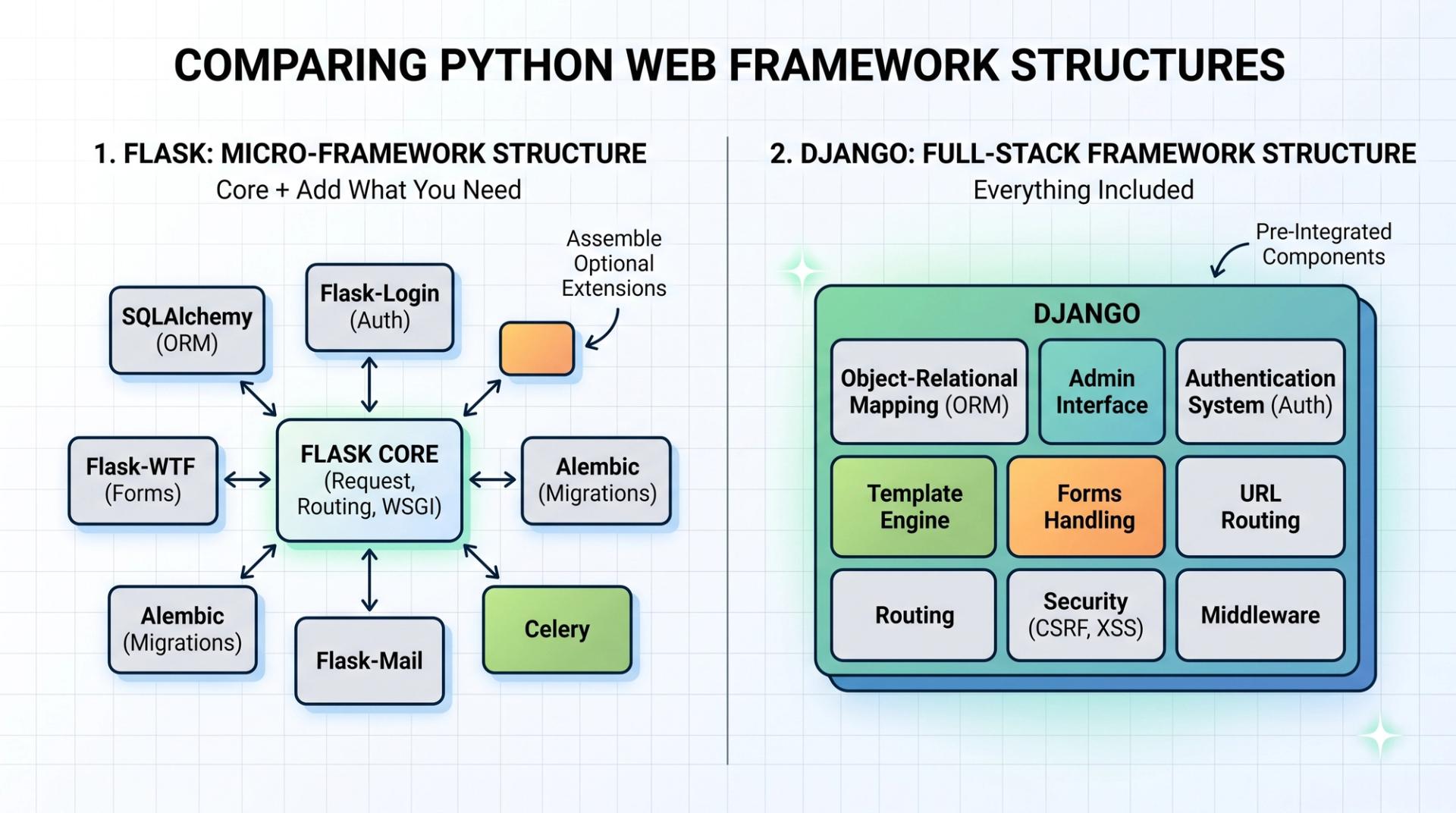
Key Takeaway: Flask hands you a foundation; Django hands you a furnished house.
Why This Choice Matters for Your Career
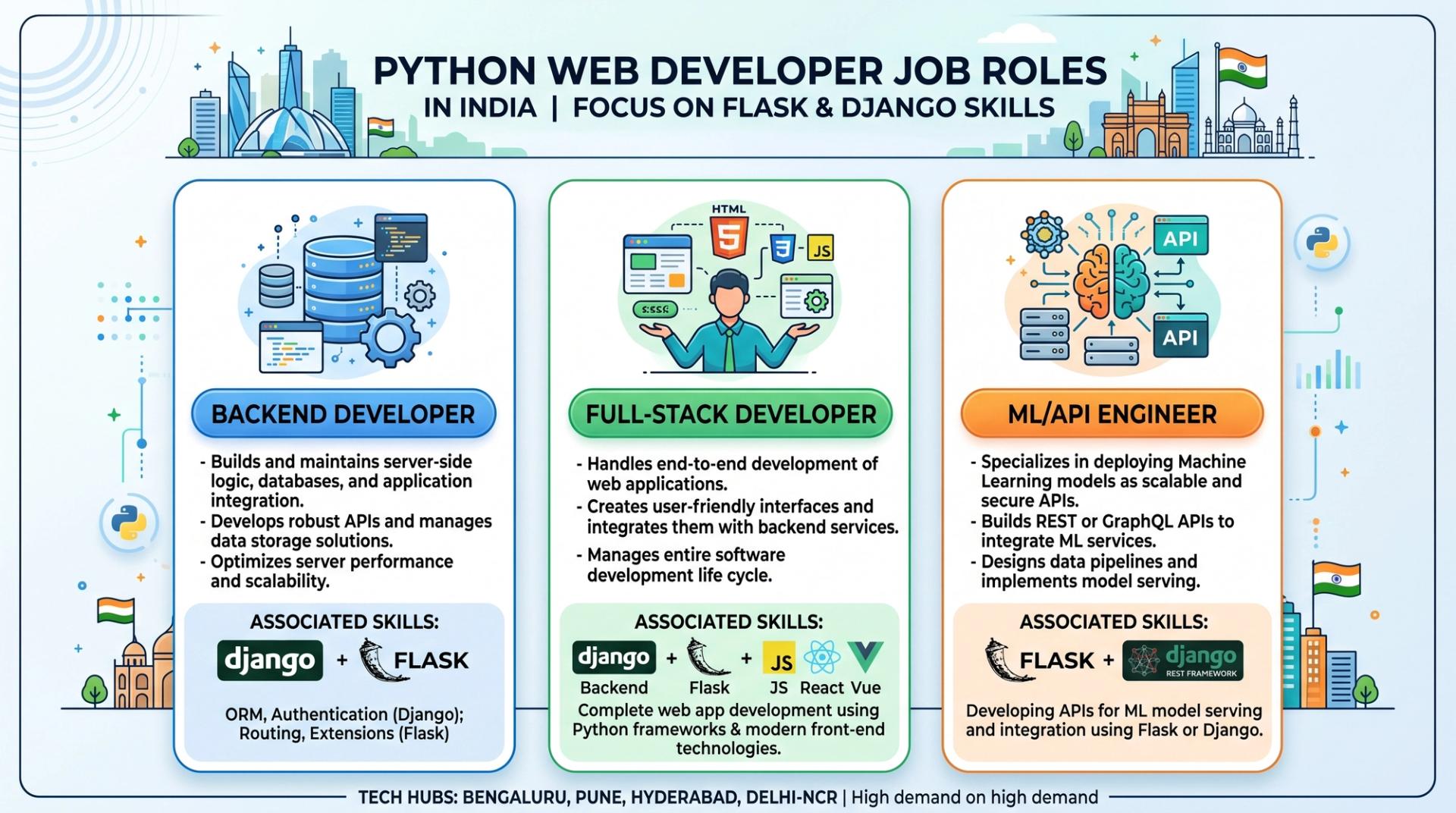
Python's web ecosystem is one of the most reliable on-ramps into a tech career, and both frameworks appear constantly in Indian job listings for backend and full-stack roles.
Here's the 2026 reality. Indian startups and product companies lean heavily on Django because it lets small teams ship secure, database-driven apps quickly. Django skills show up in roles like Backend Developer, Full-Stack Developer, and Python Developer. Flask, being lighter, dominates in microservices, internal tools, machine-learning model deployment, and API-first roles increasingly important as AI products scale.
On compensation, treat all figures as approximate verify with a current salary tool like Glassdoor, AmbitionBox, or LinkedIn Salary. As a rough guide for 2026, an entry-level Python web developer in Indian metros often starts around ₹3–6 LPA, with mid-level developers (2–4 years' experience) frequently in the ₹7–12 LPA range. Specialisation, location, and project depth move these numbers significantly.
The career point is this: employers rarely ask "do you know Flask or Django?" They ask "can you build and ship a working web application?" The framework is the vehicle. Job-readiness is the destination.
Key Takeaway: Employers hire builders who ship the framework is just the tool you shipped with.
Flask vs Django: A Real Comparison
Let's move from theory to something you can see. Below is the entire code for a working "hello world" web page in each framework.
Flask a complete minimal app:
Line by line: you import Flask and create an app.
The @app.route("/") decorator says "when someone visits the homepage URL, run this function."
The home() function returns text to the browser. The last block runs the app in debug mode. One file, ten lines that is the entire app.
Expected output: visiting http://127.0.0.1:5000/ shows Hello from Flask!
Django the same page:
In views.py:
In urls.py:
Django splits the same task across files: views.py holds the logic, urls.py maps URLs to views. It feels heavier because Django first creates a project structure with settings, database config, and an admin module ready to go. Expected output is the same page, but you started with a full skeleton.
That single example explains the whole debate. Here's the broader picture:
Read the table as a mirror of your goal, not a scoreboard. Want to understand web fundamentals deeply and build APIs? Flask. Want to build a complete, data-driven product quickly? Django.
Key Takeaway: Flask shows you how the web works; Django shows you how to ship fast.
Common Beginner Mistakes (and How to Avoid Them)
Most learners lose time not to the framework, but to avoidable habits. Watch for these five:
- Framework-hopping. Switching between Flask and Django every week teaches you neither. Pick one, finish a project, then explore.
- Tutorial loops. Watching ten tutorials without building anything feels productive but isn't. Build before you feel ready that discomfort is the learning.
- Skipping the database layer. Many beginners avoid databases. But real apps store data. Learn the ORM early; it's where job-relevant skill lives.
- Ignoring deployment. An app on your laptop impresses no recruiter. Learn to deploy on a free or low-cost host so your project has a live link.
- No version control. Not using Git makes your work invisible to employers. Push every project to GitHub from day one.
A note on responsible, secure development: Web apps handle user data, so ethics here is practical, not optional. Never store passwords as plain text — both frameworks support secure hashing, so use it. Don't disable security protections like Django's CSRF safeguards just to "make an error go away." Keep debug mode off in production, since it can expose sensitive details. And if your app collects personal data, handle it transparently and follow India's data-protection norms. Secure code isn't an advanced topic it's part of doing the job correctly.
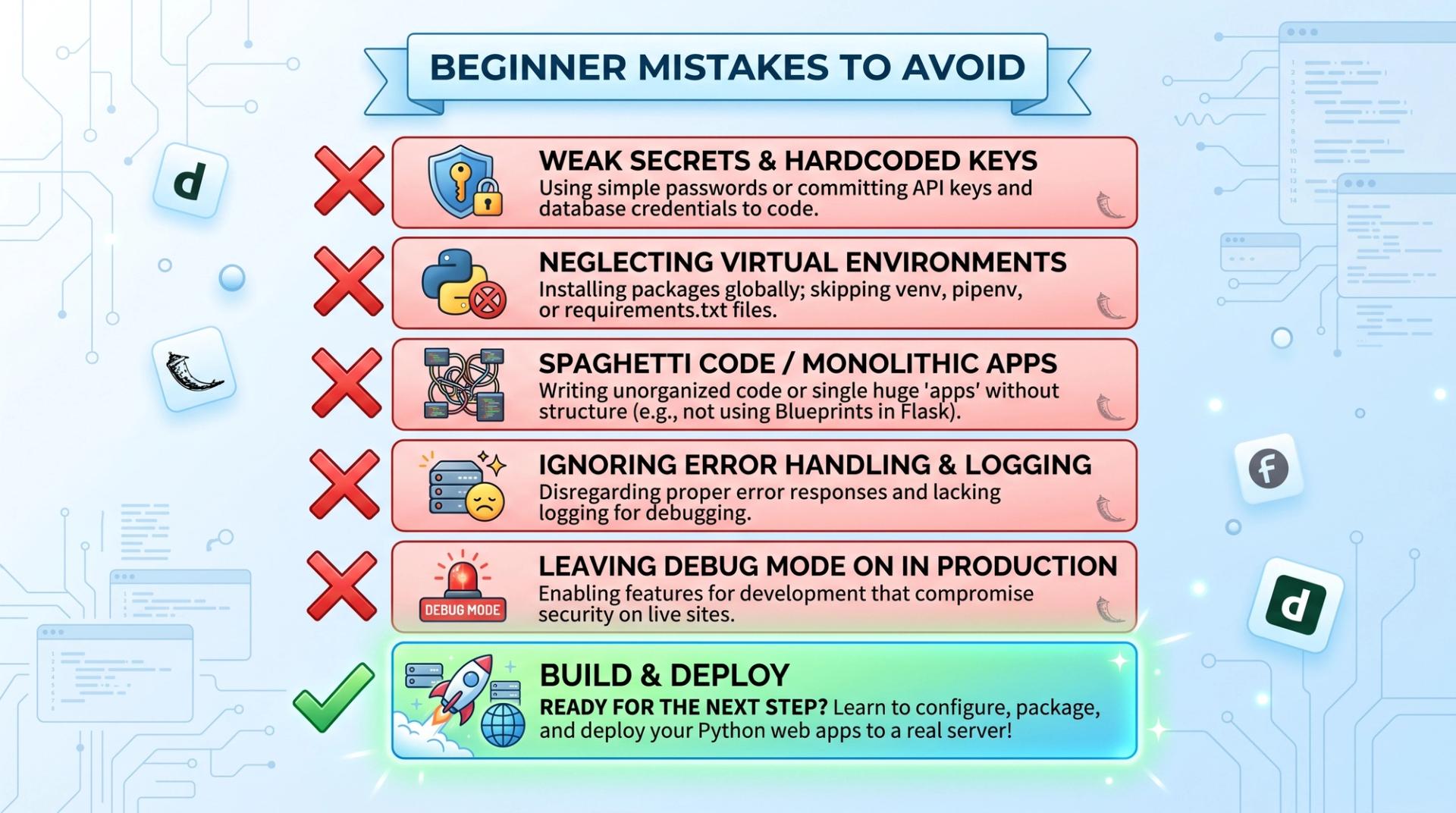
Key Takeaway: Your project's progress depends on your habits, not your framework.
Career Path & Learning Roadmap
Learning a Python framework opens clear doors: Backend Developer, Full-Stack Developer, Python Developer, and API/ML Deployment Engineer roles, plus freelance project work.
Here's a realistic roadmap. After you're comfortable with core Python, spend 3–4 weeks on your chosen framework's fundamentals routing, templates, databases. Then build two real projects (say, a blog and a small API) over the next 4–6 weeks. Add Git, basic HTML/CSS, and one deployment. With consistent effort, many learners reach job-ready, portfolio-backed confidence in roughly four to six months timelines vary with your starting point and study hours.
What to learn next: databases (SQL), REST API design, and the basics of front-end so you can present full-stack work. If you enjoy data-heavy applications, Django pairs naturally with analytics and AI roles.
If you'd rather not assemble this path alone, a structured programme keeps you accountable and project-focused. CDPL's Python programming course takes you from core Python into framework-based web projects with mentor support useful whether you choose Flask or Django.
Key Takeaway: Four to six focused months can take you from "knows Python" to "ships web apps."
FAQ
1. What is the difference between Flask and Django?
Flask is a lightweight Python micro-framework that provides a minimal core, letting you add only the features you need. Django is a full-featured framework that includes a database layer, admin panel, authentication, and security tools out of the box. Flask offers flexibility and control; Django offers speed and structure. Flask suits small apps and APIs, while Django suits large, database-driven applications. Both are excellent the right choice depends on your project and career goal.
2. Should I learn Flask or Django first as a beginner?
If your goal is to understand how web applications work from the ground up, start with Flask its simplicity makes core concepts visible. If your goal is to build complete, real-world products quickly, start with Django. For most beginners aiming for jobs, either works well. The key mistake is switching between both before finishing a project. Pick one, build two complete projects, then explore the other; the second is far easier to learn.
3. Is Flask or Django better for getting a job in 2026?
Both are valued in the Indian job market. Django appears often in startup and product-company backend roles because it ships features fast. Flask is common in microservices, API roles, and machine-learning deployment. Employers care less about the framework name and more about whether you can build and deploy working applications. A strong portfolio in either framework is more important than which one you chose.
4. How long does it take to learn Flask or Django?
With consistent daily practice and a solid Python base, you can learn the fundamentals of either framework in about three to four weeks. Reaching job-ready level with two to three portfolio projects, version control, and one deployment typically takes around four to six months. This timeline is approximate and depends on your starting knowledge, study hours, and whether you learn through a structured course or self-study.
5. Do I need to know Python well before learning Flask or Django?
Yes. Both frameworks assume you're comfortable with Python fundamentals — variables, loops, functions, and ideally basic object-oriented programming. Trying to learn a framework without this foundation usually leads to confusion and frustration. If you're still building Python basics, focus there first. A structured Python programme that bridges core Python into web development can make the transition into Flask or Django much smoother.
Conclusion
Three things to remember. First, Flask and Django aren't rivals they're different tools for different jobs; Flask gives control, Django gives speed. Second, your choice should follow your goal: APIs and deep fundamentals point to Flask, full-featured products point to Django. Third, no framework matters without finished, deployed projects on your GitHub.
If you're still unsure, here's the honest shortcut: pick Django if you want to build complete apps fast, and Flask if you want to understand the web deeply first. Either way, you'll be able to learn the other in a fraction of the time.
If you'd like guided structure, explore CDPL's Python programming course or book a free demo session to map a roadmap to your background. You can also see the full range of programmes on the Cinute Digital homepage.
Tags

A visionary data scientist dedicated to unlocking the potential of data to drive informed decision-making and spark innovation. With a strong foundation in Data Science.