
Learn Prompt Engineering from Scratch (No Code Needed)
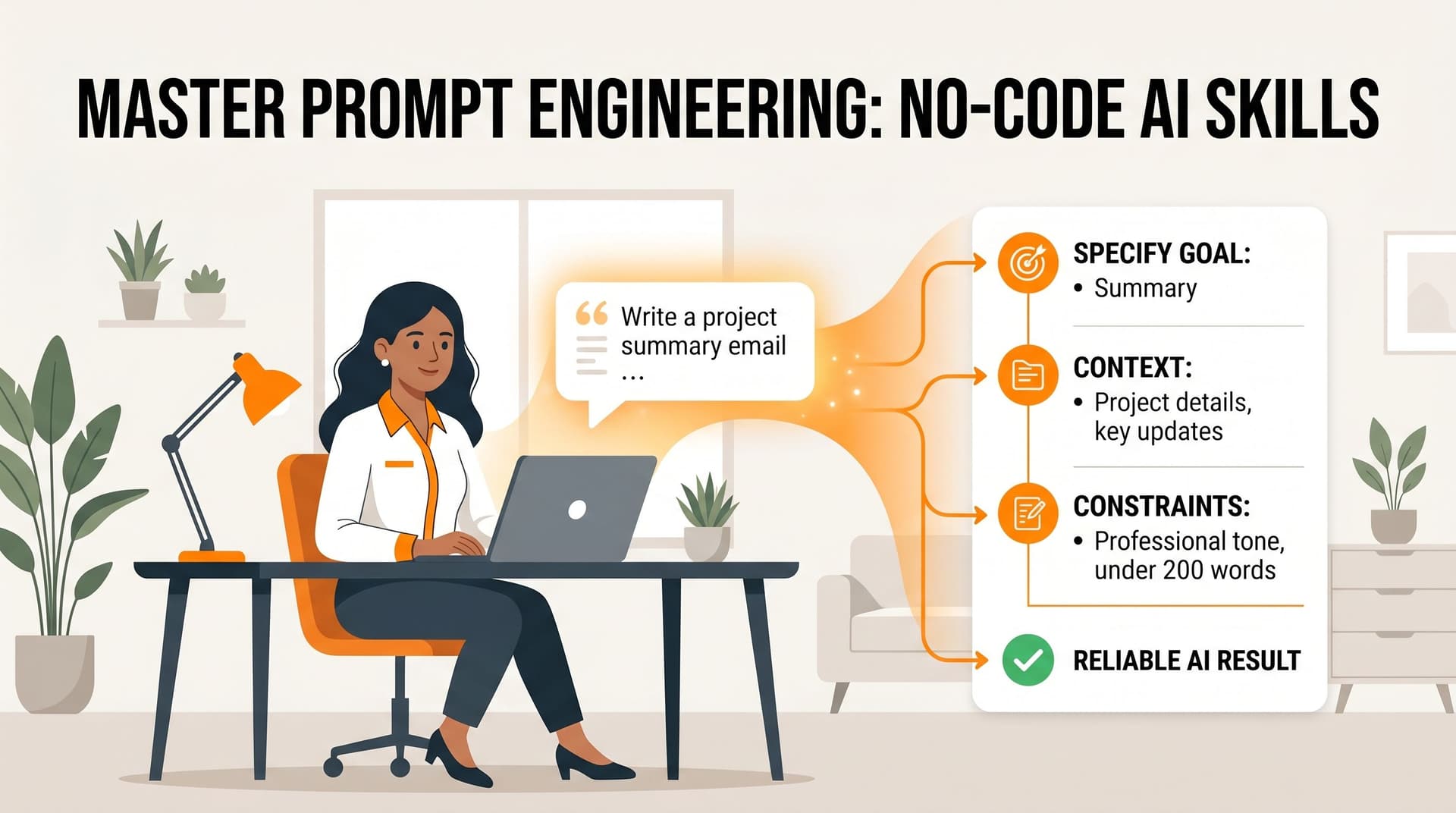
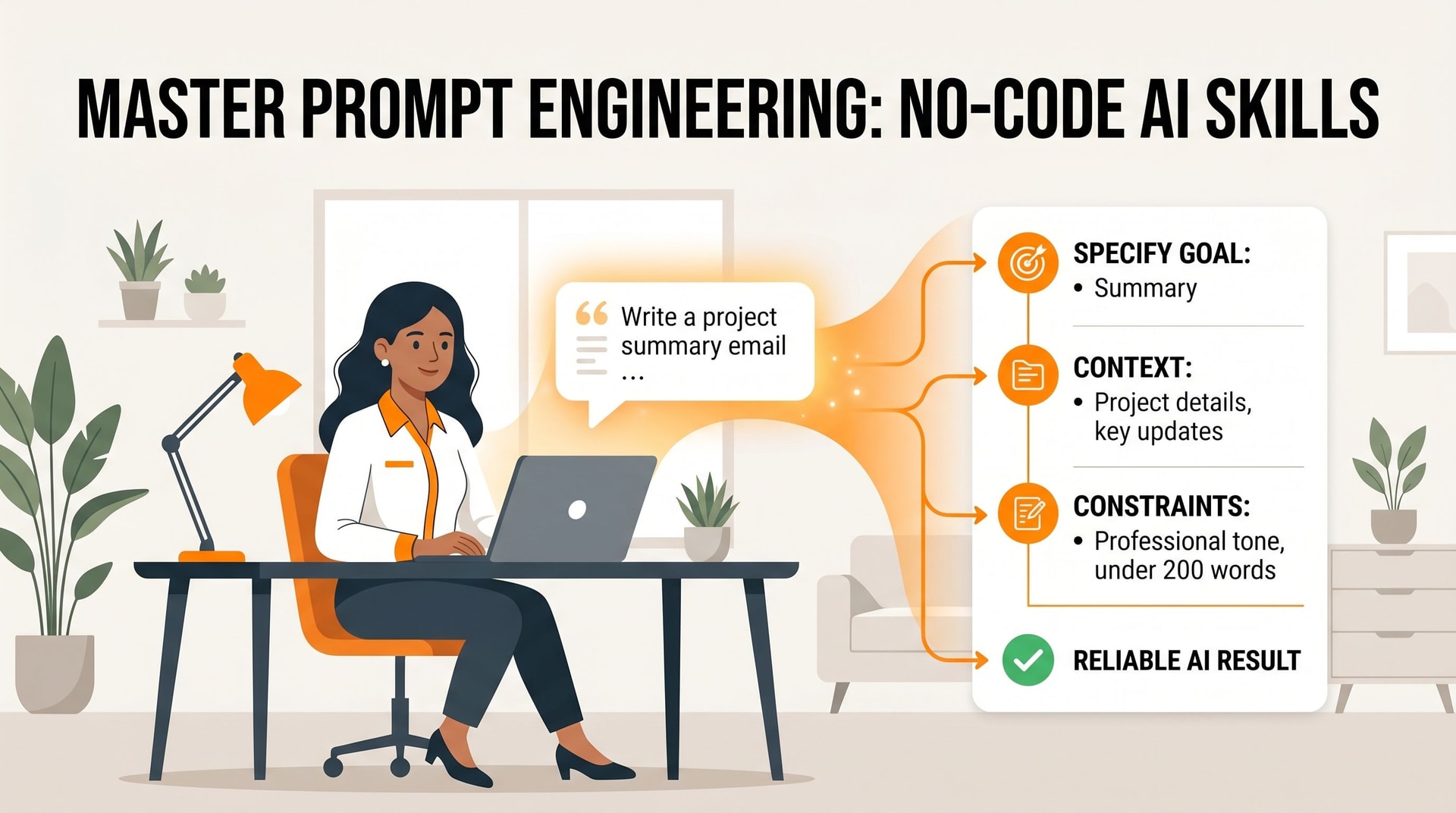
Prompt engineering is the skill of talking to AI tools so they actually do what you want and you don't need to code to learn it. This beginner guide breaks down the core frameworks, real mistakes to avoid, and the career paths it opens in India.
Think AI is only for coders? It isn't. Prompt engineering is a pure communication skill and this guide takes you from confused to confident, no programming required.
Picture this. Your colleague pastes a question into ChatGPT, gets a brilliant answer in ten seconds, and moves on. You type something similar and get vague, generic mush. Same tool, very different results. The difference is not luck or coding it is prompt engineering.
Here is the good news. Prompt engineering is a communication skill, not a programming one. If you can explain a task clearly to a junior teammate, you already have the raw ability. You just need the structure.
In this guide, you will learn what prompt engineering actually is, the five core techniques that power great results, the mistakes that quietly ruin most prompts, and the career paths this skill opens up in India all without writing a single line of code.
Let us start with the part everyone gets wrong: what prompt engineering really means.
Prompt engineering is the practice of designing clear, structured instructions (prompts) that guide an AI model to produce accurate, useful, and consistent outputs. It combines plain-language communication, logical structure, and a basic understanding of how AI interprets your words no coding is required to learn or apply it.
What Is Prompt Engineering, Really?
A prompt is simply the instruction you give an AI tool. Prompt engineering is the skill of writing that instruction well enough to get a reliable result every time.
Think of an AI model as a brilliant new intern on their first day. This intern has read almost the entire internet, works at lightning speed, and never gets tired. But they know nothing about your situation, your audience, or your standards. If you say "write something about our product," you will get something just not what you wanted.
Now imagine you are giving directions outside a Mumbai chai stall. "Go that way" is technically a direction. "Walk straight for two minutes, turn left at the pharmacy, my office is the blue building" gets the person there reliably. Prompting works exactly the same way. Vague in, vague out. Specific in, useful out.
This is why prompt engineering does not need code. You are not programming the machine. You are briefing it using ordinary language, structured well. The skill lives in clarity, context, and format, not in Python.
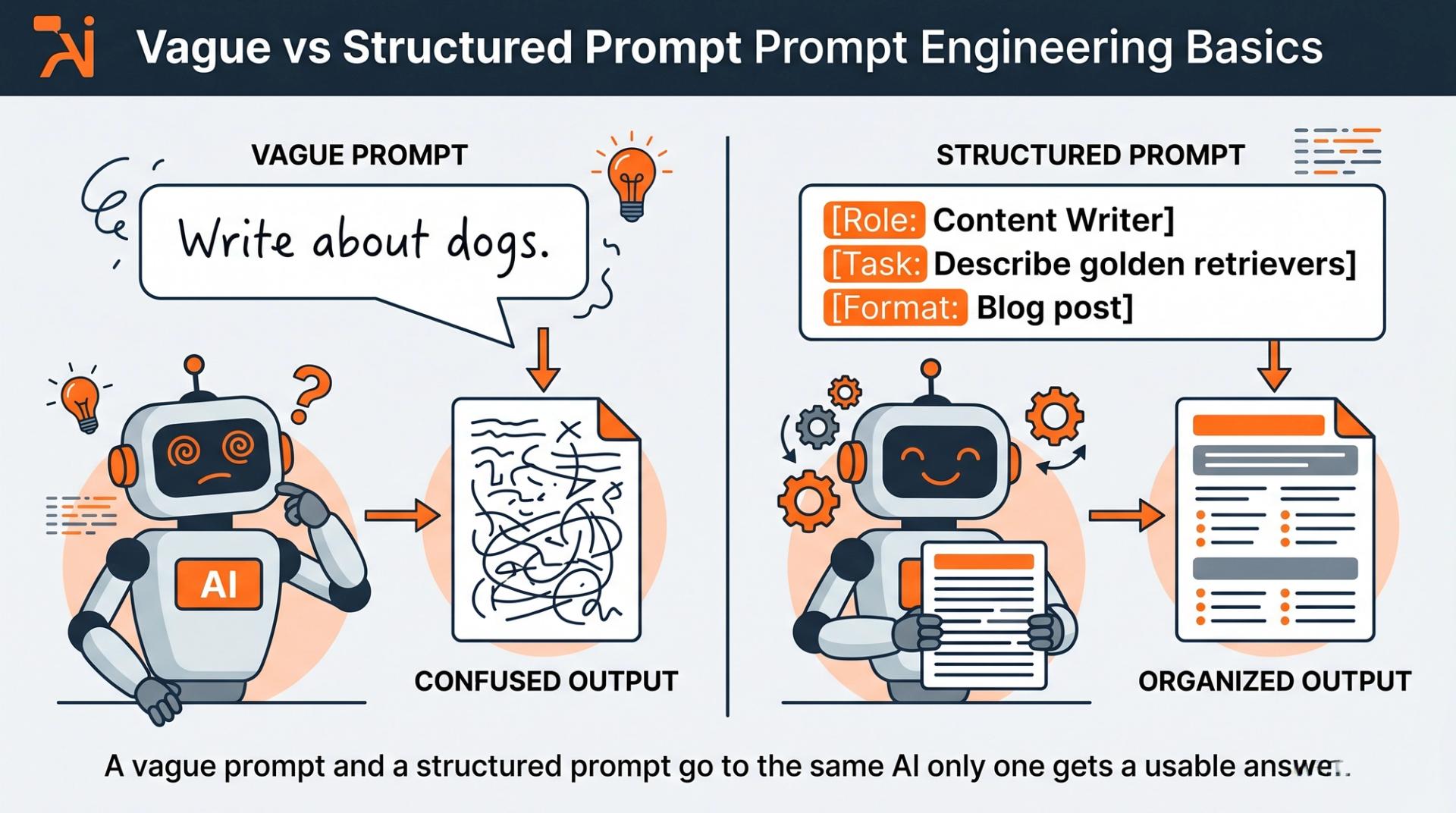
Key Takeaway: Prompt engineering is briefing, not coding you are giving a capable intern a crystal-clear brief.
Why Prompt Engineering Matters Right Now
Generative AI has moved from novelty to daily workflow tool across Indian workplaces. Marketers draft campaigns with it, analysts summarise reports, recruiters screen profiles, and support teams write replies. In almost every one of these roles, the person who prompts well simply produces more, faster.
That shift has created real demand. Job descriptions increasingly list "AI literacy" or "experience with generative AI tools" as a plus and sometimes a requirement. You will see prompt skills baked into roles like content strategist, marketing executive, business analyst, customer experience specialist, and AI/automation associate.
On pay: dedicated "Prompt Engineer" titles in India have reported wide salary ranges, and most professionals instead use prompting inside an existing role to boost their value. Treat any figure you see online as approximate verify with a current salary tool like AmbitionBox or Glassdoor before quoting it. The more dependable truth is simpler: AI fluency makes you more promotable in the job you already want.
There is also a timing advantage. Because the field is young, employers rarely expect a degree in it. A clear portfolio of strong prompts and small AI projects can speak louder than credentials which is excellent news if you are switching careers. If you want a structured path into the broader field, CDPL's Artificial Intelligence training in Mumbai is built around exactly this kind of practical, job-focused learning.
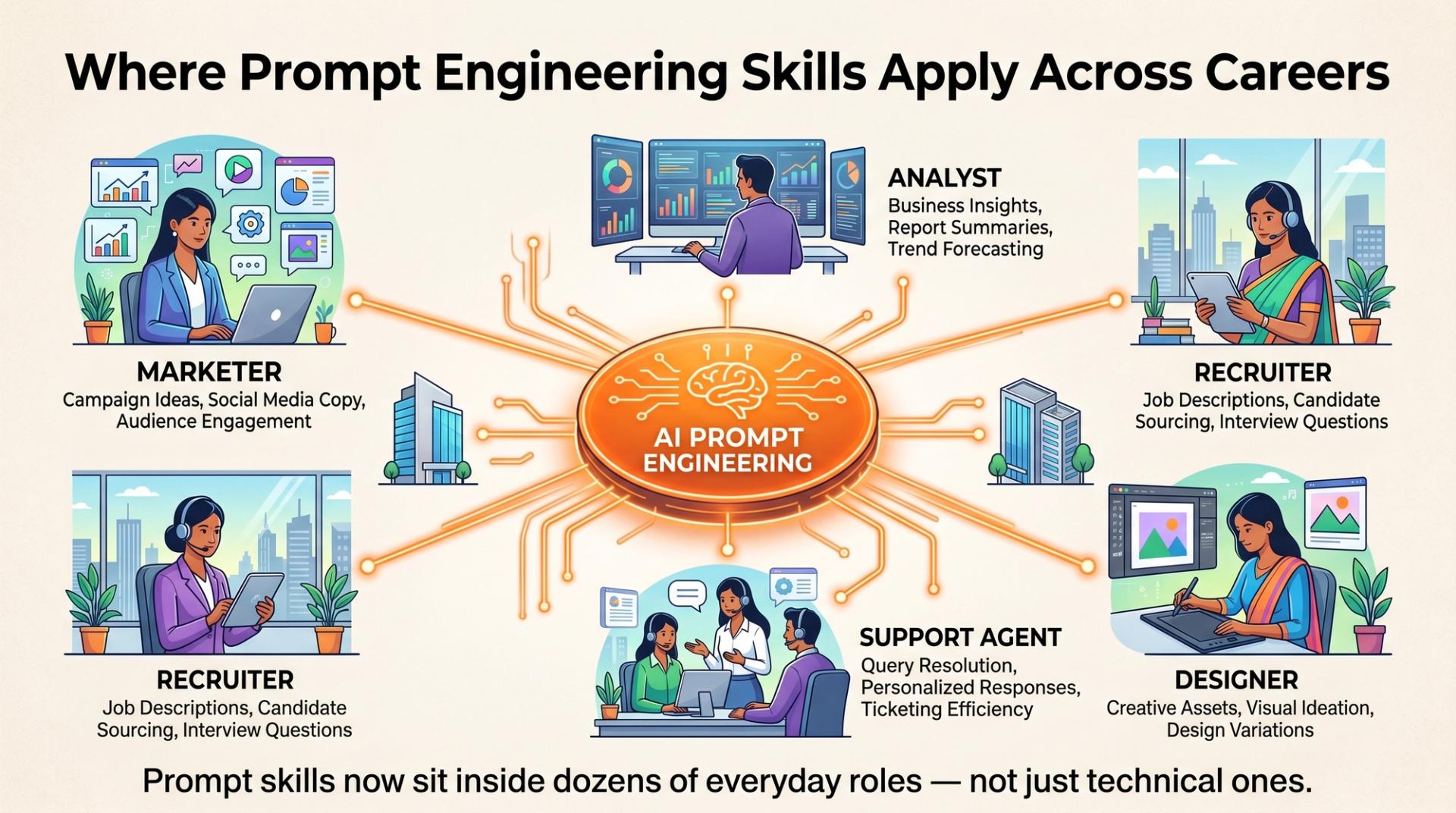
Key Takeaway: You rarely need a "prompt engineer" title prompting well makes you more valuable in the role you already want.
The 5 Core Prompt Engineering Techniques (Step-by-Step)
Here is the practical heart of this guide. Master these five techniques, in order, and you will outperform 90% of casual AI users. Every example below is plain text no code anywhere.
Step 1: Set a clear Role. Tell the AI who it should be. A role narrows its huge knowledge into the right lane.
Weak: "Write about diabetes." Strong: "You are a dietician writing for Indian readers with limited time. Explain diabetes-friendly breakfast options."
Step 2: Define a sharp Task. State exactly what you want done, with limits.
Strong: "List 5 budget-friendly breakfast ideas. Each under 30 words. Use common Indian ingredients."
Step 3: Lock the Format. Tell it how the answer should look list, table, paragraph, word count, tone.
Strong: "Reply as a numbered list. Friendly tone. No medical jargon."
This Role → Task → Format pattern is the backbone of professional prompting. Once it feels natural, layer on the next two.
Step 4: Give an example (few-shot prompting). Show the AI one or two samples of what "good" looks like, and it will copy the pattern.
Strong: "Rewrite each review in this style. Example: 'Loved it!' → 'A customer shared genuine delight with the product.' Now rewrite these: …"
Step 5: Ask it to think step-by-step (chain-of-thought). For anything involving reasoning, logic, or maths, simply add "think step by step before answering." Accuracy jumps noticeably.
Here is a quick comparison of when to reach for each technique:
The sixth skill is unofficial but vital: iteration. Your first prompt is a draft. Read the output, spot what is off, and refine one thing at a time. Great prompting is a short conversation, not a one-shot lottery. If you want to go deeper into how AI actually generates these answers, CDPL's Deep Learning, NLP and Generative AI course explains the engine behind the prompts.
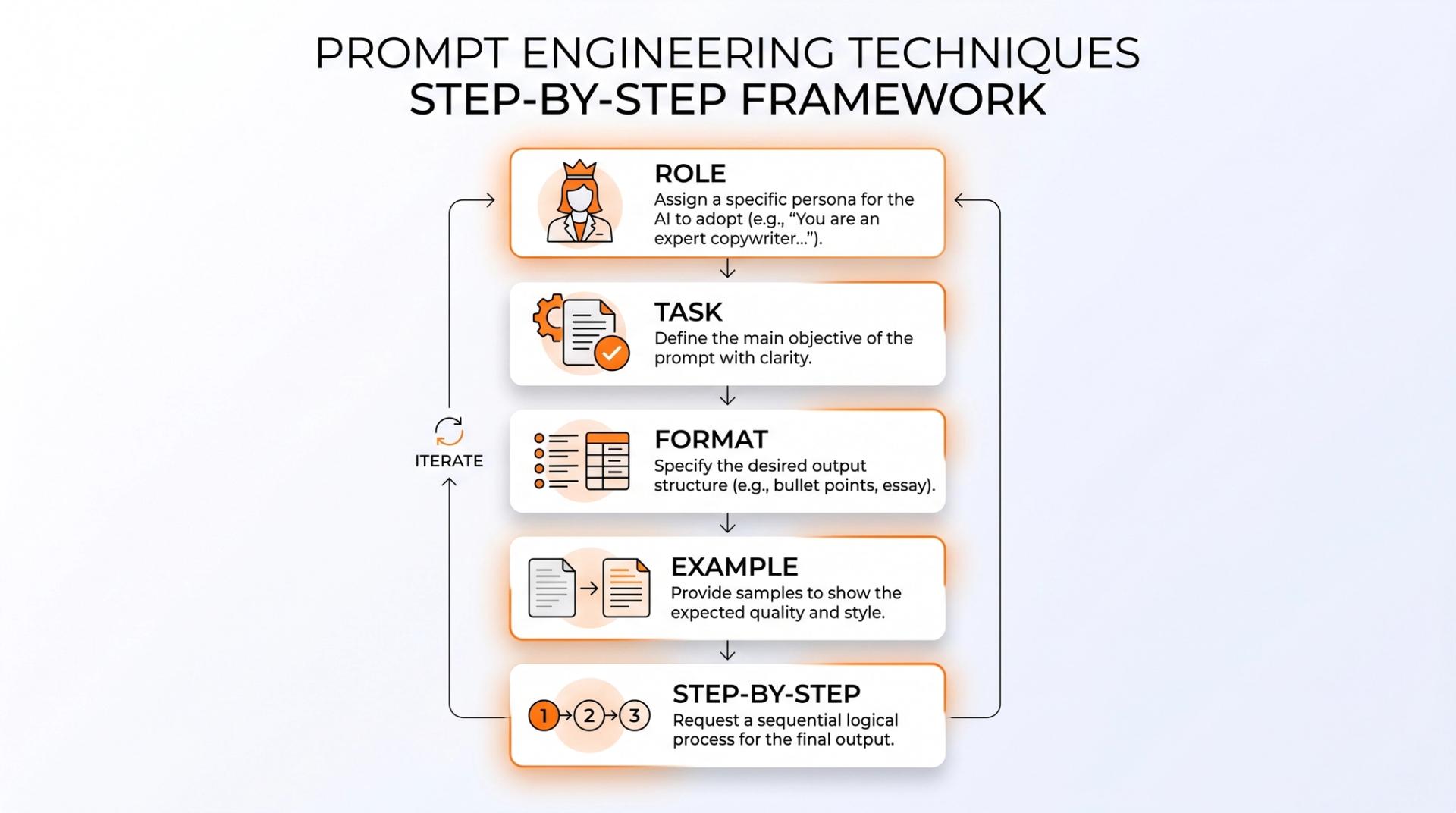
Key Takeaway: Role → Task → Format gets you 80% of the way; examples and step-by-step thinking get you the rest.
Practical Tips, Common Mistakes & Responsible AI
Knowing the techniques is half the battle. Avoiding these beginner mistakes is the other half.
- Mistake 1: Being polite but vague. "Can you help me with my resume?" wastes a turn. Give the role, the job, and the format instead.
- Mistake 2: Stuffing ten asks into one prompt. The AI loses focus. Break big jobs into smaller, sequential prompts.
- Mistake 3: Never giving context. Paste the relevant details your audience, your goal, your constraints. Context is the single biggest quality lever.
- Mistake 4: Accepting the first answer. Treat output as a draft. One round of "make it shorter and more specific" usually transforms it.
- Mistake 5: Trusting facts blindly. AI can sound confident and still be wrong. Always verify names, numbers, dates, and legal or medical claims.
A responsible-AI note you should not skip. Because prompting handles real information, practise it ethically. Never paste confidential client data, personal IDs, passwords, or proprietary company material into public AI tools it may be stored or exposed. Respect copyright when generating content, label AI-assisted work honestly where your employer requires it, and double-check any output before it reaches a customer. Good prompt engineers are also careful data citizens. This habit alone will set you apart in interviews.
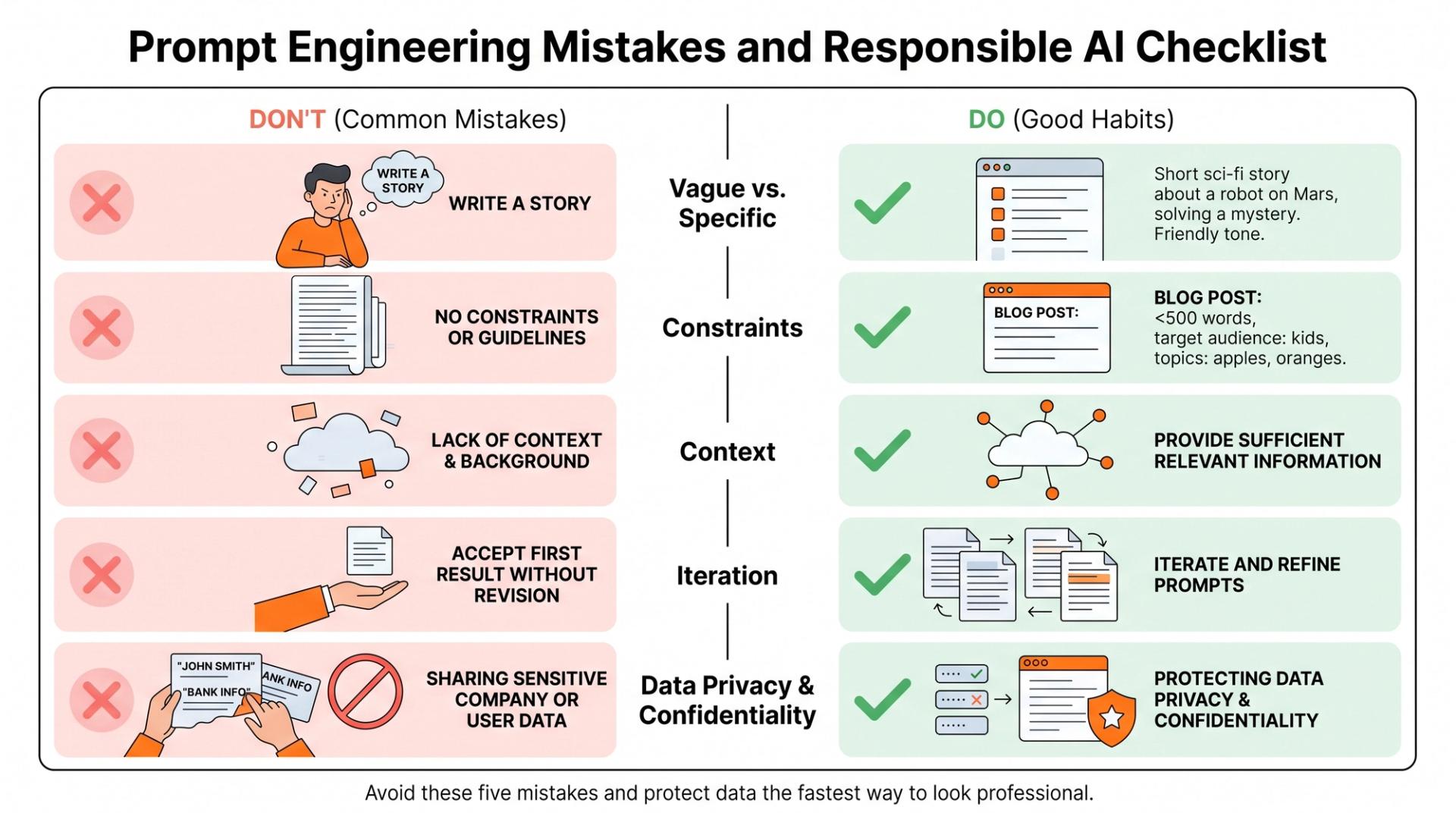
Key Takeaway: Context plus careful verification beats clever wording and never feed AI confidential data.
Career Path & Learning Roadmap
So where can this take you? Prompt skills slot directly into roles like AI content writer, marketing executive, business/data analyst, customer-experience associate, and AI-automation coordinator. As you grow, they feed into deeper paths in generative AI, data science, and applied machine learning.
Here is a realistic, no-code roadmap to job-readiness:
- Weeks 1–2: Master Role → Task → Format on a free tool. Write daily.
- Weeks 3–4: Add few-shot examples and step-by-step prompting. Build a small "prompt library" for one role you want.
- Weeks 5–8: Complete 3–4 mini projects a marketing campaign, a report summary, a Q&A assistant and save them as a portfolio.
- Ongoing: Learn how the models work and where to specialise.
With consistent effort, you can reach a confident, portfolio-ready level in roughly 6–10 weeks (this is a guideline, not a guarantee pace varies by person and hours). A structured programme shortens this curve and gives you mentor feedback. CDPL's Prompt Engineering with Gen AI course is designed for exactly this beginner-to-job-ready journey, while marketers who want to apply prompting to campaigns may prefer the hands-on Digital Marketing with AI Bootcamp.
Key Takeaway: A focused 6–10 week plan with real projects can take a complete beginner to portfolio-ready.
Q1. What is prompt engineering in simple words?
Prompt engineering is the skill of writing clear instructions for AI tools like ChatGPT so they give you accurate, useful answers. Instead of typing a vague question, you tell the AI who to act as, what to do, and how to format the reply. It is a communication skill, not a coding skill anyone who can brief a colleague clearly can learn it with practice and a simple framework.
Q2. How do I learn prompt engineering from scratch with no coding?
Start with a free AI tool and learn one framework: Role → Task → Format. Write at least one structured prompt every day. After a week, add examples (few-shot) and "think step by step" for reasoning tasks. Then build small projects a marketing post, a report summary and save them. No programming is involved at any stage; you only need clear writing, curiosity, and consistent practice over a few weeks.
Q3. Is prompt engineering a good career in India in 2026?
It is a valuable, fast-growing skill, though pure "Prompt Engineer" job titles are still limited. More commonly, prompt skills boost roles in marketing, analytics, content, support, and AI-automation making you more promotable. Because the field is young, employers often value a strong portfolio over formal degrees. Treat any salary figure you see online as approximate and verify it with a current tool before relying on it.
Q4. How long does it take to become good at prompt engineering? Most beginners reach a confident, portfolio-ready level in roughly 6–10 weeks with regular practice this is a guideline, not a guarantee, since it depends on your hours and consistency. You can write genuinely useful prompts within your very first week. A structured course with mentor feedback usually shortens the learning curve and helps you build real projects faster than self-study alone.
Q5. Do I need to know programming or maths for prompt engineering?
No. Prompt engineering relies on clear language and logical structure, not on code or advanced maths. You are briefing the AI in plain English, not building it. Programming helps only if you later want to connect AI to apps through tools and APIs an optional, advanced step. To simply use AI well and apply prompting in a job, strong communication and structured thinking are all you need.
Conclusion
Let us recap the three things that matter most. First, prompt engineering is a communication skill clarity and structure, not code. Second, the Role → Task → Format pattern, plus examples and step-by-step thinking, will carry you further than any "magic prompt." Third, in India's fast-moving job market, AI fluency makes you more valuable in almost any role you choose.
You do not need a technical background to start. You need curiosity, a free AI tool, and a little structure all of which you now have.
If you would like guided practice, mentor feedback, and a portfolio to show employers, explore CDPL's AI programmes or simply book a free demo class and ask your questions directly. Either way, open an AI tool today and write one structured prompt. That single habit is where every prompt engineer begins.
Tags

Seasoned Business Intelligence and learning and development professional with over 11 years of experience empowering students and professionals to unlock career success through data-driven skills. Specializing in Power BI, Tableau, and Prompt Engineering, Ashish is known for delivering practical, high-impact workshops and training programs across academic and corporate sectors.