
The 4 Pillars of OOPs in Python: Encapsulation, Abstraction, Inheritance & Polymorphism
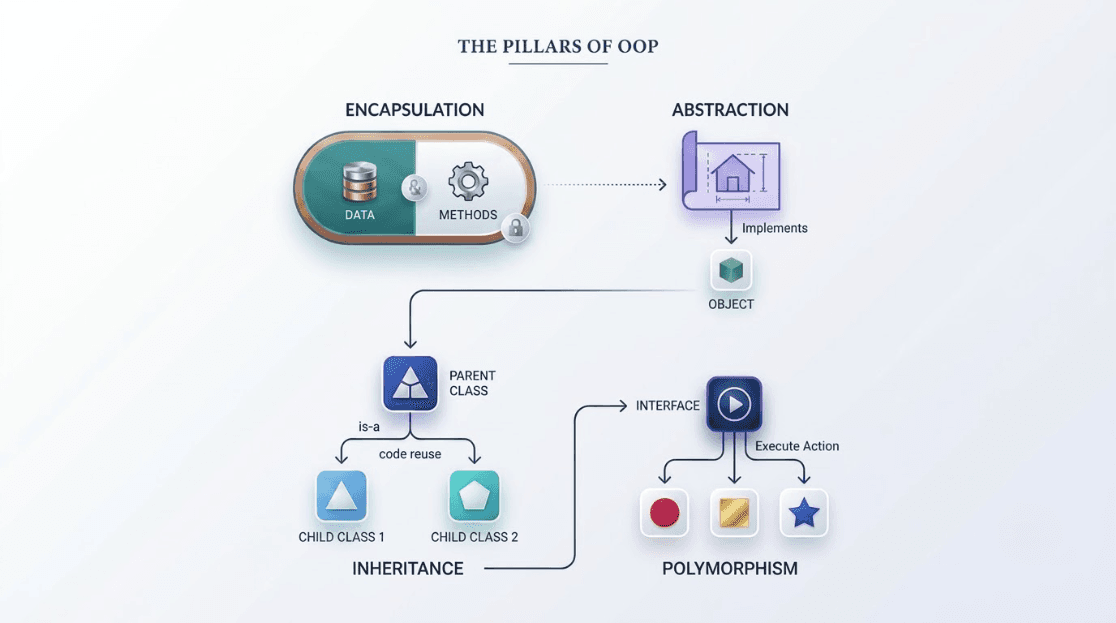
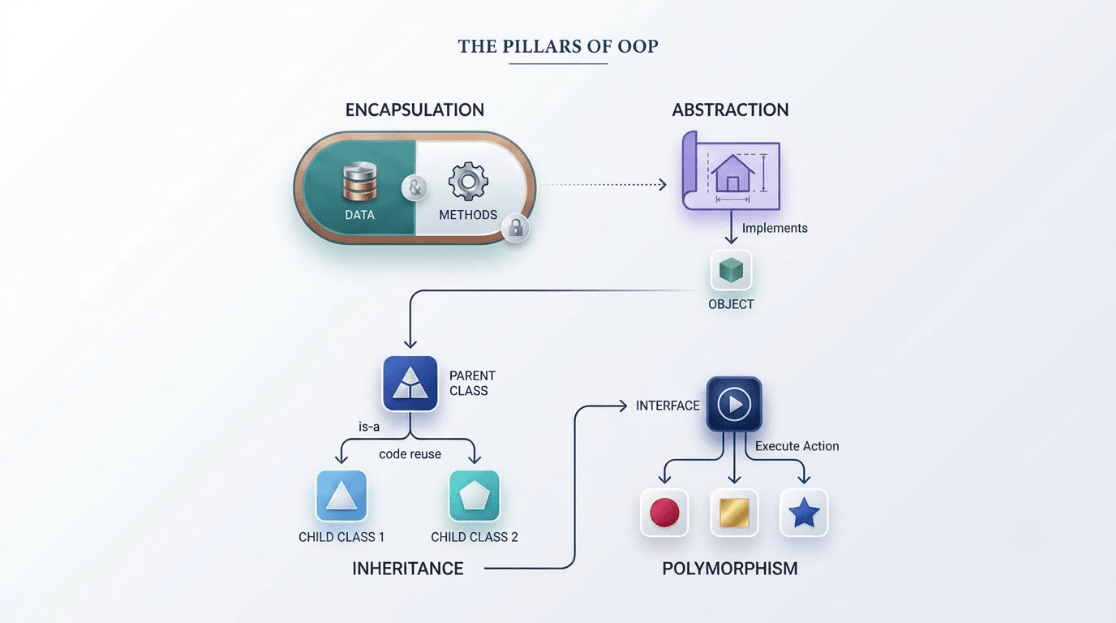
The four pillars of OOPs in Python are Encapsulation, Abstraction, Inheritance and Polymorphism. Each explained with runnable code, plus the Python-specific behaviour most tutorials get wrong.
The 4 pillars of OOPs in Python are Encapsulation, Abstraction, Inheritance and Polymorphism. Each one explained with working code examples and the Python-specific catches.
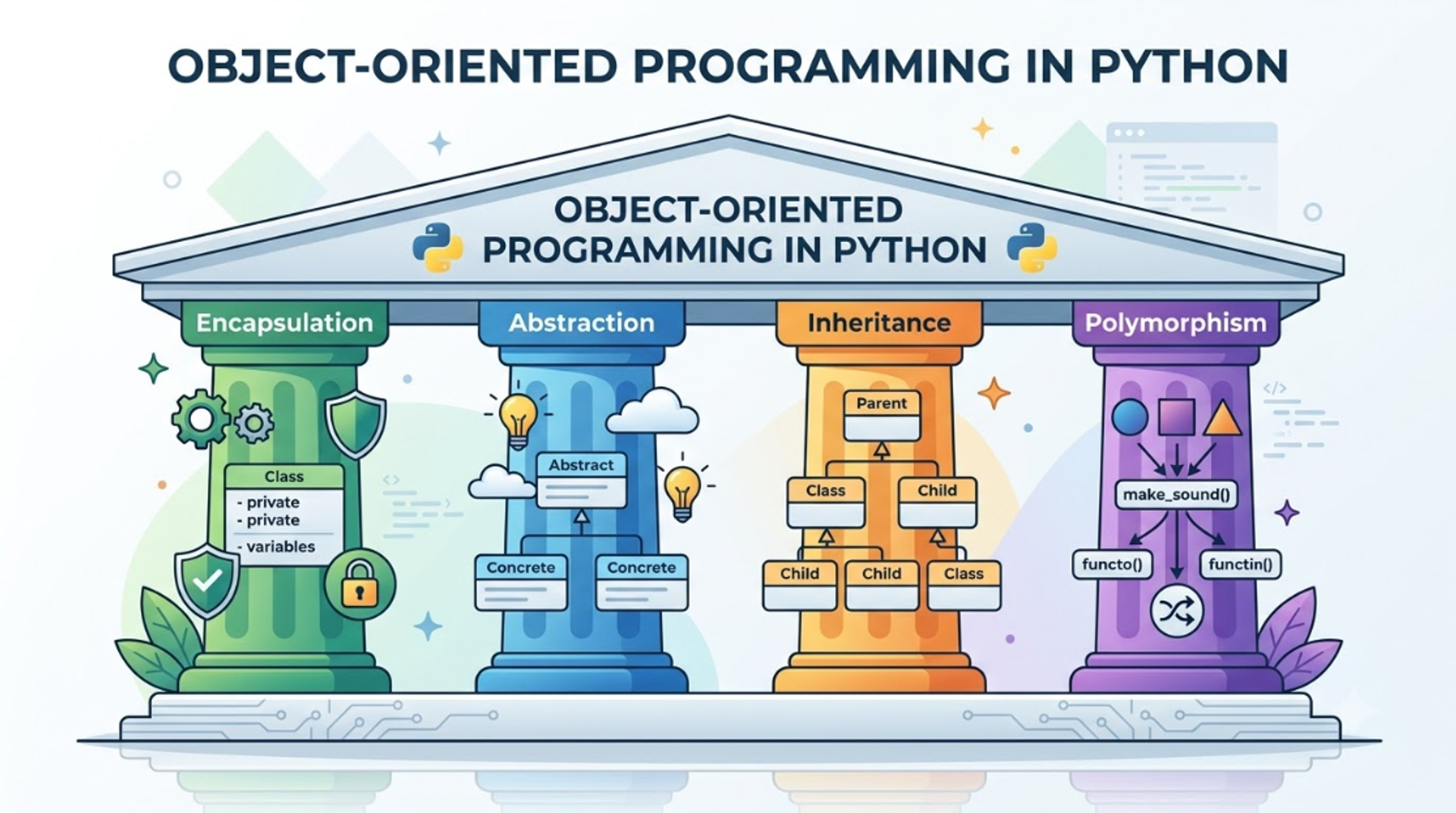
The four pillars of OOPs in Python are Encapsulation, Abstraction, Inheritance and Polymorphism. Every object-oriented language rests on these four ideas, but Python implements some of them very differently from Java or C++ and that difference is exactly where most learners get stuck in interviews.
This guide explains each pillar with code you can run, and flags the Python-specific behaviour that generic OOP tutorials skip.
First, what does OOP actually mean?
Object-oriented programming organises code around objects bundles of data and the functions that operate on that data instead of loose functions passing values around.
A class is the blueprint. An object is one thing built from it.
Student is the class. s is an object. __init__ runs automatically when you create one, and self is how an object refers to itself.
That is the foundation. The four pillars are the principles built on top of it.
Pillar 1: Encapsulation
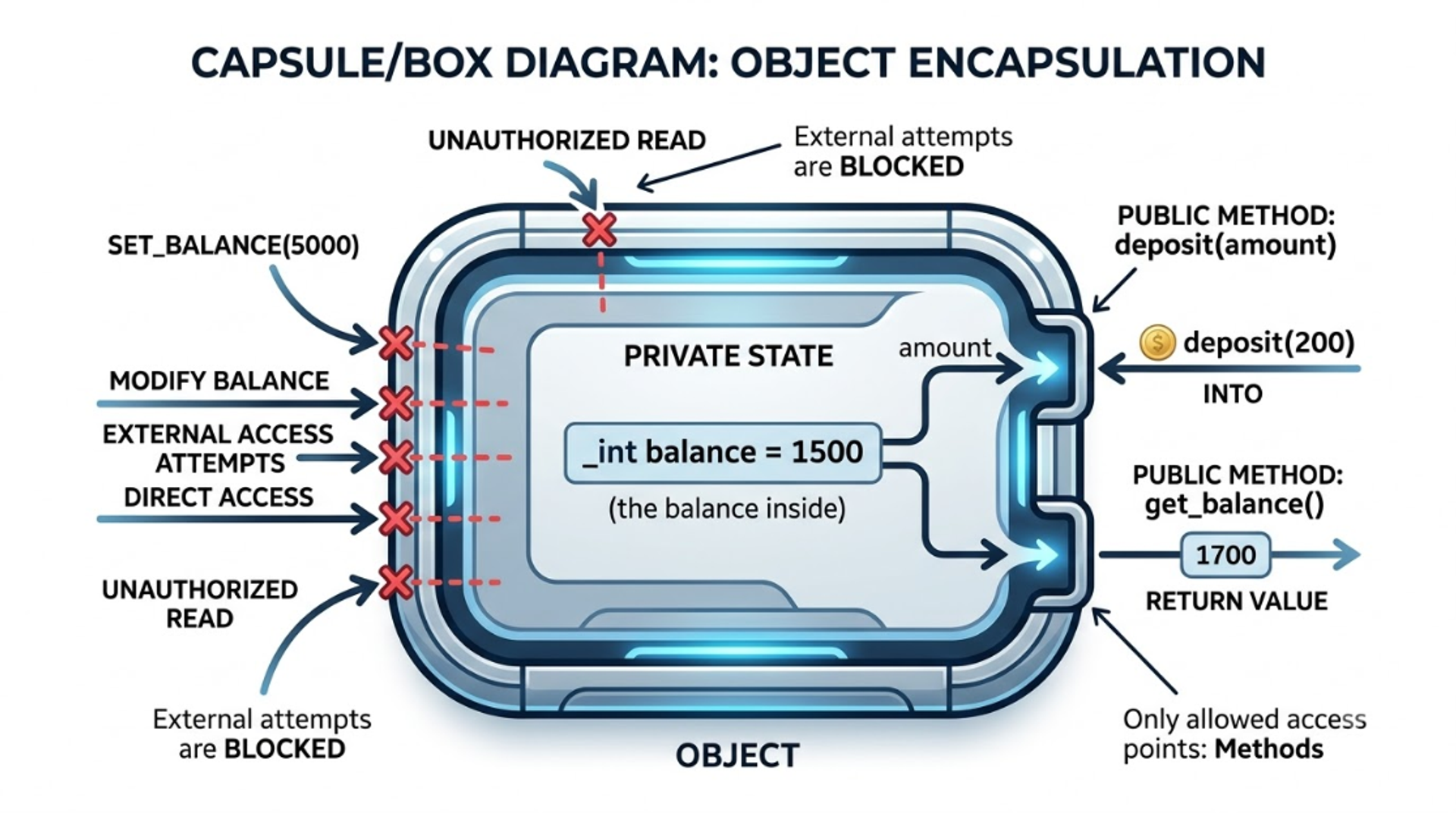
Encapsulation means keeping an object's data and the methods that change it together, and controlling access to that data from outside.
The idea: an object should protect its own state. Other code asks the object to do something rather than reaching in and editing its variables directly.
Because deposit() guards the value, nobody can set a negative balance by accident. That is encapsulation working.
The Python catch nobody mentions
Here is where Python differs from Java, and where interviewers probe:
Python has no truly private variables. The double underscore does not lock anything it triggers name mangling. Python quietly renames _ _balance to _BankAccount_ _balance.
So the data is discouraged from outside access, not prevented. Python's convention is:
If someone tells you _ _ makes a variable private in Python, they have learned OOP from a Java tutorial. Say "name mangling" in your interview and you will stand out.
Pillar 2: Abstraction
Abstraction means exposing what something does while hiding how it does it.
You drive a car without knowing how combustion works. The steering wheel is the interface; the engine is the hidden implementation.
In Python, abstraction is enforced with the abc module:
Two things happen here. TestCase cannot be created directly, and any subclass that forgets to define run() fails immediately rather than silently doing nothing.
That last part matters in real projects: the error arrives at the class definition, not three weeks later in production.
Abstraction vs Encapsulation
These two get confused constantly, and it is a standard interview question.
Pillar 3: Inheritance
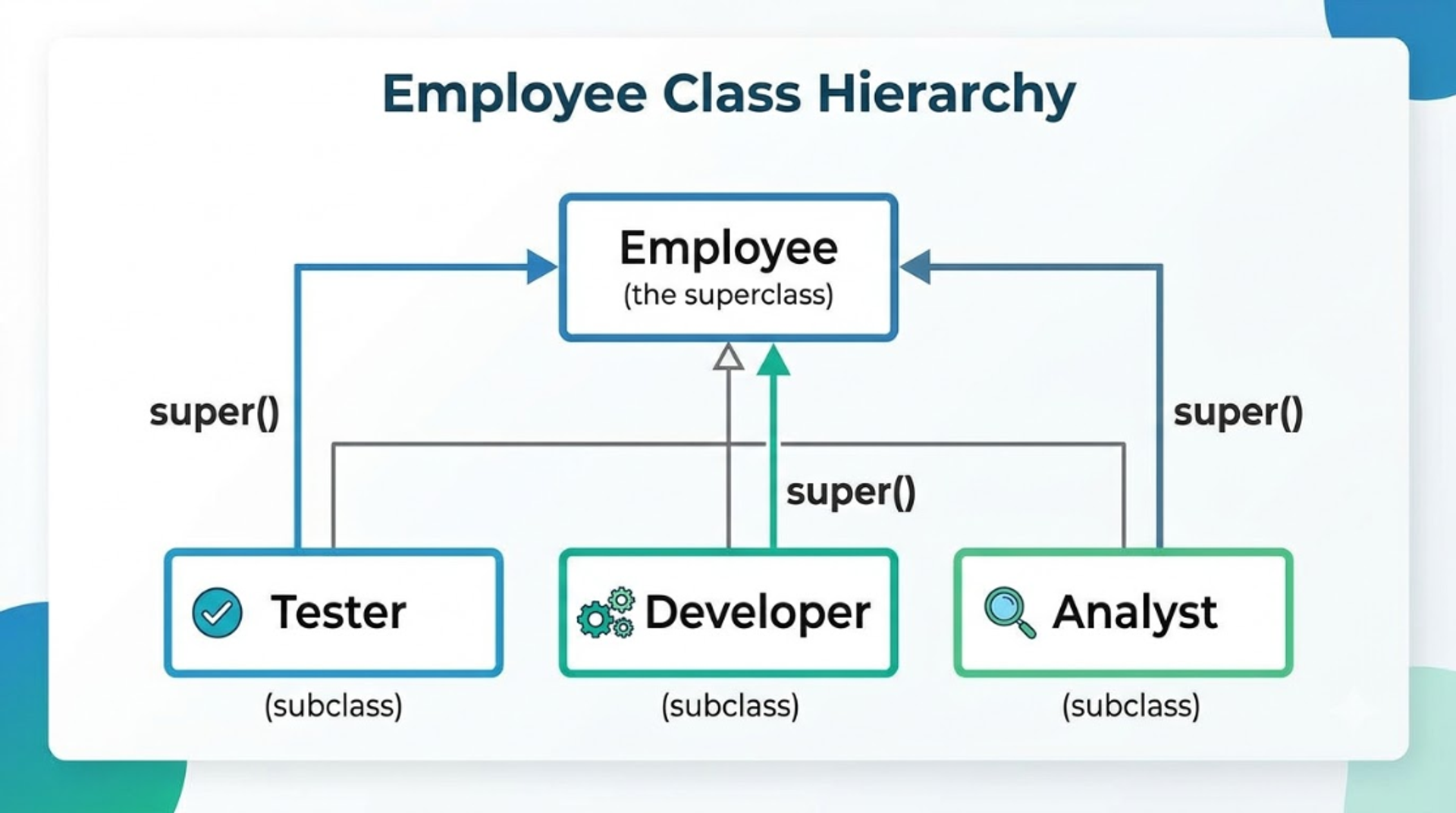
Inheritance lets one class take on the attributes and methods of another, so shared behaviour is written once.
super() calls the parent's version. It saves rewriting the parent's logic and keeps behaviour consistent when the parent changes.
Types of inheritance in Python
Python supports multiple inheritance, which Java deliberately does not:
When two parents define the same method, Python resolves the conflict using the Method Resolution Order (MRO) left to right through the inheritance chain. You can inspect it:
Being able to say "Python handles the diamond problem with MRO, which follows C3 linearisation" is the kind of answer that ends the OOP section of an interview well.
Pillar 4: Polymorphism
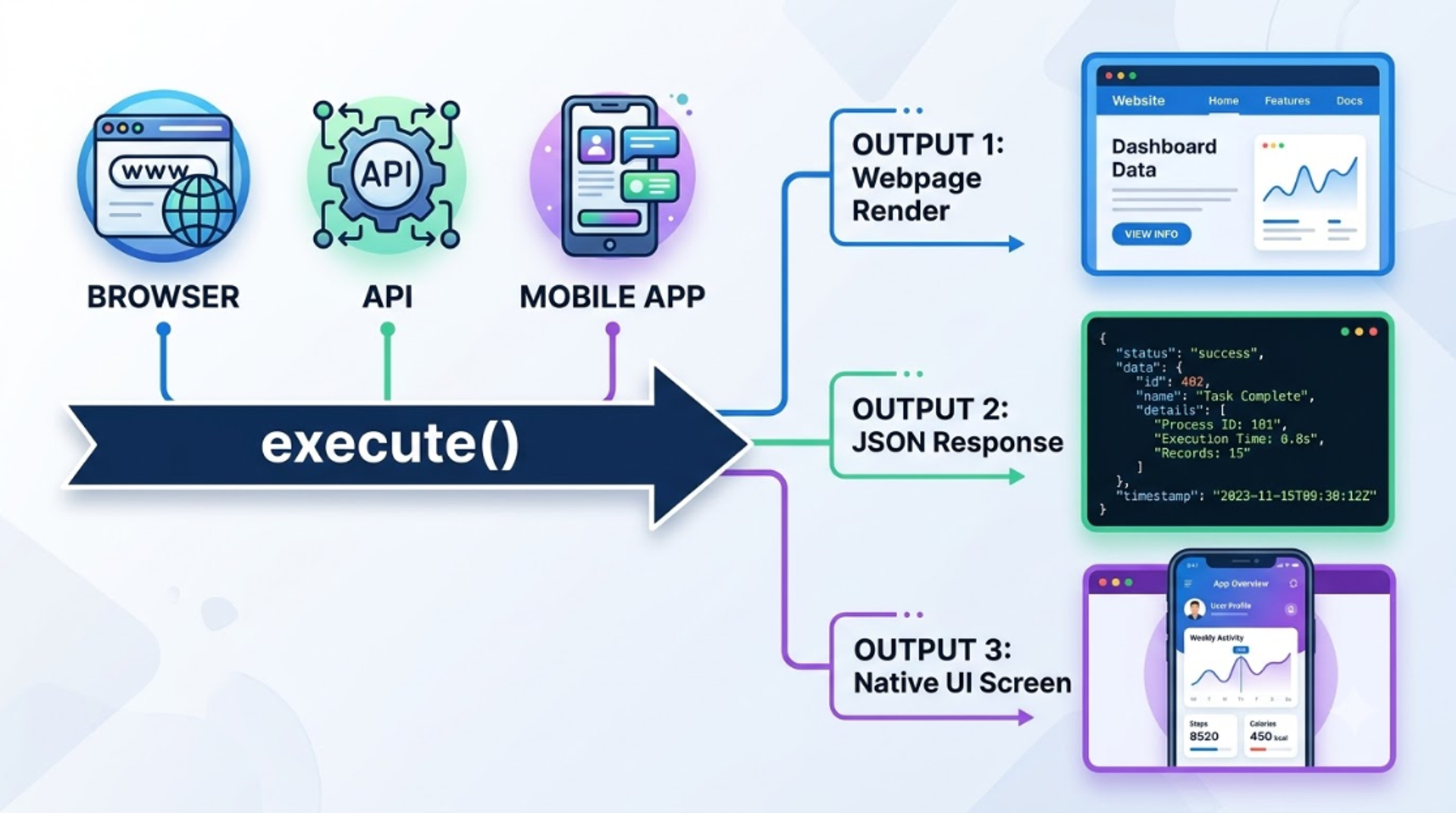
Polymorphism means the same method name behaves differently depending on the object it is called on.
The word means "many forms". One interface, several implementations.
Output:
The loop never checks which class it is holding. It calls execute() and each object responds in its own way. Add a fourth tool tomorrow and the loop needs no change at all that is the real payoff.
Duck typing Python's version
Notice those three classes share no parent class. In Java you would need a common interface. Python does not care:
If it walks like a duck and quacks like a duck, treat it as a duck.
Python checks whether the object has the method, not what it inherits from. This is called duck typing, and it is the idiomatic Python answer to a polymorphism question.
One more Python difference
Python does not support method overloading the way Java does. Define a method twice and the second definition simply replaces the first:
The Pythonic approach is default arguments or *args:
All four pillars in one example
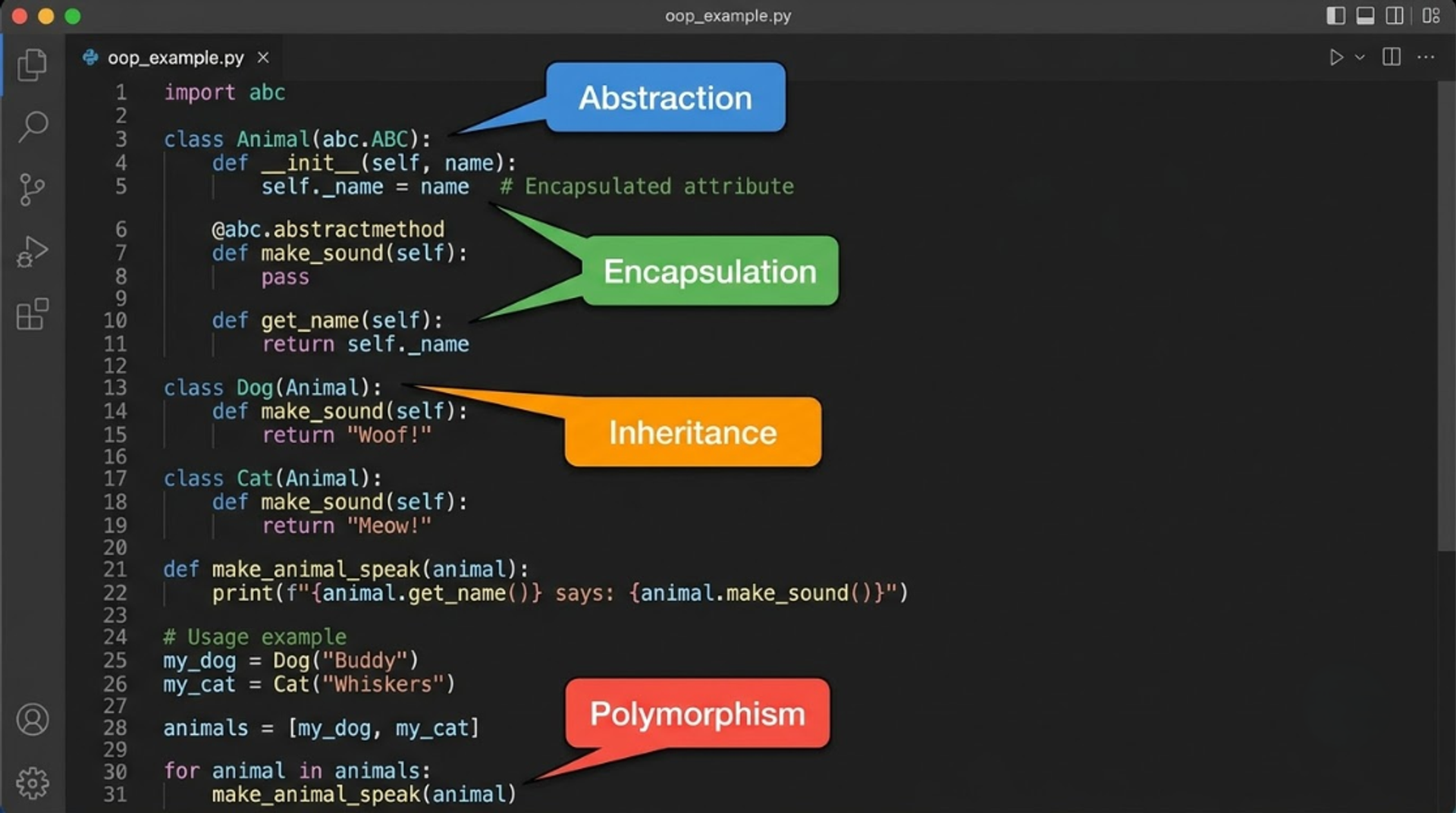
Here is a small automation framework using every pillar at once close to how real test frameworks are built.
Output:
Twenty-five lines, all four pillars, and a structure you would genuinely recognise inside a professional test framework.
Four mistakes beginners make
1. Thinking _ _ makes something private. It triggers name mangling. The value is still reachable as _ClassName_ _attribute.
2. Forgetting super()._ _init_ _(). Skip it and the parent's attributes never get set, producing an AttributeError far from the actual cause.
3. Building deep inheritance chains. Five levels down, nobody knows where a method comes from. Two or three levels is usually the limit before composition is the better answer.
4. Confusing abstraction with encapsulation. Abstraction hides complexity behind a simple interface. Encapsulation protects data behind methods. Different problems.
Why OOP matters if you are heading into testing
If you are learning Python for QA or automation work, these four ideas are not academic they are the shape of every framework you will touch:
- Page Object Model, the standard Selenium pattern, is inheritance and encapsulation: one page, one class, its elements kept inside it.
- Base test classes holding setup and teardown are abstraction.
- A single suite runner looping over different test types is polymorphism, exactly as in the example above.
This is precisely what separates a manual tester from an SDET a Software Development Engineer in Test writes the framework rather than only using it, and frameworks are built from these four ideas.
If you are starting from zero, our Python course covers OOP from first principles with test-focused examples. If you already know the basics and want to apply them, the automation testing course builds a working framework using these patterns, and the API testing course does the same at the service layer.
Coming from manual testing? Your testing judgement already transfers OOP is the coding layer you are adding on top. Prefer a different language? The same four pillars appear in our Java course, with stricter access control and no multiple inheritance.
If your interest is data rather than testing, OOP shows up just as much in data science and machine learning with Python scikit-learn's entire API is built on classes with a shared interface, which is polymorphism again.
You can see the full range in our software testing course catalogue.
Frequently asked questions
What are the 4 pillars of OOPs in Python?
Encapsulation, Abstraction, Inheritance and Polymorphism. Encapsulation protects data inside an object; Abstraction hides complexity behind a simple interface; Inheritance lets classes reuse behaviour from a parent; Polymorphism lets one method name behave differently across classes.
Is it 4 pillars or 3?
Four is standard. Some older material lists three, treating abstraction as part of encapsulation. Interviews in India almost always expect four name all four.
Does Python have real private variables?
No. A single underscore is a convention, and a double underscore triggers name mangling Python renames _ _x to _ClassName_ _x. It is discouraged from outside access, not blocked.
What is duck typing?
Python's approach to polymorphism: it checks whether an object has the method you are calling, not what class it inherits from. If two unrelated classes both define execute(), both can be used interchangeably.
Does Python support multiple inheritance?
Yes, unlike Java. When parents share a method name, Python resolves it through the Method Resolution Order, which follows C3 linearisation. Check any class's order with ClassName._ _mro_ _.
Do I need OOP for software testing?
For manual testing, no. For automation and SDET roles, yes every major framework is built on classes, and the Page Object Model is inheritance and encapsulation applied directly.
In summary
Read them once and they sound abstract. Write the examples above by hand changing the names, breaking them on purpose, seeing what errors appear and they become obvious. That hour is what turns this from a memorised list into something you can actually use.
Tags

A visionary data scientist dedicated to unlocking the potential of data to drive informed decision-making and spark innovation. With a strong foundation in Data Science.