
Full Stack Developer Roadmap: 6-Month Plan for Freshers
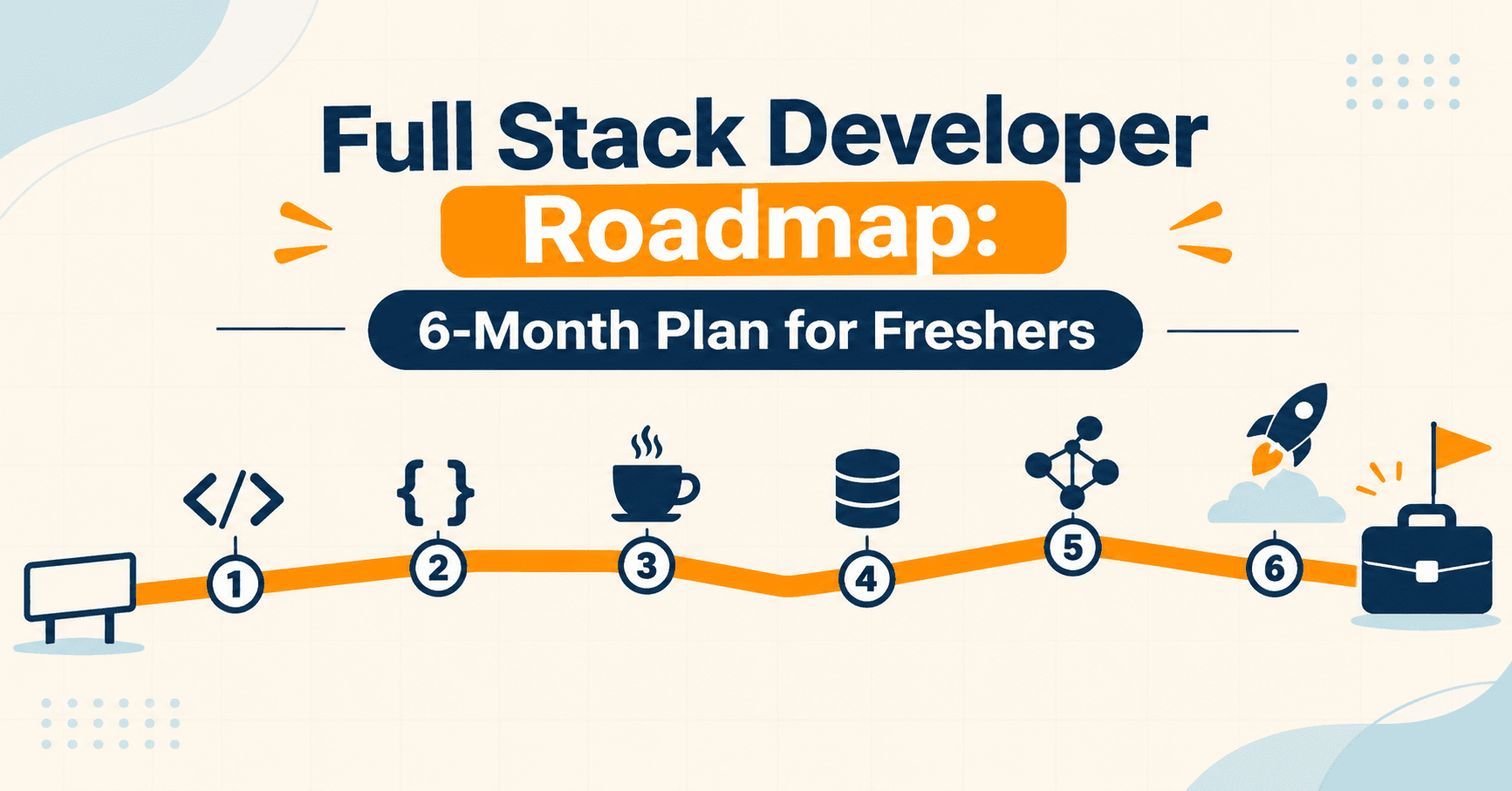
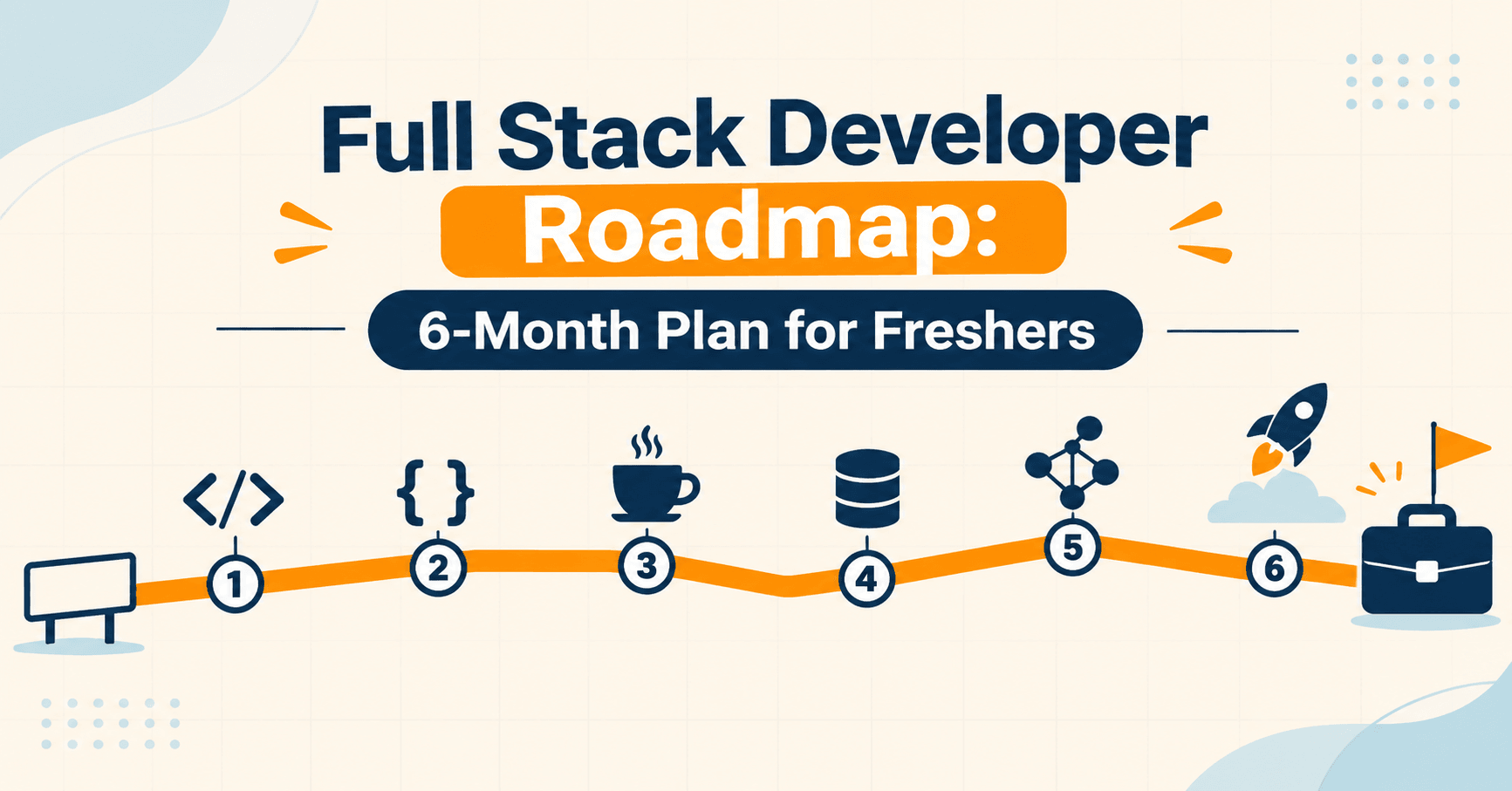
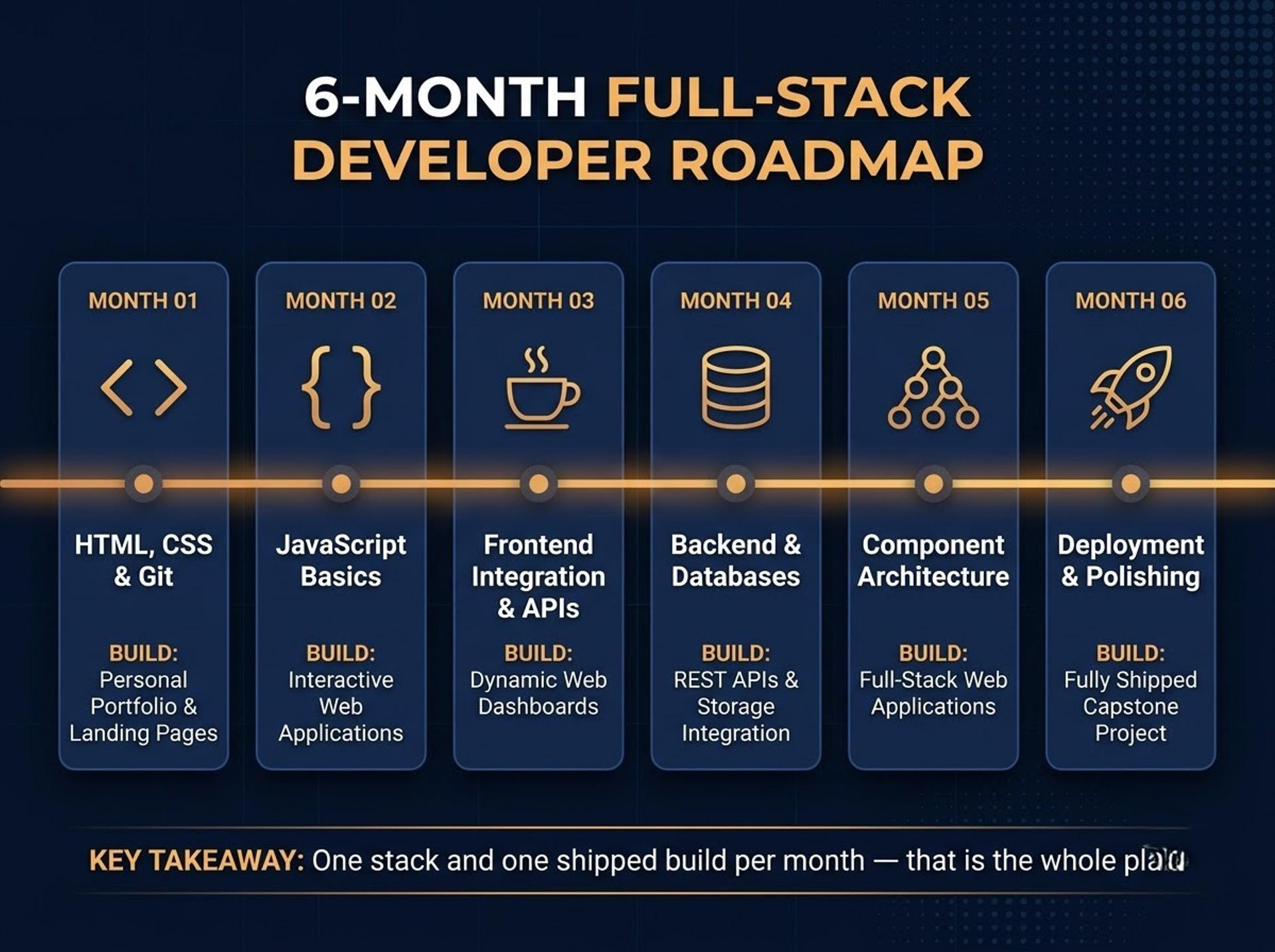
This full stack developer roadmap breaks six months into clear monthly goals, from HTML and JavaScript to Java, Spring Boot, SQL and React. Built for Indian freshers, it ends every month with a project you can show recruiters.
Six months. One stack. One shipped project every month. A practical plan for freshers who want a developer job, not another tutorial playlist.
Priya finished her BSc IT this summer. Every morning on the Virar fast, she scrolls job posts asking for full stack skills: React, Spring Boot, SQL, Git. She has saved dozens of YouTube playlists. She has not built a single app.
If that sounds familiar, effort is not your problem. The missing piece is a clear order. This full stack developer roadmap gives you one. You will see what to learn each month, what to build, and how many hours to plan for. You will also get an honest picture of the 2026 fresher market, including salary ranges and the role of AI.
The plan assumes about 20–25 hours a week: roughly three hours on weekdays and five on each weekend day. It works for graduates from any stream, whether you can code a little or are starting from zero.
At Cinute Digital, our trainers in Mira Road and Vasai build every course around hands-on projects. This roadmap follows the same rule: you build something every month.
Six months from now, you could have a live app on your resume instead of a folder of half-watched tutorials.
FEATURED SNIPPET BLOCK
A full stack developer roadmap for freshers takes about six months at 20–25 hours a week: HTML, CSS and Git in Month 1; JavaScript in Month 2; Core Java and DSA in Month 3; SQL and Spring Boot APIs in Month 4; React in Month 5; testing, deployment and interview prep in Month 6.
What Is a Full Stack Developer?
A full stack developer builds both halves of a web application: the screens people use and the server logic behind them. Job posts often describe this as front end and back end development, with a database underneath.
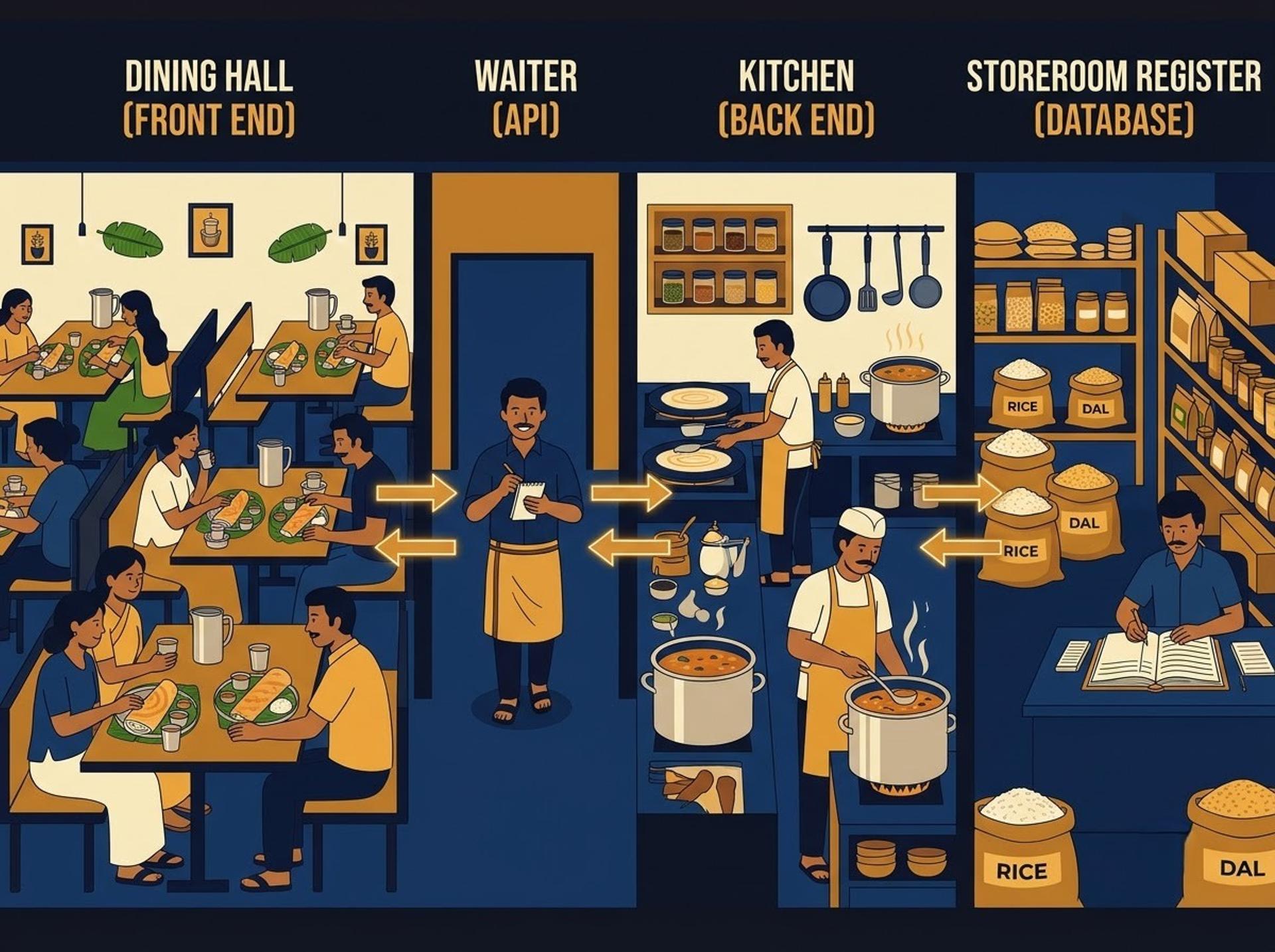
Picture a busy Udupi restaurant near your station. Every part of it maps to a layer of a web app:
- Front end = the dining hall. The menu card, tables and service are what customers experience. In code, this is HTML, CSS and JavaScript running in the browser.
- Back end = the kitchen. It receives orders, follows recipes and prepares results. In code, this is Java with Spring Boot, or Node.js, or Python.
- Database = the storeroom register. It records every item in stock. In code, this is MySQL or PostgreSQL.
- API = the waiter. The waiter carries order chits to the kitchen and brings food back. An API carries requests to the server and returns data, usually as JSON.
You do not need to be head chef and head waiter on day one. You need to be comfortable in every room and strong in one. The core full stack developer skills for a fresher are one front-end framework, one back-end language, SQL, Git and API basics.
Many freshers treat the storeroom as optional. Frameworks like Hibernate write SQL for you, so skipping it feels safe. Then an interviewer asks for a simple JOIN, and the room goes quiet. Solid MySQL and SQL fundamentals make every later month easier, because every app you build reads and writes data.
For the dining hall, Mozilla's free Learn web development curriculum on MDN is a reliable starting point. It teaches HTML, CSS and JavaScript in a sensible order, with exercises after each module.
Why Full Stack Skills Matter in India's 2026 Job Market
The fresher market in 2026 is open, but selective. TeamLease EdTech's Career Outlook Report for July–December 2026 found that 75% of employers plan to hire freshers, up from 73% in the first half. In the IT sector, though, fresher hiring intent slipped from 81% to 76%.
Where the jobs come from is shifting too. Tech demand rose about 10% in a year, yet traditional IT firms' share of fresher hiring fell from 32% to 24%. Global capability centres (GCCs) grew their share from 8% to 11%, and banks, manufacturers and healthcare firms now hire tech talent directly. Business Today's summary of the foundit July 2026 data has the full breakdown.
What does that mean for you? Two things.
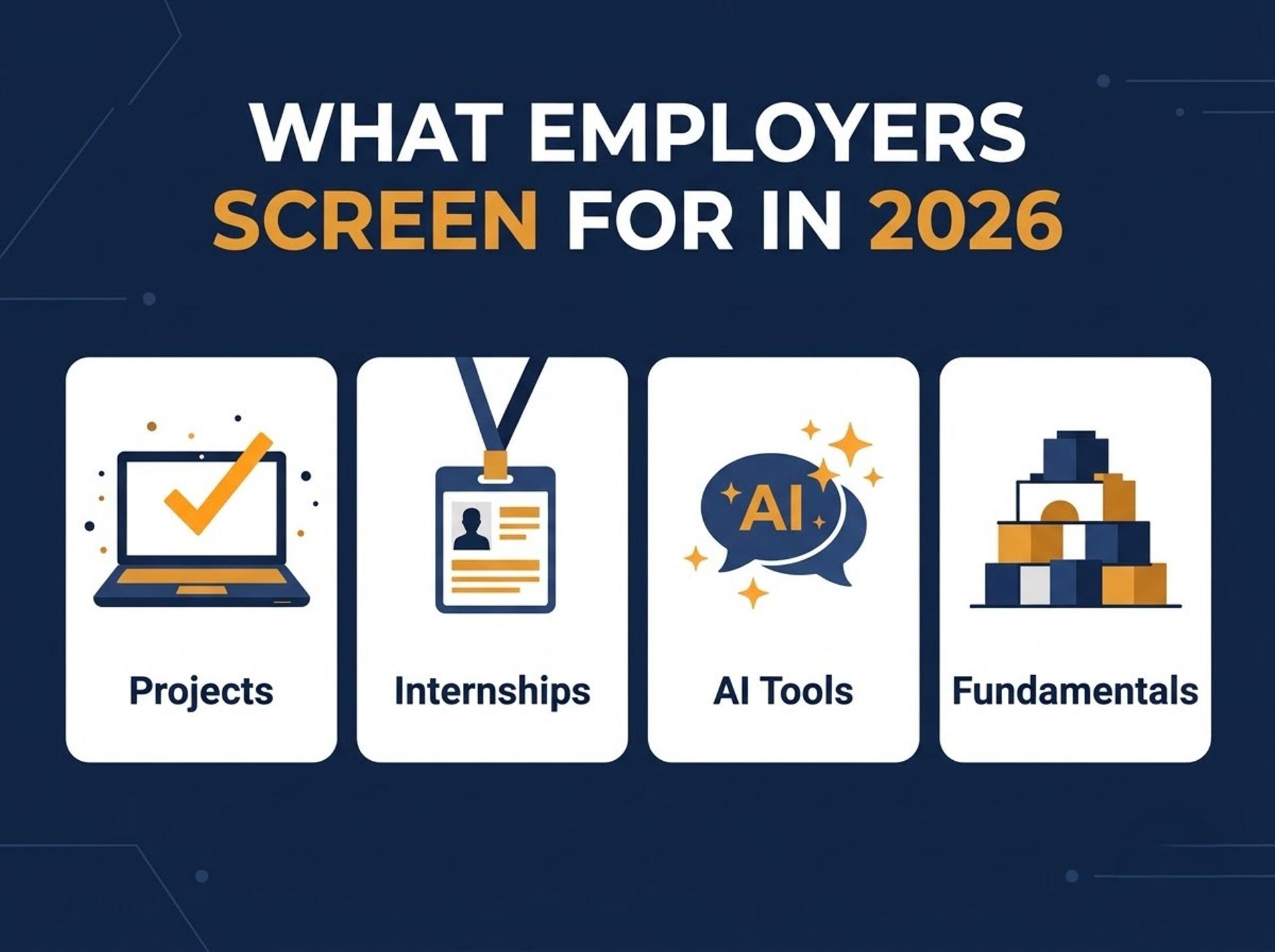
Proof of work now beats marks. TeamLease's first-half 2026 report found that employers increasingly judge freshers on interns
All figures are approximate, compiled from public 2026 salary guides and company-wise fresher reports. Pay varies by company, city and skill. Verify with a current industry source.
The 6-Month Full Stack Developer Roadmap, Month by Month
Pick one stack and stay with it for all six months. This full stack developer roadmap uses the Java full stack: Java and Spring Boot on the back end, React on the front end and MySQL for data. Java remains common in Indian IT services and banking projects, and java full stack developer roles show up across fresher job boards. If you prefer startups, MERN (MongoDB, Express, React, Node.js) is a fair swap. Just don't run both.
Every month ends with a build, not a certificate. A recruiter can open a link; nobody can open your playlist history.
Concept demo: how the front end talks to the back end
The most important idea in this roadmap is the conversation between the browser and the server. Here it is in a dozen lines of JavaScript:
What each part does:
fetch(...)sends an HTTP GET request to your back end. Port 8080 is Spring Boot's default.awaitwaits for the reply without freezing the page.response.okis true for status codes 200–299. Anything else, such as 404, becomes a clear error.response.json()turns the JSON text into JavaScript objects.forEachprints each job. On a real page, you would add each job to the HTML instead.
On the server, a Spring Boot class marked @RestController has a method marked @GetMapping("/api/jobs"). It returns a Java list, and Spring converts it to JSON such as [{"id":1,"role":"Junior Java Developer","city":"Mumbai"}]. If the back end is not running, the browser console shows "Failed to fetch" instead.
Before you write any React in Month 5, check each endpoint by hand. This is the heart of API testing with Postman: send a request, read the status code, inspect the JSON. It tells you at once whether a bug lives in the front end or the back end.
For Month 4, Spring's official guide to building a RESTful web service walks you through your first endpoint step by step.
Common Mistakes Freshers Make (and How to Fix Them)
Watch out for these five traps. Each one can quietly add months to your full stack developer roadmap.
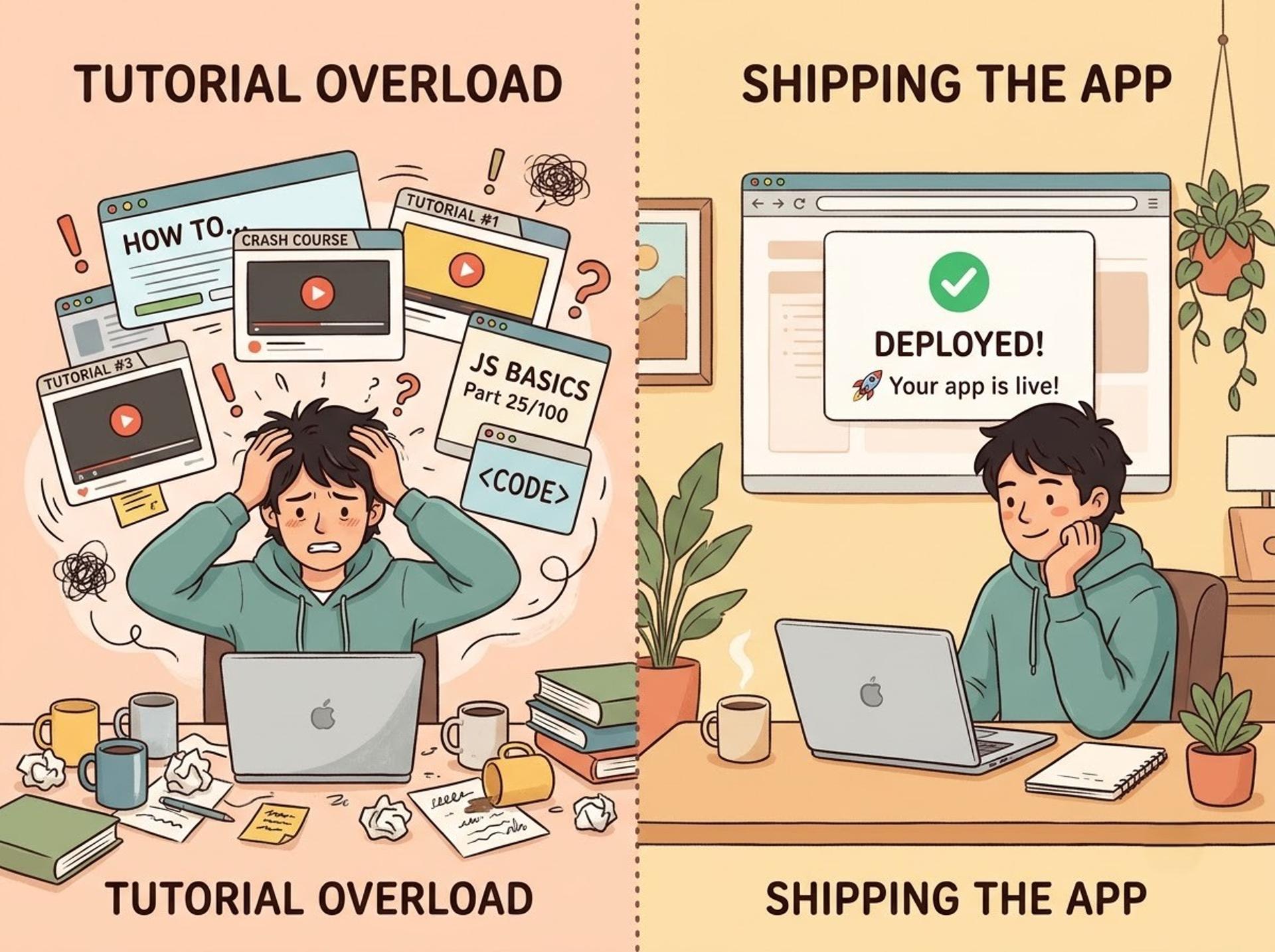
- Tutorial hell. Watching feels like progress, but it isn't. Use a simple rule: for every hour of video, spend two hours building. Close the video and rebuild the feature from memory.
- Three stacks at once. MERN in the morning, Python at night, Java on weekends. Six months later, you know three "Hello, World" programs. Finish one stack first.
- Ignoring CORS until it bites. Your React app runs on one port and calls your API on another, so the browser blocks the request. The fix lives on the back end; in Spring Boot, the
@CrossOriginannotation is the usual starting point. - Never testing your own app. Write a few JUnit tests for your API. Then learn how teams check the browser side automatically. Learning automation testing with Selenium shows you how real teams catch broken buttons before users do. It also opens a second entry route into IT through test automation roles.
- Pasting AI code you cannot explain. If you cannot walk an interviewer through a line, it is not your code yet.
A note on responsible practice. Use AI to learn faster, not to skip learning; Nasscom has flagged the same risk. Never paste passwords, API keys or a client's code into public AI tools. Keep secrets out of GitHub with a .gitignore file. When you reuse open-source code, follow its licence.
Career Path: Jobs This Roadmap Opens
Finish this full stack developer roadmap with a deployed project, and you can apply for these entry roles:
- Associate software engineer or Java developer at IT services firms and GCCs
- Junior full stack developer at startups and mid-size product companies
- Front-end (React) or back-end (Spring Boot) developer
- QA automation engineer, as an adjacent route
What should you learn next? In Months 7–12, add TypeScript, Docker, cloud basics on AWS and simple system design. Then build a second, bigger project.
Be realistic about time. Six months works at 20–25 hours a week, but it is a plan, not a promise. Many published roadmaps assume 8–12 months, and that is a fine pace if you study part-time. You are job-ready when you can build, explain and debug your project in an interview.
This path suits you if you enjoy building things people can click. If you prefer working with numbers and reports, a data analytics track may suit you better.
If you have been searching how to become a full stack developer without a CS degree, here is the good news. Employers in 2026 increasingly screen for skills and projects over degrees.
For mentor-led structure in Months 3 and 4, CDPL's Java programming course covers Core Java through Spring Boot, REST APIs and JPA/Hibernate. It runs in live online and classroom batches, with mock interviews, resume support and placement assistance.
Conclusion: Start Month 1 This Week
Remember Priya from the start? Her problem was never ability. It was order, and now you have one.
Here is what matters most in this full stack developer roadmap:
- Pick one stack and finish it. The Java full stack fits Indian hiring well, and MERN is a fair alternative.
- Ship one project every month. Put each one on GitHub with a clear README, and deploy at least one.
- Learn the fundamentals deeply. Use AI to move faster, never to skip understanding.
You do not need a perfect plan. You need to start, and to keep building when it gets hard. Some weeks will go well, and some will not. Consistency matters more than speed.
Want a trainer to review your plan or your first project? You can book a free demo class with Cinute Digital, online or at our Mira Road and Vasai centres.
Open your laptop this week and start Month 1. Six months from now, you will be glad you began today.
Frequently Asked Questions
1. What is a full stack developer roadmap?
A full stack developer roadmap is an ordered learning plan that takes you from web basics to job-ready skills. It usually moves from HTML, CSS and JavaScript to a back-end language, a database, APIs, a front-end framework and deployment. A good roadmap also tells you what to build at each stage, because employers judge freshers on working projects, not on the list of courses they have finished.
2. How to become a full stack developer as a fresher in India?
Pick one stack, such as Java with Spring Boot, React and MySQL, and stay with it. Study 20–25 hours a week and finish one project each month. Put every project on GitHub with a clear README, and deploy at least one. Practise basic data structures for service-company tests, and be ready to explain every line of your code. Internships and hackathons make your resume stronger.
3. Is full stack development worth it for freshers in 2026?
It can be, if you enjoy building things people use. Most employers surveyed in 2026 still plan to hire freshers, and many now value projects over degrees alone. The market is also more selective, and AI now handles some routine coding. Full stack suits freshers who will keep building and learning. If you prefer numbers and reporting, data analytics may fit you better.
4. How long does it take to become a full stack developer?
At 20–25 focused hours a week, a fresher can reach entry-level readiness in about six months by following a plan like this one. If you study part-time, 9–12 months is a realistic and healthy pace. Readiness depends less on the calendar and more on output: one deployed full stack project that you can build, explain and debug in an interview.
5. How much does a full stack developer earn as a fresher in India?
Approximate 2026 figures: junior full stack roles often pay around ₹3.5–6 LPA. Standard trainee tracks at large IT services firms pay about ₹3.3–3.6 LPA, and premium tracks about ₹7–9 LPA. Product startups may pay more for strong candidates. These ranges come from public salary guides and are approximate, so verify them with a current industry source before you negotiate.
Tags

Drives software development initiatives, leading teams to build robust, scalable, and high-performance solutions with latest tools and technologies.