
AI in Digital Marketing: Prompting, Content Ops, and Personalization at Scale
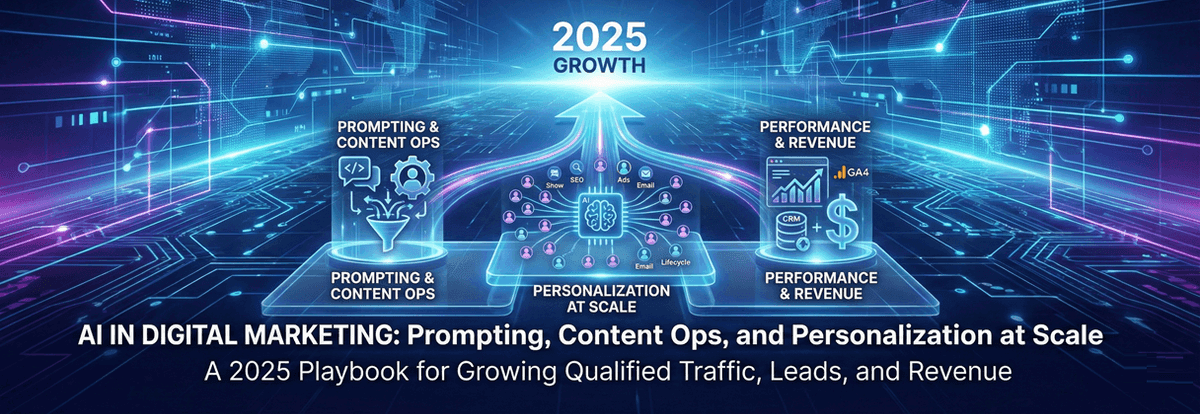
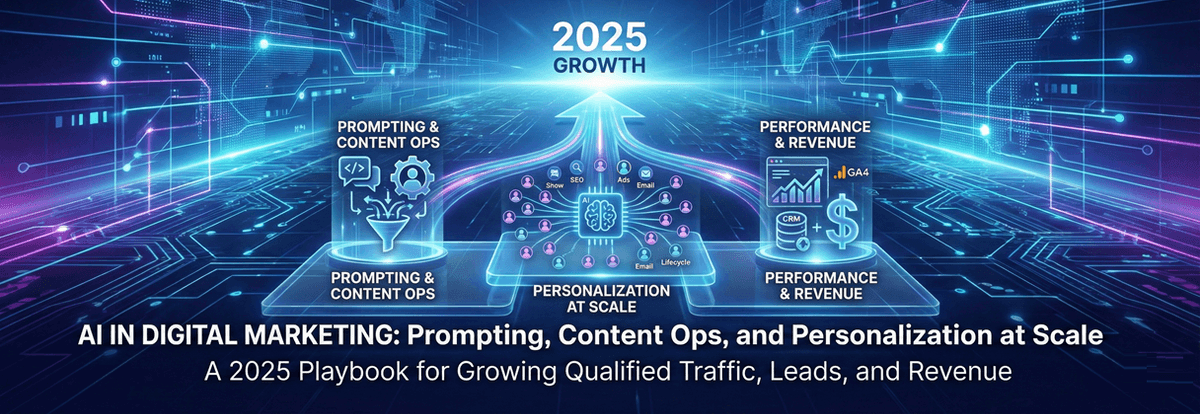
Turn AI into real pipeline. Learn prompt patterns, editorial workflows, human-in-the-loop QA, AI-driven personalization, and GA4/CRM attribution to grow qualified traffic, leads, and revenue.
A 2025 playbook for using AI in digital marketing: prompt engineering, content operations, and 1:1 personalization that scales across SEO, ads, email, and lifecycle—without sacrificing brand safety.
Introduction
AI in digital marketing has moved from shiny demo to daily workflow. Teams winning in 2025 combine prompt engineering, scalable content operations, and personalization at scale - all tied to revenue, not vanity metrics. This SEO-optimized guide lays out a practical system to ship high-quality content faster, turn first-party data into 1:1 experiences, and measure real business impact with GA4 and CRM.
We’ll cover reusable prompt frameworks, human-in-the-loop QA, programmatic SEO, AI-assisted email and ads, website personalization, governance, and a 90-day rollout plan. Use this as your 2025 blueprint to grow qualified traffic, pipeline, and LTV.
1) Strategy First: ICP, Offers, and Channel–Intent Fit
AI multiplies whatever strategy you already have. Start by clarifying your ICP (industry, role, pain, outcomes) and mapping the funnel with See–Think–Do–Care. Define 1–2 offers per segment (e.g., ROI calculator, teardown audit) and allocate channels by intent: programmatic SEO for capture, paid social for demand creation, and email for activation/retention.
Keywords to weave naturally: AI in digital marketing, prompt engineering marketing, programmatic SEO, marketing personalization, email marketing automation, GA4 attribution.
2) Prompt Engineering for Marketers: Patterns that Scale
Great prompts are structured, constrained, and contextual. Use these reusable patterns:
- Role + Goal + Guardrails: “You are a senior content strategist. Goal: produce a 1200-word outline for ‘programmatic SEO’. Guardrails: UK spelling, cite sources, no hype.”
- Few-shot examples: Provide 1–2 perfect outputs to bias tone, format, and depth.
- Checklists: Ask the model to validate against an SEO/a11y checklist before returning.
- File boundaries: For dev or template work, specify exact files/sections to avoid drift.
3) Content Operations (Content Ops): From Idea → Brief → Draft → QA → Publish
Operationalize creation so AI drafts are consistent and on-brand.
- Idea intake: cluster keyword gaps + sales questions + competitor content.
- Briefs: AI-assisted briefs with search intent, outline, angles, sources, internal links.
- Drafts: AI first pass; editor rewrites intros, adds unique POV/data.
- QA: run a checklist—factual verification, plagiarism scan, brand tone, E-E-A-T, a11y, and Core Web Vitals considerations (image sizes, lazy loading).
- Publish & distribute: on-page SEO, schema, internal links, newsletter, social repurpose.
Programmatic SEO: generate templated pages (e.g., “best X for Y”, “X vs Y”) with strict inputs (data table, decision rules) and human editorial sign-off.
4) AI for Ads & Creative: Faster Iteration, Tighter Feedback Loops
Use AI to ideate and adapt creatives across channels while keeping clear brand guardrails.
- Search Ads: generate RSA headline/description pools mapped to personas and pain points; embed dynamic keyword insertion rules.
- Social Ads: produce hooks (problem, insight, curiosity), 15–30s video scripts, and variant CTAs; rotate every 14–21 days.
- Creative QA: brand voice checks, compliance phrasing, and image alt text for a11y.
Feed performance back into prompts: paste top CTR/CR lines and ask the model to generate adjacent variations, not random spins.
5) Email & Lifecycle: AI-Driven Personalization That Respects Consent
Pair first-party data with AI to tailor sequences by role, stage, and behavior—without crossing privacy lines.
- Nurture paths: segment by intent (pricing views, product page visits, content consumed).
- Dynamic copy blocks: short role-specific paragraphs inserted into a shared template.
- Send-time/content optimization: AI suggests best timing and subject-line class (benefit, curiosity, proof).
Measure revenue per send and activation rate, not just opens/clicks.
6) Web Personalization: From Segments to 1:1
Move beyond generic pages. Use privacy-safe signals (UTM source, geo, returning user, viewed category) to swap headlines, CTAs, and social proof blocks.
- Segment-level: swap testimonials by industry and role.
- Behavioral: if user viewed pricing, surface calculator and comparison table.
- Lifecycle: logged-in customers see adoption guides; prospects see case studies.
Keep experiences helpful, not creepy—no sensitive attributes; disclose personalization in your privacy notes.
7) Guardrails & Governance: Brand, Legal, and Safety
AI at scale needs rules. Create a one-page AI Use Policy and shared prompt library.
- Do/Don’t list: allowed tools, disallowed claims, fact-check requirements, competitive mentions policy.
- Attribution: cite sources; keep editorial logs for major assets.
- Compliance: consent mode, cookie categories, opt-out links, and rights for user-generated data.
8) Measurement: Tie AI Work to Pipeline and Revenue
Track leading and lagging indicators across SEO, paid, email, and web. Attribute properly with GA4, CRM, and offline conversion uploads.
Use the table below as your scorecard:
9) Practical Workflows & Snippets
Plug-and-play prompts to accelerate common tasks.
10) CRO with AI: Hypotheses, Copy, and Test Plans
Use AI to generate hypotheses and experiment plans, then validate with data.
- Hypothesis engine: feed heatmaps, polls, and funnel drop-offs; ask AI for prioritized hypotheses using ICE scoring.
- Copy testing: produce 3 hero variants mapped to pains/outcomes; A/B on top pages.
- Post-test analysis: ask AI to summarize lift, confidence, and downstream impact (demo quality, AOV).
11) Data, Privacy & Model Choice
Adopt a first-party data strategy with clear governance.
- Consent-aware tagging: respect user choices; run server-side tagging for stability.
- PII handling: no sensitive attributes in prompts; aggregate where possible.
- Model mix: general LLM for ideation, domain-tuned model for tone and product accuracy, and on-device/edge models for low-latency personalization.
12) 90-Day AI Rollout Plan
Days 1–30: Foundations
- Define ICP, offers, and channel–intent map; pick 2 clusters for programmatic SEO.
- Publish an AI use policy + prompt library; set up GA4 events and offline conversion import.
- Pilot AI briefs → drafts → QA on 4 articles; launch one nurture sequence with dynamic blocks.
Days 31–60: Scale
- Ship 10–20 programmatic pages with editorial review; rotate 10 ad creative variants.
- Enable website personalization for 2 segments (role & lifecycle).
- Run 3 CRO tests (hero, CTA, social proof); measure INP/LCP/CLS impact.
Days 61–90: Optimize
- Promote a Hero asset (benchmark/report) for links; syndicate on social/newsletters.
- Tune prompts with performance learnings; templatize winning variants.
- Quarterly review: pipeline created, CAC payback, channel mix; reallocate budget by incremental lift.
Conclusion
AI in digital marketing works when strategy, prompts, and operations align. Standardize how you brief and QA content, let AI speed the repetitive parts, and deploy personalization that is truly helpful. Close the loop with GA4, CRM, and offline conversion uploads so models learn from actual revenue.
Start small: publish one AI-assisted pillar, launch a role-based nurture with dynamic copy, and personalize a top landing page. Iterate weekly, codify what wins, and scale—without sacrificing brand, privacy, or performance.
Tags

SEO Analyst & Digital Marketing Specialist helping brands grow organically through smart strategy, data-driven insights, and powerful content.