
2025 Digital Marketing Strategy: Proven Frameworks to Grow Traffic & Revenue
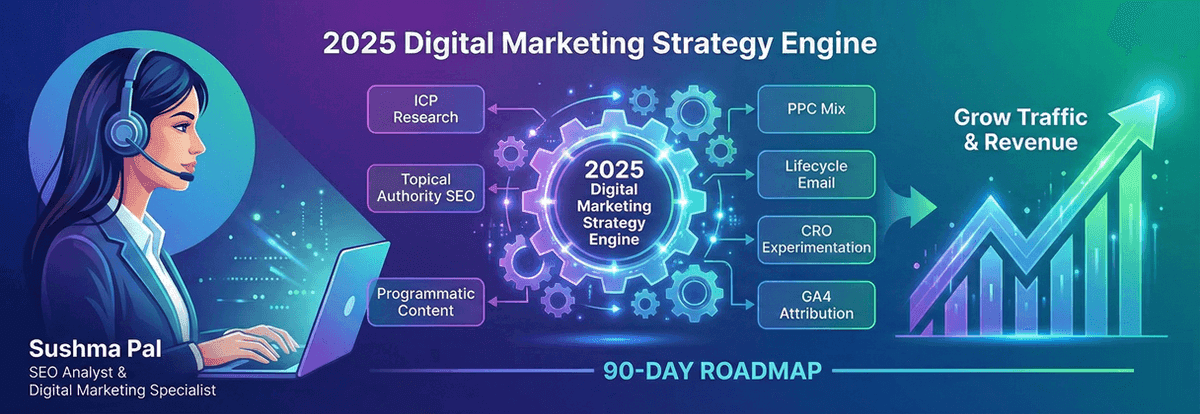
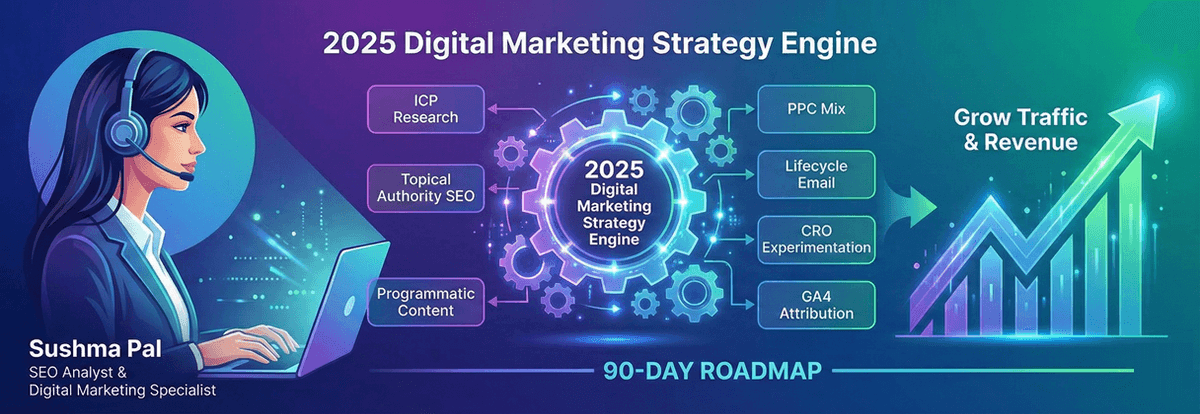
Build a high-ROI digital marketing engine for 2025. Learn ICP research, topical authority SEO, programmatic content, PPC mix, lifecycle email, CRO experimentation, and GA4 attribution—organized into a 90-day roadmap.
A step-by-step 2025 digital marketing playbook covering SEO, content strategy, paid media, email automation, CRO, and attribution. Use proven frameworks to scale qualified traffic, leads, and revenue with first-party data and GA4.
Introduction
In 2025, the best-performing growth teams pair first-party data with topic authority SEO, precision PPC, automated email/lifecycle marketing, and relentless CRO. This guide gives you a practical, SEO-optimized blueprint to scale qualified traffic, pipeline, and revenue. You’ll get proven frameworks—ICP research, STDC funnel, Topic Cluster/Pillar, AARRR, and a 90-day execution plan—backed by high-impact tactics for GA4, consent-aware tracking, and attribution.
Use this as your 2025 digital marketing strategy template to align SEO, content, paid media, and lifecycle programs around revenue goals—not vanity metrics. Bookmark it, share it with your team, and work through the checklists section by section.
1) Foundation: ICP, Goals & North Star Metrics
Start with a tight Ideal Customer Profile (ICP) and quantifiable goals. Marketing that “wins everywhere” wins nowhere.
- ICP Canvas: industry, firmographics (size, revenue), roles, pains, desired outcomes, buying triggers, objections, and channels they trust.
- North Star: Marketing Qualified Pipeline (MQP) or Sales Qualified Opportunities (SQO), supported by leading indicators (SQL rate, demo requests, CAC, LTV:CAC, payback).
- Framework: Map touchpoints with STDC (See–Think–Do–Care) to align content and offers to intent.
Output: one-sentence ICP, two priority segments, target KPIs (e.g., +40% qualified organic sessions, +25% demo rate, sub-3-month payback).
2) Keyword & Topic Research for Topical Authority (SEO 2025)
Ranking in 2025 is about topical authority, not one-off keywords. Build clusters that cover a problem space comprehensively.
- Seed topics & competitors: Pull terms from ICP interviews, CRM notes, and competitor pages.
- Cluster model: Group by search intent (informational, commercial, transactional) and funnel stage.
- Pillars & spokes: Create a pillar page (3,000–5,000 words) + 10–20 supporting articles each targeting a subtopic.
- Programmatic SEO: Identify templated pages (e.g., “tool vs tool”, “best X for Y”, “pricing for X in {city}”).
- Prioritize by business value: Volume is useless without intent. Score by revenue potential × ranking difficulty × topical gap.
High-ranking keyword examples to bake into titles/H1s naturally: digital marketing strategy 2025, seo strategy 2025, content marketing plan, programmatic seo, google ads strategy, conversion rate optimization, email marketing automation, ga4 attribution, first-party data strategy.
3) Content Engine: Pillar–Cluster + 3H Model
Use Pillar–Cluster for depth and the 3H (Hygiene–Hub–Hero) model for cadence and reach.
- Hygiene (Help): evergreen “how to” and “best practices” articles (intent: Think/Do). Publish 2–3/week.
- Hub: opinion pieces, benchmarks, templates (monthly). Great for newsletter growth.
- Hero: big swings—data reports, tools, calculators, webinars—quarterly for PR/backlinks.
On-page SEO checklist: single H1 with primary keyword, semantic subheads (H2–H3), internal links to pillar/spokes, FAQ schema, descriptive alt text, and clear CTAs aligned to funnel stage (demo, template download, calculator).
4) Technical SEO & Performance for Revenue
Traffic that can’t convert—or pages that don’t get indexed—waste money. Prioritize crawlability, indexation, and Core Web Vitals.
- Index hygiene: XML sitemaps by type, clean robots rules, canonical consistency (no parameter duplication), hreflang for locales.
- Speed: serve next-gen images (AVIF/WEBP), lazy-load below the fold, prefetch routes, and strip render-blocking JS/CSS.
- Structured Data: Article, FAQ, HowTo, Product, Organization; keep JSON-LD in the initial HTML.
- UX signals: improve LCP, INP, CLS with image dimensions, font preloads, and minimal third-party bloat.
Technical SEO compounds ranking gains and meaningfully boosts conversion by cutting friction.
5) Paid Media Mix: Demand Capture + Demand Creation
Your PPC strategy should separate demand capture (high intent) from demand creation (problem/solution education).
Demand Capture (bottom-funnel)
- Search: exact and phrase for “best X software”, “X pricing”, “X alternatives”, “X vs Y”.
- Shopping/PMAX (ecom): feed hygiene, exclusion lists, branded split to protect margins.
- Remarketing: cart/lead abandoners with dynamic content and short windows.
Demand Creation (mid/top-funnel)
- Video/YouTube & Paid Social: target ICP problem narratives; drive to middle-funnel assets (calculators, ROI tools, templates).
- LinkedIn (B2B): job titles + firmographics; rotate creative every 14–21 days; optimize to quality lead rate, not CTR.
Bidding & budgets: split budgets by intent; use tCPA/tROAS on mature campaigns; for new offers, start with Maximize Conversions + value rules. Always sync offline conversions (qualified pipeline) to ad platforms.
6) Lifecycle & Email Automation (Retention = Revenue)
Email remains the highest-ROI channel when powered by first-party data. Build a value ladder with triggered journeys.
- Acquisition: lead magnet delivery → warm-up sequence → product education → case study → demo CTA.
- Activation: onboarding checklist, quick wins, habit loops, usage nudges.
- Expansion: cross-sell/upsell based on behavior, QBR prompts (B2B), replenishment (ecom).
- Win-back: 30/60/90-day re-engagement with new value props.
Best practices: segment by lifecycle stage and intent; personalize by job role; use behavioral triggers (viewed pricing, added to cart, visited docs). Track revenue per send, not just open/clicks.
7) CRO: Turn Clicks into Customers
Conversion Rate Optimization is the bridge between traffic and revenue. Test systematically—no random guessing.
- Diagnostics: funnel analytics (GA4), heatmaps/session replays, form analytics, and qualitative surveys.
- Hypotheses: build an ICE (Impact–Confidence–Ease) backlog; prioritize above-the-fold messaging, social proof, pricing clarity, and friction reduction.
- Experiments: run A/B tests (not multivariate) to cleanly isolate variables; measure with statistical significance.
High-impact tests: outcome-driven headlines, benefit-first hero, trust badges/certifications, clear shipping/returns (ecom), pre-qualification questions (B2B) to improve lead quality.
8) Data, Privacy & Attribution: GA4 + First-Party Insights
Plan for a consent-aware, first-party future. Your measurement should survive signal loss.
- GA4: event schema for key actions (lead, demo, purchase, activation); custom channel grouping; cross-domain tracking where needed.
- Offline conversion import: push qualified pipeline/SQOs back to Google/Meta to train bidding models on real value.
- Attribution: triangulate with GA4 data-driven attribution, platform models, and a simple MMM/Bayesian baseline for budget planning.
- Consent & governance: CMP with clear tagging rules; server-side tagging to stabilize data quality.
Dashboards: one executive view (revenue, CAC, LTV:CAC, payback), one marketing ops view (channel ROAS, CPA, pipeline by source), and a product view (activation, retention).
9) Content Distribution & Link Earning (Not Just Link Building)
Great content deserves great distribution. Build topic authority and earn links naturally.
- Syndication: repurpose pillars into LinkedIn carousels, YouTube explainers, and podcast talking points.
- Digital PR: data stories, industry benchmarks, and expert roundups with unique stats; pitch journalists and niche newsletters.
- Community: contribute playbooks in category Slack/Discord groups and Q&A sites (authentically).
Focus on publisher relevance and trust (E-E-A-T signals: author bios, citations, case studies, transparent methodology pages).
10) The 90-Day Execution Roadmap
Days 1–30: Strategy & Setup
- Define ICP, segments, value propositions, and North Star metrics.
- Ship first pillar with 6–8 cluster articles; add FAQ schema and internal links.
- Launch demand capture search campaigns; sync offline conversions.
- Implement GA4 events, consent mode, server-side tagging; build dashboards.
- Set up lifecycle email: lead magnet → 5-email nurture → demo/book call CTA.
Days 31–60: Scale & Optimize
- Publish 2nd pillar + 8–10 spokes; start programmatic templates (vs, alternatives, pricing).
- Expand PPC to demand creation (video/social); retarget site visitors by intent.
- Run 3–5 CRO tests on the top traffic template and pricing/demo pages.
- Kick off digital PR for Hero asset (benchmark/report); outreach to 50–100 outlets.
Days 61–90: Compound & Automate
- Third pillar + tool/calculator; embed in key pages; promote via partners/newsletters.
- Refine bidding to tROAS/tCPA with offline conversion values.
- Automate win-back and expansion email flows; add predictive segments.
- Quarterly business review: channel mix, CAC payback, and scenario plan budgets.
11) KPI Benchmarks & Leading Indicators
Track both leading and lagging metrics to stay ahead of revenue.
- Organic: non-brand clicks, rank share for cluster head terms, pillar engagement (avg. time, scroll).
- PPC: qualified lead rate, SQO rate by campaign, blended CAC and payback.
- Email: activation rate, revenue per send, churn/unsub by segment.
- CRO: form completion rate, demo-to-SQO %, checkout completion, AOV (ecom).
Use weekly scorecards and monthly deep dives; adjust budgets based on incremental lift, not just last-click ROAS.
Conclusion
A winning 2025 digital marketing strategy is focused, intent-driven, and data-literate. Lead with topical authority SEO and programmatic content, capture immediate demand with PPC, nurture with lifecycle email, and convert with rigorous CRO. Close the loop with GA4, first-party data, and offline conversion uploads so every dollar you invest learns and compounds.
Start with the 90-day roadmap, publish your first pillar today, and build systems that grow traffic and revenue—predictably.
Tags

SEO Analyst & Digital Marketing Specialist helping brands grow organically through smart strategy, data-driven insights, and powerful content.