
Power BI vs Tableau vs Looker (Google Cloud): Which BI Tool Wins in 2025?
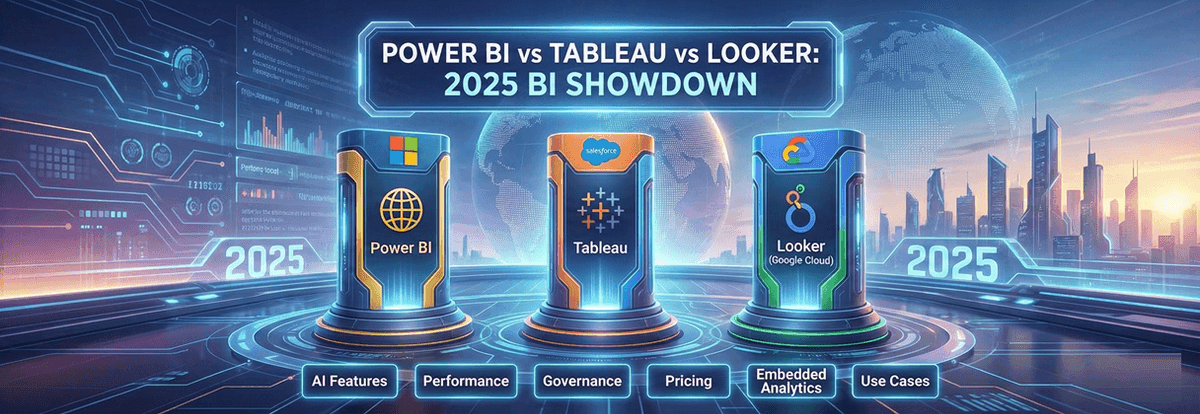
Power BI vs Tableau vs Looker in 2025: side-by-side comparison of features, pricing, performance, governance, AI, and use cases—so you can choose the right BI platform for growth.
An unbiased 2025 comparison of Power BI, Tableau, and Looker (Google Cloud). Evaluate pricing, performance, governance, embedded analytics, AI features, and best-fit scenarios for enterprises and startups.
Introduction
Power BI vs Tableau vs Looker is the BI showdown most analytics leaders face in 2025. Each platform has evolved with stronger AI features, richer governance, and faster embedded analytics. This SEO-optimized guide compares core capabilities, pricing, data modeling, performance, and use cases so you can choose the best business intelligence tool for your team—whether you’re building self-service dashboards, executive scorecards, or product analytics at scale.
We’ll cover strengths and trade-offs for Power BI (Microsoft), Tableau (Salesforce), and Looker (Google Cloud), including DAX, Tableau Viz best-in-class visuals, and LookML semantic modeling. Expect practical recommendations, a detailed comparison table, and “who wins” by scenario.
Quick Verdict: Who Wins for Your Team?
- Choose Power BI if you’re all-in on Microsoft 365/Azure, want aggressive per-user pricing, solid self-service BI, and tight Excel/Teams integration. Great TCO for enterprises standardizing on Microsoft.
- Choose Tableau if you need best-in-class data visualization, rapid ad-hoc analysis, and sophisticated storytelling for data-savvy business users. Ideal for cross-platform deployments and design-led analytics.
- Choose Looker (Google Cloud) if you want a governed, centralized semantic layer with LookML, strong embedded analytics, and deep alignment with BigQuery + modern data stack.
Not sure? Read the deep dive below and evaluate against your data stack (Azure vs AWS vs GCP), governance requirements, and embedded analytics roadmap.
Feature Comparison (2025): Side-by-Side
Use this table as a quick scorecard during vendor reviews. It focuses on the features teams ask about most: modeling, viz quality, AI, governance, embedded, performance, and cost.
Power BI (Microsoft): Strengths, Weaknesses, Best Use Cases
Why teams pick Power BI: unbeatable value in Microsoft environments, excellent Excel/Teams integration, and a modern path with Microsoft Fabric and Lakehouse. DAX unlocks powerful measures; import + DirectQuery provide flexibility for performance and freshness.
- Strengths: low TCO, self-service BI, robust security (RLS/OLS), Excel plug-in, Fabric alignment, AI Copilot/Q&A.
- Weaknesses: DAX learning curve; visuals can feel “corporate” without custom packs; cross-cloud neutrality is weaker.
- Best for: enterprises standardizing on Microsoft 365/Azure; finance & operations reporting; executive scorecards.
Tableau (Salesforce): Strengths, Weaknesses, Best Use Cases
Why teams pick Tableau: the gold standard for data visualization and ad-hoc exploration. Analysts can move fast and craft beautiful, interactive dashboards that tell clear stories. “Explain Data” and “Ask Data” add helpful AI guidance without heavy setup.
- Strengths: world-class visual design, intuitive exploration, Hyper engine speed, strong community, great embedded experience.
- Weaknesses: higher licensing costs; governance needs discipline across projects/sites; semantic consistency requires conventions.
- Best for: data-savvy organizations that value design and exploration; cross-platform stacks; data storytelling.
Looker (Google Cloud): Strengths, Weaknesses, Best Use Cases
Why teams pick Looker: its LookML semantic layer centralizes metrics and permissions, making governed self-service and embedded analytics far easier to scale. Paired with BigQuery and dbt, it’s a modern data stack favorite.
- Strengths: central metric definitions, version-controlled modeling, robust APIs for product analytics, tight BigQuery integration.
- Weaknesses: modeling upfront investment; less flashy viz; best ROI inside GCP ecosystems.
- Best for: product and customer analytics at scale; GCP-native teams; companies needing a governed metrics layer.
Pricing & TCO: Budgeting for 2025
Pricing changes by region/edition, but patterns are consistent. Power BI offers the most aggressive per-user pricing; Tableau commands a premium for its visual and exploration strengths; Looker blends licenses with consumption economics, often most efficient alongside BigQuery spend. Include costs for governance, training, and embedded workstreams when modeling TCO.
Data Modeling & Governance: DAX vs Calculated Fields vs LookML
Modeling shapes long-term maintainability and metric trust:
- Power BI (DAX): rich measure language; excellent for finance/ops star schemas. Requires DAX expertise for complex ratios and time intelligence.
- Tableau: fast calculated fields and joins in the workbook; great agility for analysts; governance relies on conventions and project discipline.
- Looker (LookML): code-as-model. Centralizes joins, permissions, and metric definitions so every dashboard uses the same truth. Ideal for multi-team scale and embedded analytics.
Performance & Scale: Import, DirectQuery, Hyper, and BigQuery
Each tool can be fast when configured correctly:
- Power BI: Import mode for speed; DirectQuery for freshness; aggregations + Fabric optimize large models.
- Tableau: Hyper extracts fly for interactive exploration; live connections require tuned sources and caching.
- Looker: Pushes queries to the warehouse; with BigQuery partitioning/clustering, it scales elegantly for huge datasets.
Embedded Analytics & Developer Experience
For embedded analytics, all three platforms offer SDKs and iframes; Looker’s API-first approach and semantic layer give it an edge for productized analytics. Power BI embedding is strong within Microsoft-centric stacks and internal portals. Tableau balances polish and interactivity for customer-facing apps.
AI & Natural Language in 2025
AI helps non-experts ask questions and spot patterns. Power BI leans into Copilot/Q&A and anomaly detection; Tableau offers Explain Data/Ask Data for guided insights; Looker exposes governed metrics to LLMs via APIs so teams can build trusted NLQ experiences on top of the semantic layer.
Security & Compliance
All three platforms support row-level security, SSO, and enterprise controls. Align your choice with corporate identity providers (Azure AD, Okta) and cloud residency requirements. Looker’s model layer enables fine-grained, version-controlled governance; Power BI’s Purview/Fabric stack centralizes data lineage and compliance in Microsoft estates; Tableau offers mature permissions and deployment patterns across sites/projects.
Decision Framework: Pick the Right BI Tool in 5 Steps
- Map ecosystem: Are you primarily Azure, Salesforce-centric, or GCP/BigQuery-first?
- Define governance level: Team agility vs centralized semantic layer and metric definitions.
- Prioritize experiences: Executive scorecards, ad-hoc exploration, or embedded product analytics?
- Model TCO: Licenses + training + modeling + embed + cloud costs.
- Pilot with real data: Run a 30-day bake-off on 3 core dashboards and 1 embedded use case.
Use your pilot to measure time-to-insight, dashboard performance, user satisfaction, and governance effort.
Conclusion
There’s no single “best BI tool” for everyone in 2025—there’s the best fit for your stack and goals. Power BI wins on price-to-value in Microsoft shops and delivers excellent self-service BI. Tableau wins on visual analytics and exploration for design-focused teams. Looker wins on governed metrics, semantic modeling, and embedded analytics—especially on Google Cloud.
Run a short, real-world pilot using the comparison table and decision framework above. Anchor your choice to governance, performance, and time-to-insight—and you’ll have the right BI platform to grow with confidence in 2025 and beyond.
Tags

Seasoned Business Intelligence and learning and development professional with over 11 years of experience empowering students and professionals to unlock career success through data-driven skills. Specializing in Power BI, Tableau, and Prompt Engineering, Ashish is known for delivering practical, high-impact workshops and training programs across academic and corporate sectors.